
Table of Contents
- Introduction
- Why a Pre-Purchase Checklist Matters
1. Match Equipment to Your Actual Menu
2. Verify Certification and Compliance Marks
3. Check Electrical and Utility Compatibility
4. Confirm Material Grade and Build Quality
5. Assess Capacity Against Your Real Production Volume
6. Review Energy Efficiency Ratings
7. Inspect Ventilation and Fire Safety Requirements
8. Evaluate Warranty Terms and Local After-Sales Support
9. Decide Between New and Used/Refurbished Equipment
10.Confirm Supplier Reputation, Lead Times, and Installation Support - Quick Reference Checklist
- Final Thoughts
- Frequently Asked Questions
Buying commercial kitchen equipment is one of the highest-stakes decisions any UAE F&B operator makes — get it right, and your kitchen runs efficiently for years; get it wrong, and you're facing failed inspections, unexpected downtime, or costly early replacements. With dozens of suppliers, brands, and price points competing for attention across Dubai, Abu Dhabi, and the Northern Emirates, it's easy to focus on price and delivery speed while missing the details that actually determine whether a piece of equipment will perform reliably in your kitchen.
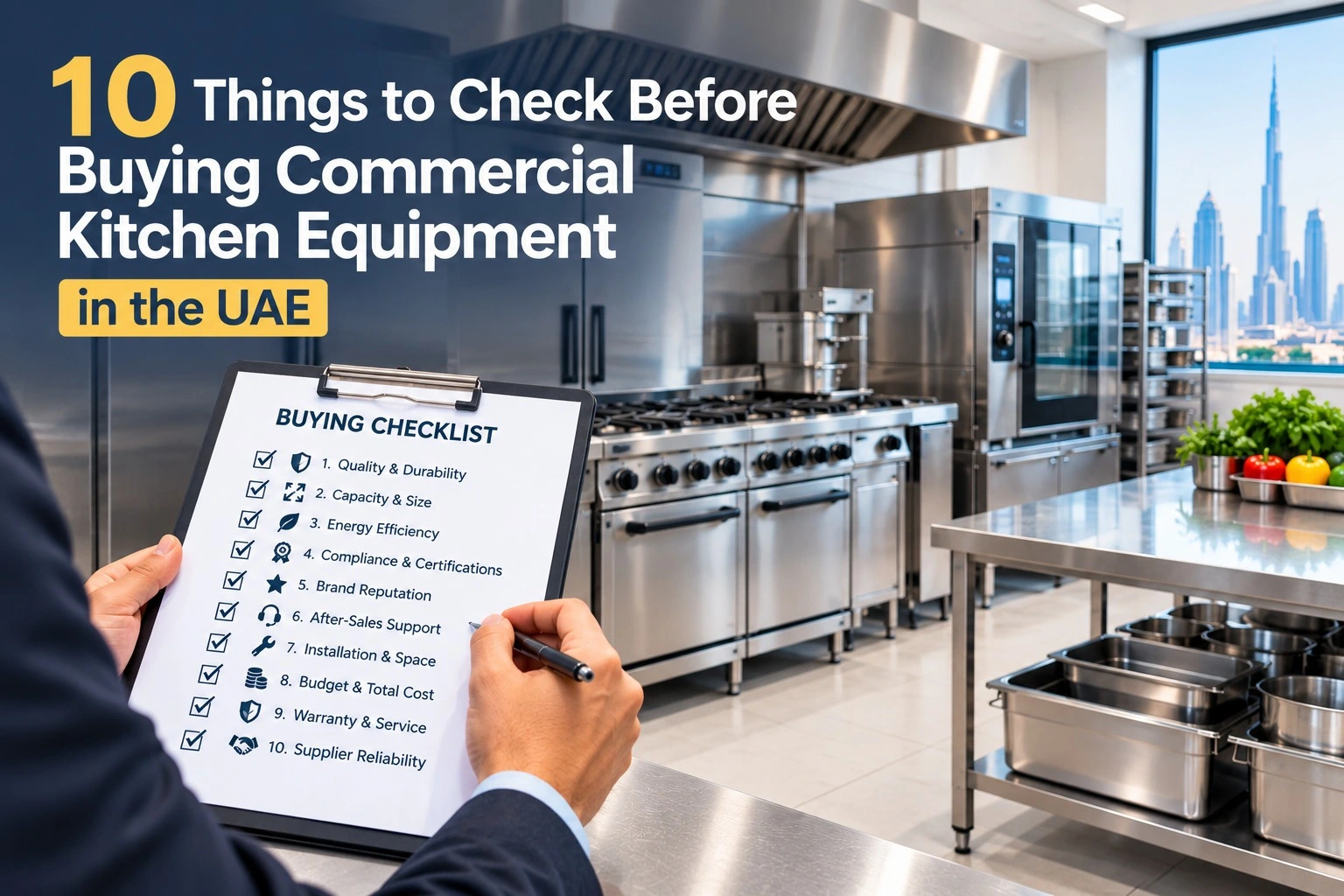
Before you sign off on any purchase order, run through these 10 checks. They cover the technical, regulatory, and practical factors that UAE kitchens specifically need to get right — not just generic buying advice copied from other markets.
Why a Pre-Purchase Checklist Matters
Commercial kitchen equipment represents a significant portion of your total setup budget, and mistakes are expensive to reverse.
A disciplined pre-purchase check helps you:
- Avoid buying equipment that fails Dubai Municipality or Civil Defence inspection
- Prevent costly compatibility issues with your kitchen's electrical and gas infrastructure
- Reduce the risk of underpowered equipment bottlenecking service during peak hours
- Catch hidden long-term costs like poor energy efficiency or weak local warranty support
- Protect your capital by choosing equipment that matches your actual menu, not a generic template
1. Match Equipment to Your Actual Menu
The most common mistake operators make is buying from a generic equipment list rather than working backward from their specific menu.
Before purchasing anything, break down your menu by cooking method and prep task — grilling, frying, baking, cold prep, sauce work — and identify exactly what equipment each dish requires. A pizzeria and a fine-dining restaurant share almost none of the same heavy equipment, even if both are technically "restaurants." Specifying your menu, rather than a template, prevents both under-equipping your kitchen and wasting capital on machines that will sit idle.
2. Verify Certification and Compliance Marks
Certification isn't optional paperwork — it's often the difference between equipment clearing UAE customs and inspections, or getting held up entirely.
Check for:
- ESMA or SASO compliance marks, since GCC customs authorities have become significantly stricter about certification enforcement in recent years, and shipments lacking valid documentation can be held at the border
- NSF, UL, or equivalent certification for food-contact equipment, which Dubai Municipality and other UAE food authorities require
- CE certification on imported appliances, confirming they meet recognized safety standards
Request the exact certificate details from your supplier — certificate number, issuing body, and expiration date — rather than accepting a general claim that equipment is "certified."
3. Check Electrical and Utility Compatibility
Equipment specified for a different market's power supply can cause real headaches after delivery.
Confirm:
- The equipment is rated for the UAE's standard 220–240V, 50Hz electrical supply, since units built for 110–120V markets need a step-down transformer or local rewiring
- Your kitchen's electrical load capacity can support the equipment, coordinating with DEWA in Dubai or ADDC in Abu Dhabi as needed for high-draw appliances
- Gas-powered equipment matches your available gas connection type and pressure, with installation carried out by a certified technician
4. Confirm Material Grade and Build Quality
Not all "stainless steel" equipment is built to the same standard, and the difference matters more in the UAE's climate and water conditions than in many other markets.
Look for:
- Grade 304 stainless steel for general kitchen use, and Grade 316 for coastal or high-humidity locations, where the additional corrosion resistance pays off over time
- Smooth, cleanable surfaces without hard-to-reach seams that trap grease or residue
- Reinforced joints, sturdy hinges, and stable bases built for continuous daily commercial use rather than light domestic-style construction
5. Assess Capacity Against Your Real Production Volume
Equipment that looks adequate on a showroom floor can bottleneck badly once real peak-hour volume hits.
Before buying, confirm:
- The equipment's rated capacity and duty cycle match your actual daily and peak-hour throughput, not just your average order volume
- Motor-driven equipment (mixers, processors, slicers) is rated for continuous use if your kitchen runs prep continuously rather than in short bursts
- You've sized refrigeration and cold storage generously, since undersized cold storage is one of the most common — and most disruptive — capacity mistakes in UAE kitchen buildouts
6. Review Energy Efficiency Ratings
Refrigeration and cooking equipment run for years, so lifetime energy cost often ends up exceeding the original purchase price.
Prioritize:
- Equipment with recognized energy efficiency certifications or ratings, since certified units can meaningfully reduce utility and water costs over the equipment's lifespan
- Inverter-compressor technology on refrigeration units, which adjusts cooling output rather than cycling fully on and off
- Manufacturer-stated energy consumption figures, compared across shortlisted models before purchase, rather than assumed from price point alone
7. Inspect Ventilation and Fire Safety Requirements
Ventilation and fire safety aren't separate from your equipment decision — they directly depend on what you buy and how it's used.
Check that:
- Kitchen hoods and exhaust systems carry adequate CFM ratings for your specific cooking equipment, particularly grills and fryers producing heavy grease
- Grease filters and ducting align with your municipality-approved layout and plan
- Certified fire suppression systems are installed and inspected annually, as required by Dubai Civil Defence and equivalent authorities in other emirates
- Heavy grease-producing equipment is paired with the correct ESP and carbon filtration where mandated
8. Evaluate Warranty Terms and Local After-Sales Support
A warranty is only as useful as the local support behind it — imported equipment without a UAE distributor can mean weeks of downtime waiting for parts or service.
Before buying, confirm:
- The specific warranty period and what it actually covers (full unit vs. motor/compressor only vs. wear parts)
- Whether spare parts are stocked locally or need to be imported
- Response times for technical support and repairs, ideally with a named local service contact
- Installation, calibration, and testing support, since some suppliers bundle this and others charge it separately
9. Decide Between New and Used/Refurbished Equipment
New isn't always necessary, and used isn't always risky — the right choice depends on the specific equipment category.
A practical approach many UAE operators use:
- Buy new for high-failure-risk, high-use items like refrigeration compressors, where downtime is most costly
- Consider reputable used or refurbished equipment for lower-risk items like prep tables, basic ranges, or shelving, where the cost savings are meaningful and failure risk is lower
- Always request maintenance history and remaining warranty (if any) on used equipment before purchase, and buy only through established dealers rather than unverified private sellers.
Before deciding how much to spend, it can also help to understand the broader kitchen equipment budget in the UAE, including typical equipment costs, hidden expenses, and the difference between new and used equipment.
10. Confirm Supplier Reputation, Lead Times, and Installation Support
The supplier relationship matters as much as the equipment itself, particularly for larger orders feeding a fixed opening date.
Before committing, check:
- The supplier's track record with your specific concept type and kitchen scale
- Realistic delivery and installation lead times, factoring in customs clearance for imported equipment
- Whether the quote includes delivery, installation, calibration, and testing, or whether these are separate cost lines
- References or reviews from other UAE F&B operators who've used the same supplier
Quick Reference Checklist
Before finalizing any commercial kitchen equipment purchase in the UAE, confirm you can answer "yes" to each of the following:
- Does this equipment match a specific, identified need on my menu?
- Does it carry valid ESMA/SASO and NSF/UL/CE certification (as applicable)?
- Is it rated for 220–240V, 50Hz, or the correct gas connection for my kitchen?
- Is it built from appropriate-grade stainless steel for my location and use?
- Is its capacity and duty cycle matched to my real peak-hour volume?
- Have I compared energy efficiency ratings across shortlisted models?
- Does my ventilation and fire suppression setup account for this equipment?
- Do I understand exactly what the warranty covers and who provides local support?
- Have I made a deliberate new-vs-used decision for this specific item?
- Have I verified the supplier's reputation, lead times, and installation support?
Final Thoughts
Buying commercial kitchen equipment in the UAE involves far more than comparing prices across a few suppliers. Certification compliance, electrical compatibility, material grade, real-world capacity, energy efficiency, and dependable local after-sales support all directly affect whether your equipment performs reliably — and passes inspection — once your kitchen opens. Running through these 10 checks before any purchase order is signed helps protect both your budget and your opening timeline.
Whether you're equipping a small café, a full-service restaurant, or a cloud kitchen anywhere in the UAE, taking the time to verify these details upfront is far cheaper than discovering a compliance gap, a capacity shortfall, or a warranty dead-end after the equipment is already installed.