
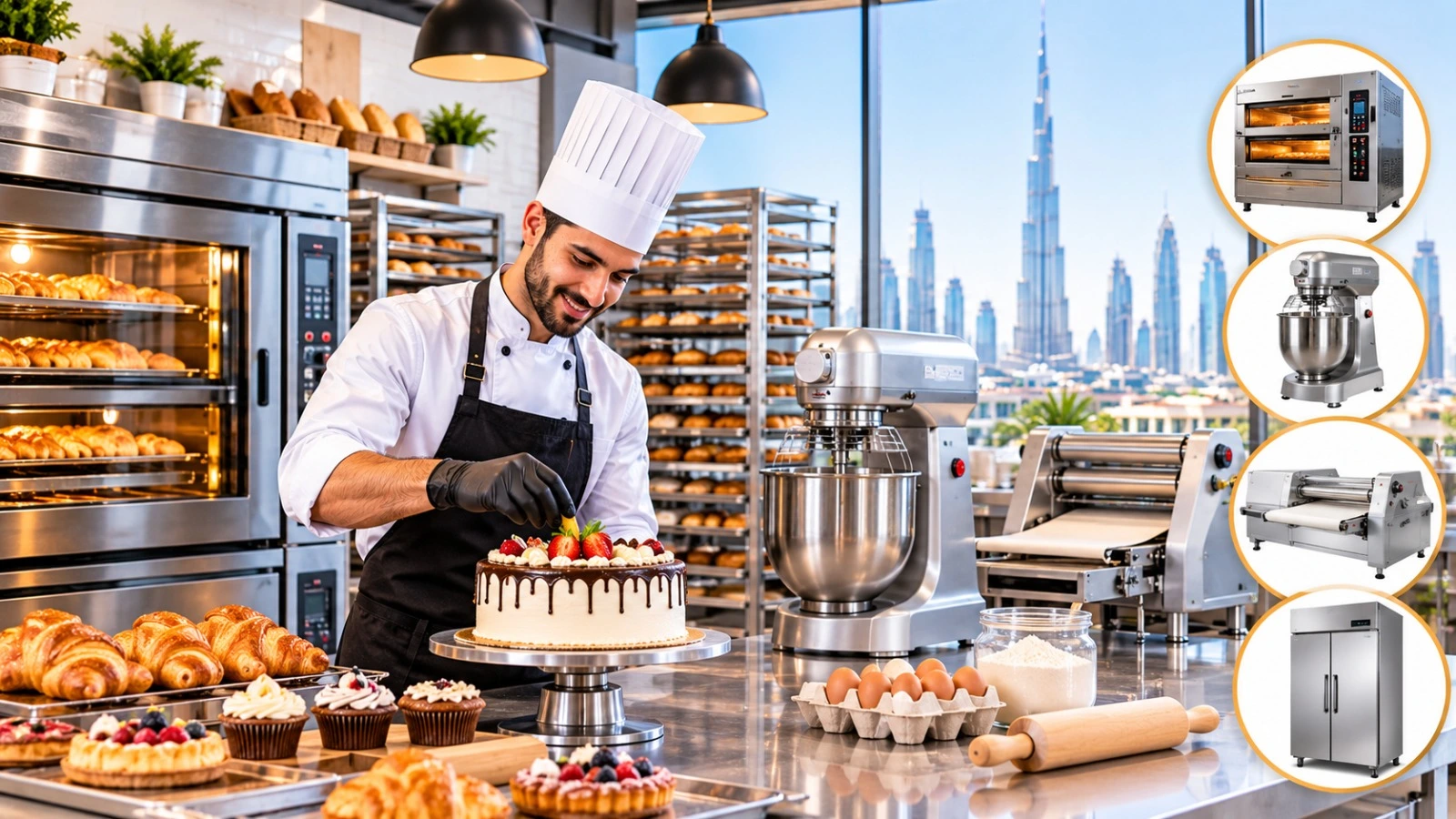
Quick answer: The core commercial bakery equipment every UAE bakery needs is a mixer (spiral for bread dough, planetary for cakes and pastry), an oven (deck, convection, or rotary rack, depending on product and volume), a proofer or retarder-proofer, a work table and dough-handling tools, cold storage, and cooling and display equipment. Startups and small cafés can open with roughly AED 60,000–180,000 of equipment, mid-size bakeries typically need AED 200,000–600,000, and large production bakeries run into the millions. The UAE-specific priorities are temperature and humidity control (heat and humidity make dough behave very differently from temperate markets), T-class rated refrigeration, hard-water management, correct electrical and gas supply, and compliant extraction and fire safety. Choose ovens and mixers by daily flour volume and product mix, not by price alone.
Prices and capacities in this guide are indicative planning ranges, not quotes. Verify current UAE pricing, availability, and local service support with suppliers.
Table of Contents
- The Short Answer: Best Equipment by Bakery Size
- Why Bakery Equipment Choice Is Different in the UAE
- The Core Bakery Equipment Categories
- Mixers: Spiral, Planetary, and Specialty
- Ovens: Deck, Rotary Rack, Convection, and Combi
- Proofers, Retarders, and Dough Fermentation Control
- Dough Sheeters, Dividers, Rounders, and Moulders
- Refrigeration, Blast Chillers, and Freezers for Bakeries
- Work Tables, Racks, Trays, and Smallwares
- Display, Cooling, and Packaging Equipment
- Specialty Equipment: Pastry, Cakes, Arabic Bakery, and Chocolate
- Best Equipment Setup for a Startup or Home-to-Commercial Bakery
- Best Equipment Setup for a Café With In-House Baking
- Best Equipment Setup for a Large Bakery or Production Facility
- How to Size Equipment: Capacity Calculation
- Gas or Electric Ovens: Which Is Better in the UAE?
- UAE Climate Factors: Heat, Humidity, Flour, and Water
- Utilities, Layout, Ventilation, and Fire Safety
- UAE Regulatory and Food Safety Considerations
- Brands and Equipment Types: How to Compare Options
- Price Guide — UAE 2026
- Total Cost of Ownership: The 5-Year Picture
- New vs. Used vs. Refurbished Bakery Equipment
- Maintenance Essentials for UAE Bakeries
- Common Bakery Equipment Mistakes in the UAE
- Bakery Equipment Buying Checklist
- Conclusion: Build Around Your Product and Your Volume
- Frequently Asked Questions (FAQ)
The Short Answer: Best Equipment by Bakery Size
Recommended Core Equipment by Bakery Type
| Bakery Type | Core Equipment | Typical Daily Output | Indicative Equipment Budget (AED) |
| Startup / home-to-commercial bakery | Planetary mixer, convection or small deck oven, proofer cabinet, work tables, under-counter fridge and freezer, racks and trays | Roughly 20–80 kg flour per day | 60,000 – 180,000 |
| Café with in-house baking | Planetary mixer, combi or convection oven, proofer, refrigeration, display, small sheeter if making pastry | Roughly 30–100 kg flour per day | 90,000 – 250,000 |
| Neighbourhood artisan bakery | Spiral mixer, deck oven, retarder-proofer, sheeter, divider/moulder as needed, cold storage, display | Roughly 100–300 kg flour per day | 200,000 – 600,000 |
| Arabic bakery / flatbread producer | Dough mixer, divider/rounder, sheeting or pressing line, specialised oven (tunnel, stone-deck, or traditional), cooling and packing | Varies widely, often high volume | 250,000 – 1,200,000+ |
| Large production / wholesale bakery | Industrial mixers, divider/rounder/moulder lines, rotary rack or tunnel ovens, large proofing and retarding rooms, blast freezers, cooling and packaging lines | 500+ kg to many tonnes of flour per day | 1,000,000 – several million |
Outputs and budgets are illustrative planning ranges. Your product mix (bread, pastry, cakes, Arabic breads, cookies) changes the answer significantly.
Why Bakery Equipment Choice Is Different in the UAE
Bakeries are among the most climate-sensitive food businesses. Dough is a living product, and UAE conditions affect it in ways that surprise operators coming from cooler markets.
- Heat accelerates fermentation. In a warm kitchen, dough ferments faster and can over-proof before it reaches the oven. Controlling dough temperature becomes a core design question, not an afterthought.
- Humidity affects dough and storage. High humidity, especially in coastal emirates, affects flour handling, crusts, and storage of finished goods.
- Ovens add heat to already hot spaces. Bakery kitchens run ovens for hours, so cooling, ventilation, and extraction need to be planned together.
- Refrigeration works harder. Retarding dough, chilling pastry, and storing butter and cream all rely on refrigeration that must be rated for UAE ambient conditions.
- Hard water affects boilers and steam. Ovens with steam injection and combi ovens are exposed to scale unless water is treated.
- High expectations and volume swings. UAE customers expect consistent, fresh products, and demand spikes around holidays, Ramadan, and Eid require capacity planning.
The practical result: UAE bakeries benefit from equipment with strong temperature control, reliable refrigeration, and good ventilation, and from layouts that keep heat sources away from dough and cold storage.
The Core Bakery Equipment Categories
The Main Equipment Categories
| Category | What It Does | Essential For |
| Mixing | Develops dough and batters | Every bakery |
| Dough handling (sheeting, dividing, rounding, moulding) | Shapes and portions dough consistently | Bread and pastry production beyond very small scale |
| Proofing and retarding | Controls fermentation | Bread, croissants, and laminated doughs |
| Baking | Bakes products | Every bakery |
| Refrigeration and freezing | Stores ingredients, retards dough, and holds finished goods | Every bakery |
| Cooling, display, and packaging | Cools, presents, and packs finished products | Retail and wholesale bakeries |
| Work tables and racks | Supports preparation and transport | Every bakery |
| Utilities and safety | Power, gas, ventilation, extraction, and fire protection | Every bakery |
Mixers: Spiral, Planetary, and Specialty
Mixer Types and Best Uses
| Mixer Type | Best For | Typical Capacity | Indicative UAE Price (AED) |
| Planetary mixer | Cakes, batters, creams, light doughs, cookies, and general pastry | 10–80+ litres | 6,000 – 45,000 |
| Spiral mixer | Bread dough, pizza dough, and stiff doughs | 20–200+ kg dough | 12,000 – 80,000 |
| Fork or twin-arm mixer | Delicate artisan doughs | Varies | 30,000 – 120,000+ |
| High-speed or specialty mixers | Specific products | Varies | Varies |
| Industrial mixers with bowl handling | Large-scale production | 200 kg to many tonnes of flour per hour in lines | Several hundred thousand and up |
How to choose:
- Bread-focused bakeries should prioritise a spiral mixer, which develops gluten efficiently and handles stiff doughs.
- Cake and pastry shops do well with a planetary mixer with interchangeable tools.
- Cafés and startups often begin with a planetary mixer for flexibility, then add a spiral mixer when bread volume grows.
- Check the motor rating, bowl capacity, and minimum and maximum dough weight. Running a mixer near its maximum load constantly shortens its life.
- Check power requirements. Larger mixers often need three-phase power.
Ovens: Deck, Rotary Rack, Convection, and Combi
The oven is usually the biggest bakery equipment decision. The right type depends on your products, volume, and layout.
Oven Types Compared
| Oven Type | How It Works | Best For | Indicative UAE Price (AED) | Considerations |
| Deck oven | Products bake directly on heated stone or steel decks | Artisan bread, pizza, Arabic breads, hearth-style products | 25,000 – 250,000+ | Excellent crust and bake quality; slower loading; needs space and ventilation |
| Convection oven | Fans circulate hot air around trays | Cookies, pastries, small breads, general baking | 10,000 – 80,000 | Flexible and affordable; good for startups and cafés |
| Rotary rack oven | A trolley rack rotates inside the oven for even baking | High-volume bread, rolls, and pastries | 60,000 – 400,000+ | High output; needs more space, power or gas, and ventilation |
| Combi oven | Steam, convection, and combination modes | Cafés, hotel bakeries, and mixed kitchens; supports baking and cooking | 15,000 – 65,000+ | Versatile; steam helps bread but needs water treatment; check bakery-specific models |
| Tunnel or conveyor oven | Products move through on a belt | Large-scale production, flatbreads, and consistent products | Several hundred thousand and up | Industrial scale; requires planning and utilities |
| Stone or traditional Arabic bread ovens | Specialised for flatbread baking | Arabic bakeries and flatbread producers | Varies widely | Choose according to your product and local fire rules |
Which oven for which business?
| Business | Typical First Oven | Why |
| Startup selling cookies, cakes, and small pastries | Convection oven | Flexible and affordable |
| Café baking croissants, pastries, and light breads | Combi or convection oven with steam | Versatile; fits tight spaces |
| Artisan bread bakery | Deck oven | Best crust and bread quality |
| Neighbourhood bakery with high morning volume | Deck oven plus a convection or rotary oven | Quality plus capacity |
| Wholesale or large production | Rotary rack or tunnel oven | High throughput |
| Arabic flatbread | Dedicated flatbread oven | Product-specific performance |
Proofers, Retarders, and Dough Fermentation Control
Fermentation control is where UAE heat matters most.
Fermentation Equipment
| Equipment | What It Does | Best For | Indicative UAE Price (AED) |
| Proofer cabinet | Warm, humid chamber for final proof | Startups, cafés, and small bakeries | 5,000 – 30,000 |
| Retarder-proofer | Chills dough to slow fermentation, then warms to proof | Artisan bakeries and croissant programmes; allows scheduling and overnight fermentation | 25,000 – 120,000+ |
| Proofing room | Walk-in controlled environment | Larger bakeries | Custom-built; often tens of thousands and up |
| Dough retarder / chiller | Slows fermentation for storage | High-volume bread production | 15,000 – 100,000+ |
| Chilled water unit | Supplies cold water for mixing | Hot climates where dough temperature control matters | 5,000 – 30,000 |
UAE note: In a hot kitchen, using chilled water or ice in the mix, keeping flour cool, and retarding dough in refrigeration can be the difference between consistent quality and over-fermented dough. A retarder-proofer also lets a small team bake fresh in the morning from overnight dough.
Dough Sheeters, Dividers, Rounders, and Moulders
These machines save labour and improve consistency once volume grows.
Dough-Handling Equipment
| Equipment | What It Does | Best For | Indicative UAE Price (AED) |
| Dough sheeter | Rolls dough to even thickness | Croissants, puff pastry, Danish, pizza, and flatbreads | 8,000 – 60,000+ |
| Dough divider | Cuts dough into equal portions | Bread rolls and loaves | 15,000 – 80,000+ |
| Divider-rounder | Divides and rounds dough | Rolls and small breads | 20,000 – 100,000+ |
| Dough moulder | Shapes dough into loaves or baguettes | Bread production at scale | 15,000 – 80,000+ |
| Pizza dough press | Presses dough balls to discs | Pizza and flatbread operations | 3,000 – 15,000 |
| Bread slicer | Slices loaves uniformly | Bakeries selling sliced bread | 8,000 – 40,000 |
Tip: Startups can often manage with manual dough handling and one sheeter. Add dividers and moulders when volume and labour costs justify them.
Refrigeration, Blast Chillers, and Freezers for Bakeries
Bakeries use refrigeration for butter, cream, dairy, fillings, fresh dough, and finished goods.
Bakery Refrigeration Needs
| Equipment | Use | UAE Spec Priority |
| Under-counter and upright chillers | Butter, dairy, fillings, and ingredient storage | T-class (tropical) rating; correct ventilation clearance |
| Freezers | Frozen dough, butter blocks, and bulk ingredients | T-class rating; reliable temperature stability |
| Walk-in cold room or freezer | Larger bakeries and production | Properly specified insulation and compressor sizing for UAE heat |
| Blast chiller / freezer | Rapid cooling of fillings, creams, and products; freezing par-baked or finished goods | Useful for food safety and shelf-life control |
| Refrigerated display | Cakes, pastries, and cream-based items | Rated for UAE ambient; keep away from ovens and sunlight |
| Pastry fridge or marble-top refrigerated table | Chilled work surface for pastry | Valuable for laminated doughs in hot conditions |
Because UAE kitchens run hot, specify refrigeration to at least T-class and keep it away from ovens. Cream-based and dairy products must be stored within the required temperature limits and logged as your food safety authority requires.
Work Tables, Racks, Trays, and Smallwares
Essential Support Equipment
| Item | Notes |
| Stainless steel work tables | Food-grade, with undershelves; consider marble or granite tops for pastry |
| Bakery racks and trolleys | Choose racks sized to your oven and trays |
| Baking trays and tins | Match sizes to your ovens; keep spares |
| Proofing baskets, moulds, and cutters | Product-specific |
| Scales and measuring equipment | Accurate scales are essential for recipe consistency |
| Dough tubs and bins | Food-grade containers for dough storage |
| Ingredient bins and flour storage | Sealed, pest-proof containers; keep off the floor |
| Hand tools and utensils | Bench scrapers, lames, rolling pins, piping bags, and similar tools |
| Cooling racks | Allow air circulation for cooling finished goods |
| Sinks | A dedicated handwash sink plus wash sinks as required |
| Dishwashing and pot washing | Plan for large trays and mixing bowls |
Display, Cooling, and Packaging Equipment
For retail bakeries and cafés, presentation and shelf life matter.
Display and Packaging Equipment
| Equipment | Use | Indicative UAE Price (AED) |
| Ambient bread and pastry display | Bread, pastries, and dry goods | 3,000 – 20,000 |
| Refrigerated cake display | Cakes and cream-based items | 8,000 – 40,000 |
| Heated display | Hot savoury items | 4,000 – 18,000 |
| Cooling racks or cooling room | Cool products before packing | 1,500 – 15,000 |
| Packaging and labelling equipment | Bags, boxes, and labels with required information | Varies |
| Bread bagging or flow-wrap machines | Wholesale or high-volume packing | Varies widely |
Make sure labelling meets UAE requirements for the products you sell, and confirm current labelling rules with the relevant authority.
Specialty Equipment: Pastry, Cakes, Arabic Bakery, and Chocolate
Different product lines add specific equipment needs.
Specialty Equipment by Product Line
| Product Line | Equipment to Consider |
| Croissants and laminated pastry | Sheeter, retarder-proofer, refrigerated pastry table, and proofing capacity |
| Cakes and desserts | Planetary mixer, cake display chillers, decorating stations, turntables, and blast chiller |
| Arabic breads and sweets | Flatbread oven, dough divider-rounder, sheeting or pressing equipment, and equipment for syrups and fillings |
| Cookies and biscuits | Convection oven, depositor or scoop tools, and cooling racks |
| Pizza and flatbreads | Deck oven, dough press, and spiral mixer |
| Donuts and fried items | Fryer, proofer, and glazing equipment; plan for extraction and fire safety |
| Chocolate and confectionery | Tempering machine, cooling space, and climate control |
| Gluten-free or allergen-controlled production | Dedicated equipment and separate storage to prevent cross-contact |
Best Equipment Setup for a Startup or Home-to-Commercial Bakery
Startup Setup (Indicative)
| Equipment | Suggested Spec | Notes |
| Planetary mixer | 20–40 litre | Flexible for cakes, cookies, and light doughs |
| Oven | Convection oven (multi-tray) | Affordable and versatile; check electrical requirements |
| Proofer cabinet | Small cabinet or retarder-proofer if budget allows | Helps control dough in hot conditions |
| Refrigeration | Under-counter chiller and freezer, T-class | Keep away from the oven |
| Work tables | Stainless steel with undershelves | Add a marble top if making pastry |
| Racks, trays, and smallwares | As required | Buy extra trays |
| Handwash sink and wash sinks | Compliant layout | Plan with your authority's requirements |
| Display (optional) | Small refrigerated or ambient display | Depends on retail format |
Indicative budget: AED 60,000–180,000 for equipment, depending on oven choice and used-versus-new decisions. Excludes fit-out, extraction, licensing, and working capital.
Startup tips:
- Start with equipment that matches your first-year menu, not your dream menu.
- Choose flexible equipment (planetary mixer, convection oven) so you can pivot.
- Check electrical supply early; ovens and mixers can need more power than a typical small unit provides.
- Consider shared or commissary kitchens to test products before committing capital.
Best Equipment Setup for a Café With In-House Baking
Café Setup (Indicative)
| Equipment | Suggested Spec | Notes |
| Planetary mixer | 20–40 litre | Covers most café bakery needs |
| Combi or convection oven | 6–10 tray | Combi ovens add steam and cooking flexibility |
| Proofer or retarder-proofer | Compact | Lets staff prep dough the night before |
| Dough sheeter (optional) | Tabletop | Worth it if making croissants or pastry in-house |
| Refrigeration | Under-counter and upright, T-class | Plan space and ventilation |
| Refrigerated display | For cakes and pastries | Keep away from sunlight and heat |
| Blast chiller (optional) | Small | Helpful for cooked fillings and food safety |
| Dishwasher | Undercounter or compact hood-type | Needs to handle trays and bowls |
Indicative budget: AED 90,000–250,000, excluding espresso equipment and front-of-house fit-out.
Best Equipment Setup for a Large Bakery or Production Facility
Large Bakery Setup (Indicative)
| Area | Equipment | Notes |
| Mixing | Spiral mixers with bowl handling, plus planetary mixers for pastry | Plan capacity for peak days |
| Dough handling | Dividers, rounders, moulders, sheeters, and lamination lines | Automation reduces labour |
| Fermentation | Proofing rooms, retarders, and chilled water systems | Critical for UAE heat |
| Baking | Rotary rack, deck, or tunnel ovens | Match to product mix and volume |
| Cooling | Cooling room or conveyors | Controls product quality before packing |
| Packaging | Slicers, baggers, labellers, and packing lines | Plan for traceability |
| Cold chain | Walk-in chillers and freezers, blast freezers | T-class or high-ambient rated with redundancy |
| Utilities | Three-phase power, gas supply, extraction, steam, and compressed air where needed | Plan with engineering consultants |
| Safety and hygiene | Fire suppression, extraction, pest control, and cleaning-in-place routines | Align with authority requirements |
Large facilities should be designed with process engineers, and equipment should be specified as a complete production line, not item by item.
How to Size Equipment: Capacity Calculation
Sizing starts with your daily volume and peak demand.
Capacity Planning Steps
| Step | What to Calculate | Example |
| 1. Estimate daily product volume | Units of each product per day, including peak days | 300 loaves, 400 pastries, 200 cakes slices |
| 2. Convert to dough or batter weight | Units × weight per unit | For example 300 loaves × 0.5 kg = 150 kg dough |
| 3. Choose mixer size | Dough weight per batch and number of batches | A 60–80 kg spiral mixer, two to three batches |
| 4. Estimate oven loads | Units per tray × trays per bake cycle | Number of trays and bake time determine bake cycles per hour |
| 5. Plan fermentation capacity | Racks or cabinet space for proofing and retarding | Enough rack space for peak overnight production |
| 6. Add headroom | Allow growth and peak seasons, around 20–30% | Ramadan, Eid, holidays |
| 7. Check utilities | Power, gas, extraction, and floor space | Confirm before ordering |
Oven throughput depends on bake time and loading efficiency, so ask suppliers for realistic capacity figures for your actual products, not just maximum tray counts.
Gas or Electric Ovens: Which Is Better in the UAE?
Gas vs. Electric Ovens
| Factor | Gas Ovens | Electric Ovens |
| Running cost | Often lower in many setups, depending on gas supply and prices | Depends on electricity tariffs |
| Availability of gas supply | Requires a piped or cylinder supply and compliant installation | No gas needed; power capacity must be sufficient |
| Heat control | Good, depending on model | Often precise and easy to control |
| Installation | Needs gas piping, flues, and safety systems | Needs adequate electrical capacity, often three-phase for larger units |
| Fire and safety requirements | Gas safety, leak detection, and extraction | Electrical safety and extraction |
| Heat in the kitchen | Both add heat; plan ventilation | Both add heat; plan ventilation |
| Best for | Locations with reliable gas supply and the right approvals | Locations without gas, malls, or buildings restricting gas |
In many UAE malls and buildings, gas use is restricted or heavily regulated, so confirm what your landlord and authorities allow before choosing a gas oven. Always use licensed contractors for gas and electrical work.
UAE Climate Factors: Heat, Humidity, Flour, and Water
UAE-Specific Considerations for Bakeries
| Factor | Effect | What To Do |
| Heat | Faster fermentation and warmer dough | Use chilled water, cool flour, retarders, and air conditioning around dough areas |
| Humidity | Affects crusts, storage, and flour handling | Use sealed storage, dehumidification where needed, and proper cooling of products |
| Hard water | Scale in steam ovens, combi ovens, and boilers | Install water treatment and descale regularly |
| Ambient heat near refrigeration | Compressor stress | Use T-class refrigeration, ventilation clearance, and position away from ovens |
| Pests | Flour and sugar attract pests | Use sealed bins, pest control, and cleanliness routines |
| Power demand | Ovens and mixers draw heavy loads | Confirm capacity and consider energy-efficient models |
| Seasonal peaks | Ramadan, Eid, and holiday volumes | Plan capacity buffers and ingredient supply |
Utilities, Layout, Ventilation, and Fire Safety
A bakery layout should follow product flow: ingredient storage, mixing, dough handling, proofing, baking, cooling, and packing, with minimal backtracking and with heat sources separated from cold storage.
Planning Checklist for Utilities and Layout
| Item | Considerations |
| Power | Confirm single- or three-phase capacity for ovens, mixers, sheeters, and refrigeration |
| Gas | If using gas, confirm availability, approvals, piping, and safety systems |
| Water and drainage | Water treatment, floor drains, grease management where relevant |
| Ventilation and extraction | Plan hood coverage and make-up air for ovens; follow authority requirements |
| Fire safety | Suppression and extinguishers where required; flour dust and fryers add risks; confirm with Civil Defence |
| Floor and structure | Heavy ovens, mixers, and racks need suitable floor loading |
| Space | Allow room for rack movement, cleaning access, and servicing |
| Hygiene flow | Separate raw ingredients from finished products and keep clean and dirty flows apart |
| Cooling and air conditioning | Maintain cool zones for dough and pastry work |
Flour dust is combustible in large quantities, so large facilities should discuss dust control with their safety consultant.
UAE Regulatory and Food Safety Considerations
Bakery Compliance Considerations
| Area | What Is Generally Expected |
| Food safety licensing | Bakeries need relevant licences and approvals from the municipality or food safety authority |
| Hygiene and food-grade materials | Food-contact surfaces and equipment should be food-grade and easy to clean |
| Temperature control | Chilled and frozen storage monitored and logged as required |
| Handwashing and facilities | A dedicated handwash sink and compliant staff facilities |
| Allergen management | Controls to prevent cross-contact and correct labelling |
| Labelling | Compliant labels for packaged products, including ingredients, dates, and other required information |
| Fire and extraction | Compliant extraction and fire safety measures from Civil Defence |
| Pest control | Documented pest control programme |
| Electrical and gas safety | Licensed installation and certification |
| Halal requirements | Ingredients and processes must meet halal expectations where relevant to your market and customers |
Requirements vary by emirate, licence type, and product. Confirm current rules with Dubai Municipality, ADAFSA, or your relevant authority and with Civil Defence before finalising equipment.
Brands and Equipment Types: How to Compare Options
The bakery equipment market includes European, Asian, and regional manufacturers across mixers, ovens, proofers, and dough-handling machines. Rather than ranking brands, use these criteria to compare options:
How to Compare Bakery Equipment Suppliers
| Criterion | What to Check |
| Local service and spare parts | Is there a UAE service technician and local parts stock? How fast is breakdown response? |
| Build quality | Stainless steel construction, motor ratings, and durability under daily use |
| Suitability for UAE conditions | Cooling, ventilation, and refrigeration rated for heat; steam systems with water-treatment compatibility |
| Energy efficiency | Insulation quality, heat recovery, and power use per output |
| Capacity claims | Realistic throughput for your products, with references from similar bakeries |
| Warranty | Coverage on parts, labour, heating elements, and motors |
| Training and commissioning | Installation, training, and recipe or programme setup |
| Track record | References from UAE bakeries of similar size |
| Total cost | Purchase, installation, utilities, maintenance, and spare parts |
Well-known international bakery equipment manufacturers include makers of spiral mixer and planetary mixers, deck and rotary ovens, sheeters, and proofers. Availability and local support vary, so ask suppliers for UAE references and confirm service coverage before choosing.
Price Guide — UAE 2026
Indicative UAE Bakery Equipment Price Ranges
| Equipment | Entry (AED) | Mid-Range (AED) | Professional / Industrial (AED) |
| Planetary mixer | 6,000 – 12,000 | 12,000 – 25,000 | 25,000 – 60,000+ |
| Spiral mixer | 12,000 – 25,000 | 25,000 – 50,000 | 50,000 – 150,000+ |
| Convection oven | 10,000 – 20,000 | 20,000 – 45,000 | 45,000 – 90,000 |
| Deck oven | 25,000 – 60,000 | 60,000 – 130,000 | 130,000 – 300,000+ |
| Rotary rack oven | 60,000 – 120,000 | 120,000 – 250,000 | 250,000 – 500,000+ |
| Proofer cabinet | 5,000 – 12,000 | 12,000 – 22,000 | 22,000 – 40,000 |
| Retarder-proofer | 25,000 – 50,000 | 50,000 – 90,000 | 90,000 – 150,000+ |
| Dough sheeter | 8,000 – 18,000 | 18,000 – 35,000 | 35,000 – 80,000 |
| Dough divider / rounder | 15,000 – 35,000 | 35,000 – 70,000 | 70,000 – 150,000+ |
| Blast chiller / freezer | 12,000 – 22,000 | 22,000 – 45,000 | 45,000 – 100,000+ |
| Refrigerated display | 8,000 – 15,000 | 15,000 – 28,000 | 28,000 – 50,000 |
| Stainless steel work tables | 1,500 – 3,000 | 3,000 – 6,000 | 6,000 – 15,000 |
All figures are indicative AED, VAT-exclusive; add 5% UAE VAT. Installation, utilities, extraction, and delivery are usually extra. Obtain at least two or three itemised quotes.
Total Cost of Ownership: The 5-Year Picture
Illustrative 5-Year Cost Considerations for a Mid-Size Bakery Oven
| Cost Element | Lower-Spec Oven | Higher-Spec Oven |
| Purchase price | Lower | Higher |
| Energy consumption | Typically higher per output if poorly insulated | Typically lower with better insulation and controls |
| Maintenance and parts | More frequent repairs possible | Often fewer breakdowns and better parts support |
| Downtime and lost sales | Higher risk | Lower risk |
| Product quality and wastage | May bake less evenly, causing waste | Better consistency reduces waste |
| Resale value | Lower | Often higher |
Energy, labour, and wastage often outweigh purchase price over five years. When comparing options, ask suppliers for energy consumption data and expected service intervals, and build a simple comparison using your own power or gas costs.
New vs. Used vs. Refurbished Bakery Equipment
Sourcing Options
| Option | Typical Savings | Best For | Risks |
| New | None | Ovens, refrigeration, and anything critical to production | Higher upfront cost |
| Refurbished | Often meaningful savings vs. new | Mixers, sheeters, and dough handling from reputable refurbishers | Check warranty and service history |
| Used (as-is) | Often largest savings | Work tables, racks, and simple equipment | Hidden wear, missing safety features, and no warranty |
Guidance:
- Buy new ovens (especially steam and combi ovens), refrigeration, and any equipment where failure stops production.
- Consider refurbished or used for stainless steel tables, racks, and some mixers, after inspection.
- Inspect used mixers for gearbox wear, bowl and hook condition, and safety guards.
- Check that any used equipment meets UAE electrical and safety requirements.
Maintenance Essentials for UAE Bakeries
Bakery Equipment Maintenance Schedule (Indicative)
| Frequency | Task |
| Daily | Clean mixers, bowls, and tools; clean oven surfaces and trays; wipe work tables; check refrigeration temperatures; clear flour dust |
| Weekly | Clean proofers and retarders; check door seals; inspect belts and guards; clean sheeter rollers and scrapers |
| Monthly | Brush-clean refrigeration condensers; check oven door seals and gaskets; descale steam systems per water hardness; lubricate as the manufacturer advises |
| Quarterly | Check oven burners, elements, and thermostats; inspect electrical connections; review pest control |
| Annually | Professional service for ovens, mixers, refrigeration, and extraction; calibrate thermostats; safety checks on gas and electrical systems |
Keep service records, and follow the manufacturer's maintenance guidance for each machine.
Common Bakery Equipment Mistakes in the UAE
| Mistake | Why It Hurts | How to Avoid It |
| Buying equipment before confirming utilities | Ovens and mixers may need three-phase power or gas that isn't available | Check power, gas, and extraction first |
| Choosing the wrong oven for the product | Poor quality and wasted investment | Match oven type to your products and volume |
| Ignoring dough temperature control in UAE heat | Over-fermented, inconsistent dough | Use chilled water, retarders, and cool work zones |
| Putting refrigeration next to ovens | Compressor stress and higher energy use | Separate heat and cold zones and leave ventilation clearance |
| Skipping water treatment for steam ovens | Scale damages boilers and steam systems | Install water treatment and descale regularly |
| Undersizing capacity for peak seasons | Lost sales at Ramadan, Eid, and holidays | Plan 20–30% headroom |
| Overbuying large equipment at startup | Ties up capital | Start with flexible equipment and scale up |
| Forgetting extraction and fire safety | Delayed approvals and risk | Involve consultants early and confirm with Civil Defence |
| No local service support | Long downtime when something breaks | Confirm UAE service and spare parts availability |
| Cross-contact in allergen-sensitive production | Safety risk | Plan dedicated equipment or strict cleaning |
Bakery Equipment Buying Checklist
- [ ] Define your product list, volumes, and growth plan
- [ ] Calculate daily dough or batter weight and peak demand
- [ ] Confirm power (single or three-phase), gas availability, water, drainage, and extraction
- [ ] Choose mixer types for your products (spiral for bread, planetary for cakes and pastry)
- [ ] Choose the oven type that matches your product and volume
- [ ] Plan proofing and retarding capacity for UAE heat
- [ ] Specify T-class rated refrigeration and plan ventilation clearance
- [ ] Plan water treatment for steam and combi ovens
- [ ] Plan layout flow and keep heat sources away from cold storage and dough areas
- [ ] Confirm fire safety and extraction requirements with Civil Defence
- [ ] Confirm food safety licensing and labelling requirements with your authority
- [ ] Compare itemised quotes from at least two or three suppliers
- [ ] Verify UAE service, spare parts, and warranty terms
- [ ] Decide what to buy new and what can be refurbished or used
- [ ] Plan training, commissioning, and a maintenance schedule
Conclusion: Build Around Your Product and Your Volume
The best commercial bakery equipment in the UAE is the equipment that matches your products, your daily volume, and your site's utilities, and that stands up to UAE heat, humidity, and hard water. Startups and cafés do well with flexible equipment: a planetary mixer, a convection or combi oven, a proofer or retarder-proofer, and properly rated refrigeration. Artisan and neighbourhood bakeries move toward spiral mixers, deck ovens, sheeters, and retarder-proofers. Large production bakeries should design a full production line with engineers.
Across every size, the same disciplines apply: confirm utilities and extraction before you buy, control dough temperature in the heat, rate refrigeration for UAE conditions, treat your water, size for peak seasons, and verify local service support. Get those right, and your equipment will support consistent quality and growth instead of limiting them.