
Quick Answer
In UAE commercial kitchens, a "chiller" is simply a commercial refrigerator. The word is trade shorthand for a unit that stores food at positive, above-freezing temperatures (typically about 0–5°C for food storage), as opposed to a freezer, which holds food at −18°C or below. A "refrigerator" or "fridge" usually means a household appliance, and household fridges are not designed or tested for commercial food service and are generally not rated for hot kitchen conditions.
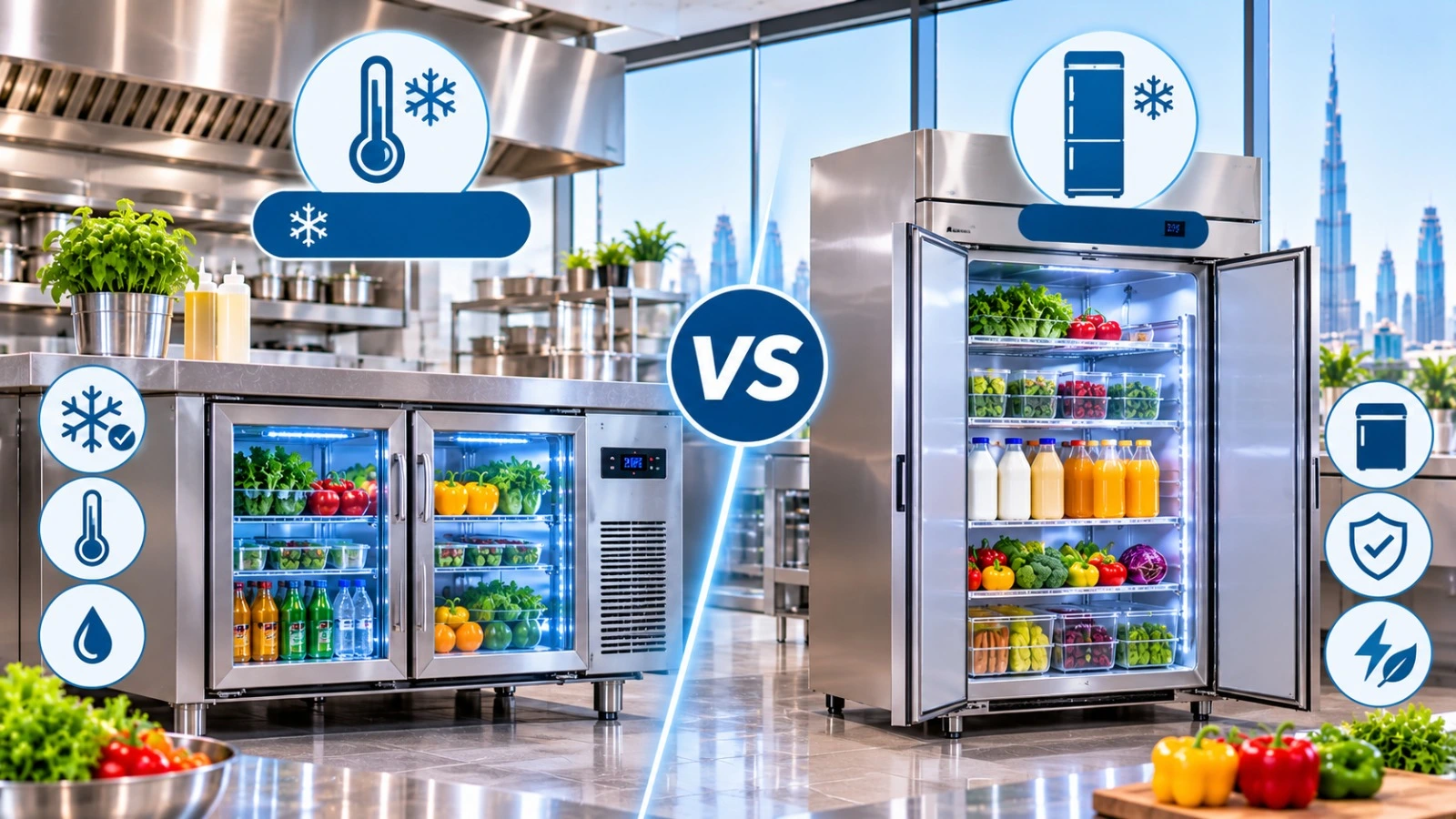
So for a restaurant, café, hotel, or catering kitchen, the best choice is a commercial chiller, not a household refrigerator. Choose the type by how you work:
- Upright (reach-in) chiller: general daily storage
- Undercounter or prep chiller: ingredients at the cooking or prep station
- Display chiller or bottle cooler: customer-facing drinks and desserts
- Walk-in chiller room: high-volume bulk storage
- Blast chiller: rapid cooling of cooked food for safe storage
Typical UAE price ranges: undercounter chillers about AED 2,000–12,000, upright chillers about AED 3,000–15,000, display chillers about AED 4,000–22,000, walk-in chiller rooms about AED 15,000–50,000+, and blast chillers about AED 9,000–50,000+. Whatever you buy, check the maximum rated ambient temperature, the refrigerant, and local service support.
Key Facts at a Glance
- Chiller = commercial refrigerator (positive-temperature storage). Freezer = frozen storage at −18°C to −22°C.
- The Dubai Food Code figures commonly cited are 5°C or below for chilled food and −18°C or below for frozen food. Set your chiller to hold food at or below 5°C, even if the thermostat can go higher.
- "Chiller" has other meanings: a blast chiller (rapid cooling), a walk-in chiller room, or an HVAC water chiller. Make sure you and your supplier mean the same thing.
- Household fridges are built for light home use, with a few door openings a day, not continuous commercial service.
- Commercial units are built for higher ambient temperatures. Some UAE suppliers state ratings up to about 43°C.
- Using a household fridge in a food business may create compliance and warranty risks. Confirm with your municipality and the manufacturer.
Table of Contents
- Introduction
- What Does "Chiller" Mean in the UAE?
- Chiller vs. Refrigerator: What's the Real Difference?
- Chiller vs. Refrigerator vs. Freezer: Comparison Table
- Types of Commercial Chillers
- Which Cooling Solution Is Best for Your Kitchen?
- Decision Rules: If You Need X, Choose Y
- Why Household Fridges Struggle in Commercial UAE Kitchens
- What About Home Kitchens?
- Temperature, Capacity, and Layout Considerations
- Energy Efficiency and Refrigerants
- Compliance and Food Safety in the UAE
- Chiller Price Ranges in the UAE
- Popular Brands in the UAE
- New vs. Used
- Warranty and Local Service
- Common Mistakes to Avoid
- Pre-Purchase Checklist
- Final Thoughts
- Frequently Asked Questions
If you've browsed commercial kitchen suppliers in the UAE, you've probably noticed that almost everything is called a "chiller," while the word "refrigerator" appears less often. That causes real confusion for new operators: is a chiller something different from a fridge, and can a normal fridge do the job in a commercial kitchen? This guide clears up the terminology, explains the practical differences, and helps you choose the right cooling solution for your UAE kitchen.
What Does "Chiller" Mean in the UAE?
In UAE commercial kitchen trade usage, a chiller is a commercial refrigeration unit that keeps food and drinks cold without freezing them.
Suppliers describe chillers as holding fresh food, dairy, produce, and drinks at positive temperatures. Quoted ranges vary by supplier, from about 0–4°C to 0–8°C or wider (some list a thermostat range of about −2°C to +10°C). That wider figure describes what the unit can be set to, not the temperature you should store food at. For food safety, use a setting that keeps food at or below 5°C.
The word can also mean other things, so clarify when you talk to a supplier:
| Term | What It Usually Means |
| Chiller (commercial) | Upright, undercounter, prep, or display refrigerator for chilled storage |
| Chiller room | Walk-in refrigerated room, usually about +2°C to +10°C |
| Blast chiller | Machine that rapidly cools cooked food for safe storage |
| Water chiller | HVAC or process equipment that cools water, not a food storage unit |
| Freezer | Unit holding food at −18°C or below |
| Refrigerator / fridge | Often a household appliance, or a generic word for cold storage |
Chiller vs. Refrigerator: What's the Real Difference?
Functionally, a commercial chiller and a household fridge do the same basic job: they keep food cold. The difference is in how they are built, tested, and used.
| Factor | Commercial Chiller | Household Refrigerator |
| Intended use | Continuous commercial food service | Home use, a few door openings a day |
| Ambient rating | Designed for hot kitchens, often with higher stated ambient limits | Usually not rated for hot working kitchen conditions |
| Compressor and build | Heavier duty, stainless steel interior and exterior | Lighter duty, domestic materials |
| Capacity and shelving | Often supports commercial shelving such as GN pans | Home-style shelves and door bins |
| Temperature recovery | Built to recover quickly after frequent door openings | Slower recovery under heavy use |
| Compliance suitability | Intended for food business use | May create compliance risk in a food business |
| Warranty | Covers commercial use | Warranties commonly exclude commercial use (check the terms) |
| Price | Higher upfront | Lower upfront |
Some UAE suppliers add technical detail: for example, one supplier states that its under-counter chillers run at about −10°C evaporating temperature while the matching freezers run at about −35°C, which is why freezers work harder and use more energy. Treat such figures as manufacturer-specific, and compare datasheets.
Chiller vs. Refrigerator vs. Freezer: Comparison Table
| Feature | Commercial Chiller | Household Fridge | Commercial Freezer | Blast Chiller |
| Typical food storage temperature | 0–5°C | About 0–4°C | −18°C to −22°C | Cools food rapidly to safe storage temperature |
| Best for | Daily fresh storage, dairy, produce, drinks | Home groceries | Long-term frozen stock | Cooling cooked food quickly |
| Built for hot commercial kitchens | Yes | Generally no | Yes | Yes |
| Typical UAE price | AED 2,000–22,000 (by type) | Not covered here | AED 3,000–15,000 (reach-in), walk-in higher | AED 9,000–50,000+ |
| Energy use | Moderate | Moderate (home use) | Higher | Higher during cycles |
| Main risk if misused | Overloading with hot food | Failing under commercial load | Frost buildup, defrost issues | Skipping use and failing cooling rules |
Types of Commercial Chillers
Upright (Reach-In) Chiller
Single- or multi-door units for general kitchen storage. They are the workhorse of most restaurants and cafés.
Undercounter and Prep Chillers
Compact units under counters or with built-in ingredient wells for sandwiches, pizza, and salads. Good for tight spaces and stations.
Display Chillers and Bottle Coolers
Glass-door or open-front units for customer-facing drinks, desserts, and grab-and-go items. They prioritize presentation and accessibility.
Walk-In Chiller Room
A refrigerated room for bulk storage, typically run at about +2°C to +4°C for meat, dairy, and seafood and up to about +8°C to +10°C for some produce and beverages. A walk-in "cold room" can also be configured as a freezer.
Blast Chiller
Rapidly cools cooked food through the temperature danger zone. The Dubai Food Code requires cooked food to be cooled quickly (commonly cited as 60°C to 21°C within 2 hours, then to 5°C within a further 4 hours), which standard chillers are not designed to do. See our guide on the rules for buying a commercial refrigerator in Dubai.
Which Cooling Solution Is Best for Your Kitchen?
| Business or Need | Best Solution | Why |
| Small café or kiosk | Undercounter chiller plus upright chiller | Compact, enough for daily needs |
| Casual restaurant | Upright chillers plus prep chiller at the line | Speed and organization |
| Bakery, deli, or dessert shop | Display chiller plus back-of-house chillers | Merchandising and storage |
| Bar or beverage service | Bottle cooler or back-bar chiller | Fast access to drinks |
| Hotel, catering, or central kitchen | Walk-in chiller room plus blast chiller | Volume and cooling compliance |
| Cloud kitchen | Compact upright and undercounter chillers | Space-saving |
| Staff pantry or office kitchenette (not food business storage) | Household fridge may be acceptable | Light use, not part of food production |
Decision Rules: If You Need X, Choose Y
- If you store food for a business, choose a commercial chiller, not a household fridge.
- If space is tight and you need ingredients within reach, choose an undercounter or prep chiller.
- If you sell drinks or desserts to customers, choose a display chiller or bottle cooler.
- If you store bulk deliveries, choose a walk-in chiller room, and size it for your busiest delivery cycle.
- If you cook food in advance, add a blast chiller and keep temperature records.
- If you store raw meat and ready-to-eat food, use separate units where possible.
- If your kitchen is hot or poorly ventilated, prioritize a high maximum rated ambient temperature and clearance for airflow.
- If a supplier cannot state the maximum rated ambient or provide local service, choose another supplier.
Why Household Fridges Struggle in Commercial UAE Kitchens
- Heat: kitchens in the UAE are hot, and household fridges are generally not rated for those ambient conditions, so compressors run harder and temperatures may drift above safe limits.
- Usage: frequent door openings, heavy loads, and long running hours exceed what a household fridge is designed for.
- Compliance: inspectors look for reliable temperature control, records, and suitable equipment. Industry guidance commonly treats household fridges as unsuitable for food business storage, though I could not confirm a single official one-line rule, so confirm with your municipality.
- Warranty: many manufacturers exclude commercial use from household appliance warranties.
- Cleaning and durability: household interiors and shelving are not built for heavy cleaning and commercial loads.
What About Home Kitchens?
In a home kitchen, the right appliance is a household refrigerator or fridge-freezer, and you don't need a commercial chiller. Some homes add a beverage or wine chiller for drinks. If you run a home-based food business, the rules may differ from a standard food establishment, so confirm what equipment is required with Dubai Municipality or your emirate's authority.
Temperature, Capacity, and Layout Considerations
- Set and monitor temperature: aim to hold chilled food at or below 5°C, and keep records. A display and an independent probe thermometer help.
- Size for your busiest delivery cycle, not your average day, and leave headroom for growth.
- Separate raw and ready-to-eat storage where possible to support HACCP-aligned cross-contamination control.
- Plan ventilation clearance around condensers, especially in tight spaces and near cooking equipment.
- Place units close to where they are used to reduce staff movement and time food spends outside refrigeration.
- Check net vs gross capacity, because gross litre figures are often higher than usable space.
Energy Efficiency and Refrigerants
Chillers run around the clock, so energy and refrigerant choices matter:
- Look for inverter compressors, EC fans, LED lighting, and quality door gaskets
- Compare stated kWh per 24 hours under the same test conditions
- Prefer low-GWP refrigerants such as R290 or R600a for new self-contained units
- Ask about maximum rated ambient temperature and the climate class
See our guide on commercial refrigeration energy efficiency standards and regulations for details.
Compliance and Food Safety in the UAE
- Include your chillers and freezers in the equipment list submitted for permit and layout approval, and avoid ordering before approval where possible.
- The Dubai Food Code figures commonly cited are 5°C or below for chilled and −18°C or below for frozen storage, with temperature records and calibrated thermometers.
- Regulated electrical products generally need ECAS conformity to be traded in the UAE, so ask your supplier for the certificate reference.
- Units should be built for the UAE's 220–240V, 50Hz supply.
- Keep manufacturer certification, warranty documents, temperature logs, and service records on file.
- Confirm current requirements with Dubai Municipality or your emirate's authority, as details can change.
Chiller Price Ranges in the UAE
Prices vary by brand, size, and build quality. As a general guide for the UAE market:
| Type | Approximate Price (AED) |
| Bottle cooler or back-bar chiller | 1,800–8,000 |
| Undercounter chiller | 2,000–12,000 (branded units can be higher) |
| Refrigerated prep table | 4,000–10,000 |
| Upright (reach-in) chiller | 3,000–15,000 |
| Display chiller | 4,000–22,000 |
| Walk-in chiller room | 15,000–50,000+ |
| Blast chiller | 9,000–50,000+ |
Prices shift with brand, capacity, and import costs, so request a current quote that states whether VAT, delivery, and installation are included. See our guides on restaurant equipment costs and choosing a commercial refrigerator for more detail.
Popular Brands in the UAE
Commonly encountered brands include True, Precision, Gemm, Cold Line, Gastrodomus, Scandomestic, and ANKE, with Irinox for blast chillers, supplied through UAE commercial kitchen equipment suppliers. Rather than choosing by brand alone, compare:
- Maximum rated ambient temperature and climate class
- Refrigerant type and energy consumption
- Local spare parts and technician availability
- Net capacity and shelving compatibility (such as GN pans)
- Warranty terms for the unit and compressor
New vs. Used
Used commercial chillers are widely available in the UAE and can reduce upfront cost, particularly for compact units. However, compressor condition and remaining life are harder to verify. Because refrigeration failure directly risks stock loss and compliance problems, many operators prioritize buying new for refrigeration while considering used equipment for lower-risk items elsewhere in the kitchen.
Warranty and Local Service
Choose a supplier that offers:
- A clear manufacturer warranty, commonly one to two years on the unit and longer on the compressor
- Local technicians with a stated response time
- Spare parts such as gaskets, fans, and controllers stocked in the UAE
- Installation support, especially for walk-ins
- Documentation for inspections and audits
Common Mistakes to Avoid
- Using a household fridge for business storage
- Setting the thermostat by the unit's maximum range instead of holding food at or below 5°C
- Putting hot food into a chiller instead of cooling it properly first
- Undersizing chiller capacity for peak delivery days
- Ignoring ventilation clearance around the unit
- Buying units without a stated maximum rated ambient temperature
- Skipping temperature logs and calibration
- Confusing a water or HVAC "chiller" with a food storage chiller
Pre-Purchase Checklist
Confirm you can answer "yes" to each:
- Do I know which type I need (upright, undercounter, display, walk-in, blast chiller)?
- Is the unit a commercial chiller rated for my kitchen's ambient temperature?
- Can it hold chilled food at or below 5°C reliably in real conditions?
- Do I have separate storage for raw and ready-to-eat food where possible?
- Do I need a blast chiller for cooling cooked food?
- Does the supplier confirm ECAS conformity and provide documents?
- Is the unit built for 220–240V, 50Hz?
- Do I know the refrigerant type and kWh per 24 hours?
- Is there ventilation clearance and a place for temperature logging?
- Is the chiller on my submitted equipment list and approved layout?
- Does the supplier provide a clear warranty and local service?
Final Thoughts
In a UAE commercial kitchen, "chiller vs. refrigerator" is mostly a terminology question with a clear practical answer: use a commercial chiller for food storage, add freezers for frozen stock and a blast chiller if you cook in advance, and keep household fridges for staff pantries or home kitchens. Choose the type by how you work, confirm the maximum rated ambient temperature, hold food at or below 5°C, and buy from a supplier who can document conformity and service what they sell.