
Introduction: Why Cookware Procurement is a Strategic Decision in the UAE
The UAE's food and beverage industry is one of the fastest-growing in the world. With a foodservice market valued at approximately USD 23.21 billion in 2025 and projected to reach USD 61.21 billion by 2031, the Emirates are in the midst of a hospitality boom that shows no signs of slowing. Dubai alone hosts over 13,000 restaurants and cafes, with new outlets opening every week across Dubai, Abu Dhabi, Sharjah, and beyond.
In this intensely competitive environment, commercial kitchen efficiency isn't a luxury — it's a survival requirement. And cookware sits at the centre of kitchen efficiency. The wrong choice of supplier — whether driven by a low price, unfamiliarity with UAE compliance requirements, or inadequate supply chain reliability — can lead to failed health inspections by Dubai Municipality, premature equipment failure in high-heat conditions, and significant hidden replacement costs.
This guide is written specifically for the UAE market. It covers the regulatory environment set by ESMA and Dubai Municipality, the local and international supplier landscape, AED-denominated pricing benchmarks, the region's unique cooking demands (think high-volume Arabic cuisine, hotel banqueting, and rapid-growth cloud kitchen operations), and a practical checklist for evaluating any supplier before signing a purchase order.
The UAE Foodservice Market in 2026: What It Means for Cookware Buyers
Understanding the market you operate in is essential to making smart procurement decisions. Here is what the data tells us about the UAE foodservice landscape in 2026:
Explosive Overall Growth
The UAE foodservice sector is growing at a compound annual rate of 11.71% through 2034, driven by surging tourism, a large and diverse expatriate population, and strong government investment in hospitality infrastructure under the 'We the UAE 2031' vision. For cookware buyers, this growth means rising competition for kitchen talent, accelerating pressure to run efficient operations, and growing demand for durable, high-performance equipment.
Cloud Kitchens Are Reshaping Demand
The UAE is home to over 400 cloud kitchens, and this segment is growing at a remarkable 17.34% CAGR. Dubai Municipality mandated in mid-2025 that all cloud kitchens register under a dedicated 'virtual restaurant' category — a move that formalises the sector and increases scrutiny of kitchen equipment standards. Cloud kitchen operators need durable, stackable, NSF/ESMA-compliant cookware that can handle intense, continuous-use cooking cycles with minimal maintenance downtime.
Delivery is the Fastest-Growing Channel
UAE delivery orders surged 18% in Q1 2026 year-on-year, with platforms like Talabat, Deliveroo, and Zomato driving volume. Average quarterly revenue per delivery restaurant reached AED 454,000 in Q1 2026. This delivery-first shift means commercial kitchens are running harder and longer than ever — placing greater stress on cookware and making durability more critical than low upfront cost.
Hotel & Institutional Kitchens Lead Premium Demand
Lodging-based foodservice is the fastest-growing hospitality sub-segment in the UAE, with a projected 20.10% CAGR through 2031. Five-star hotels, resort properties, and institutional catering operations in Dubai and Abu Dhabi represent the highest-value commercial cookware buyers — prioritising certified, premium-grade cookware from established international and regional suppliers.
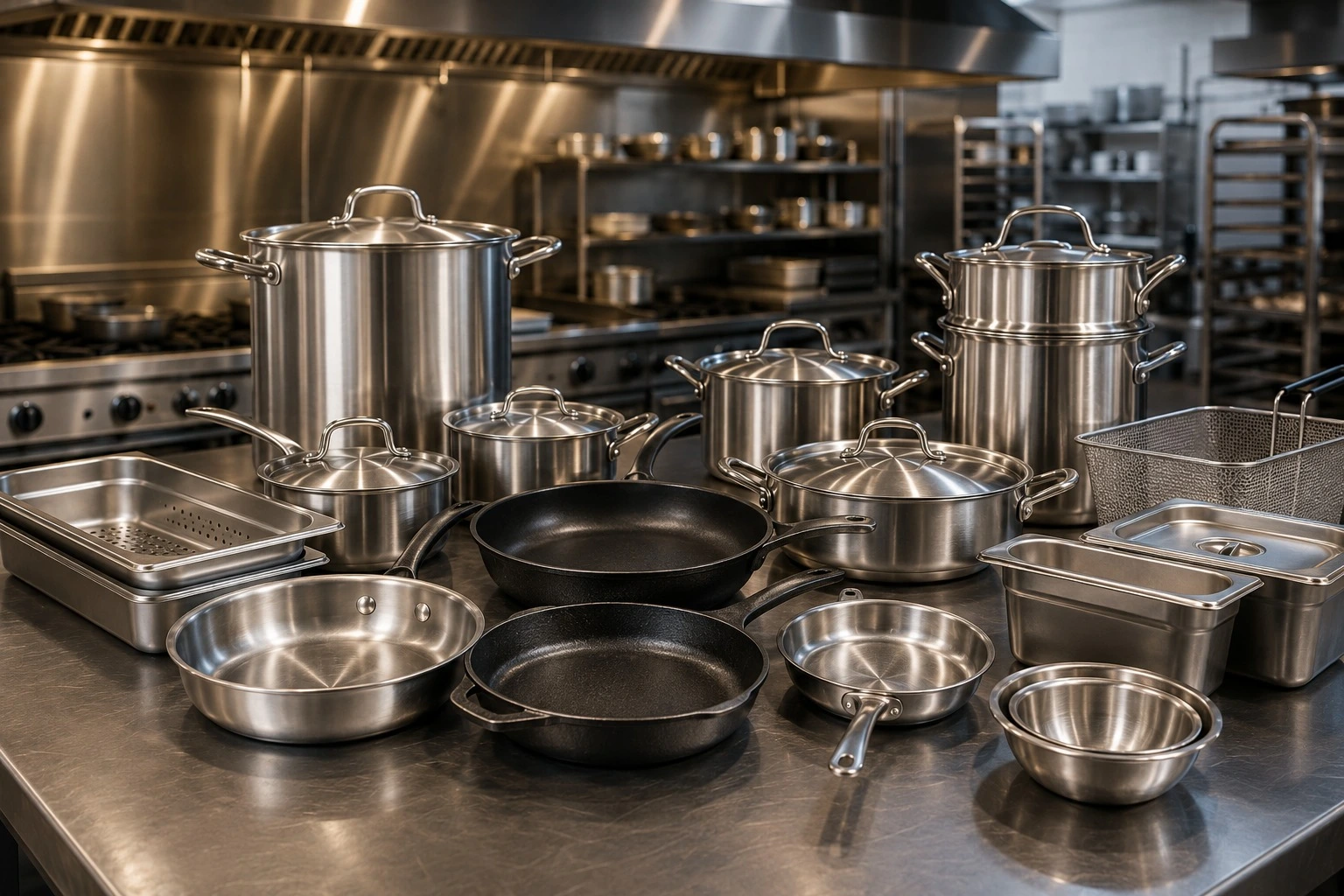
Types of Commercial Cookware Used in UAE Kitchens
UAE commercial kitchens are distinctive in their breadth: they must serve everything from Emirati traditional dishes to Indian subcontinent cuisine, East Asian cooking, European fine dining, and mass-production catering. This diversity creates broader cookware requirements than most markets.
Core Pots & Pans
• Stockpots (8–80 quart): Essential for stocks, broths, and Arabic slow-cooked dishes like harees and lamb broth. Stainless steel preferred for hygiene.
• Saute & sauce pans: Workhorse items across all cuisine types. 18/10 stainless is the industry standard in UAE hotel kitchens.
• Frying pans & skillets: High-volume demand driven by cafes, cloud kitchens, and QSR operations. Non-stick and carbon steel both widely used.
• Rondeau / brazier pans: Used for large-batch braising of lamb, chicken, and seafood in HORECA settings.
Bakeware & GN Pans
• Gastronorm (GN) pans: The universal standard across UAE hotel buffets, airline catering, and institutional kitchens. GN 1/1, 1/2, and 1/3 sizes dominate.
• Sheet pans & baking trays: High demand from UAE's rapidly growing bakery cafe segment.
• Perforated trays: Used in convection ovens widely adopted in hotel and flight catering operations.
Specialty Cookware for UAE Cuisine
• Woks: Essential for the significant number of Asian restaurants and Chinese, Indian, and Southeast Asian food operations in the UAE.
• Pressure cookers (industrial): Used in large institutional kitchens for speed cooking and stock reduction.
• Dallah coffee pots & traditional vessels: Some HORECA operators source specialty Arabic service vessels alongside their commercial cookware.
• Induction-compatible vessels: Growing demand driven by UAE's push toward energy-efficient kitchen setups.
Cookware Materials: Performance Guide for UAE Conditions
The UAE kitchen environment presents specific challenges: extreme ambient heat, high-volume continuous service, powerful commercial burners (typically running on LPG or natural gas from DEWA/ADDC networks), and increasingly widespread induction cooking. Material selection must account for these conditions.
| Material | Heat Performance | Durability | UAE Use Case | Induction Ready | Est. Lifespan |
| Stainless Steel 18/10 | Good (moderate conductivity) | Excellent | All-purpose: hotels, restaurants, catering | With clad base only | 10–20+ years |
| Aluminum | Excellent | Moderate | Bakeries, fast cooking, institutional bulk prep | No | 3–7 years |
| Hard-Anodized Aluminum | Excellent | High | High-volume cloud kitchens, QSRs | No | 5–10 years |
| Cast Iron | Excellent heat retention | Exceptional | Steakhouses, grills, Arabic slow cooking | Yes | Decades |
| Carbon Steel | Very Good | High | Asian kitchens, woks, high-heat saute | Yes (with base) | 10–15 years |
| Copper (tin-lined) | Superior | Moderate | Fine dining, Michelin-level properties | No | 15–20 years |
| Non-stick (PTFE/ceramic) | Good | Low–Moderate | Eggs, fish, low-oil cooking, cafes | Some models | 1–3 years |
| Clad Multi-ply Stainless | Excellent | Very High | Premium hotels, all-cuisine versatility | Yes | 15–25 years |
UAE-Specific Note: In commercial kitchens running high-BTU gas burners — common across Dubai and Abu Dhabi restaurant setups — aluminum cookware can warp under sustained high heat. Invest in heavy-gauge (3mm+) aluminum or clad stainless for longevity.
Carbon Steel: The Underrated Choice for UAE Asian Cuisine
With Indian, Pakistani, Filipino, and East Asian cuisines forming a major segment of UAE foodservice, carbon steel woks and pans are heavily used in professional kitchens. Carbon steel heats faster than cast iron, is lighter for tossing and wok-cooking, and develops a natural non-stick seasoning over time. Leading brands like Matfer Bourgeat and de Buyer supply carbon steel cookware to fine dining and Asian cuisine restaurants across the Gulf.
UAE Compliance & Certifications: What You Must Know
This is the section that distinguishes buying cookware in the UAE from buying it in Europe or the US. The UAE has its own regulatory framework for food contact materials — and non-compliance can result in product seizure, fines, and failed Dubai Municipality health inspections.
ESMA: The Primary Regulatory Authority
The Emirates Authority for Standardization and Metrology (ESMA) is the key UAE body governing food contact materials, including commercial cookware. All manufacturers, importers, and distributors of cookware sold or used in the UAE must obtain an ESMA conformity certificate. This applies to metals, non-stick coatings, and any material that contacts food during preparation.
| Certification / Standard | Issuing Body | What It Covers | Why It Matters in UAE |
| ESMA Conformity Certificate | ESMA (UAE) | Food-grade materials, migration limits, chemical composition, labelling | Mandatory for all cookware sold/used commercially in UAE — non-compliance = product seizure |
| GSO 839 / GSO 2231 | GCC Standardization Organization | GCC-wide food contact material standards adopted by UAE | Underpins ESMA requirements; verify supplier meets GSO standards |
| Cabinet Resolution No. 20 (2015) | UAE Federal Government | Specific requirements for food contact materials in UAE market | Governs testing methods and specifications required for ESMA certification |
| Dubai Municipality Approval | Dubai Municipality | Sanitary design of commercial kitchen equipment in Dubai | Required for equipment installed in Dubai-licensed food premises |
| MOHAP Registration | Ministry of Health & Prevention | Food contact materials in direct contact with food | Required in addition to ESMA for certain cookware categories |
| NSF/ANSI 2 | NSF International (USA) | Sanitary design and food-safe materials | Not mandatory in UAE but widely recognised; adds credibility for international brand sourcing |
| LFGB (Germany) | German Food Law | Strict European food contact material safety | Respected by UAE hotel procurement teams; exceeds minimum UAE requirements |
| ISO 9001 | ISO International | Quality management system | Look for this in any manufacturer you source from — signals consistent production quality |
Critical Warning: Suppliers claiming ESMA compliance without being able to produce a current certificate (valid for one year, renewable two months before expiry) should be disqualified from consideration. Always request the physical certificate document — not just a verbal assurance.
Dubai Municipality Health Inspections
Dubai Municipality's Health and Safety Department conducts random inspections of commercial food premises, including visual and laboratory analysis of cookware and food contact equipment. Using non-certified or damaged cookware (cracked non-stick coatings, pitting on stainless) can result in violation notices, temporary closure orders, and reputational damage. Maintaining an up-to-date equipment log with certification documentation is strongly recommended for all Dubai-based operators.
Commercial Cookware Brand in UAE: Who's in the Market
The UAE supplier landscape spans local trading companies, regional distributors of international brands, and direct-import operations sourcing from China, Europe, and Turkey. Here is an overview of key players and supplier types:
International Brands Widely Available in UAE
| Brand | Origin | Speciality | UAE Price Tier | Where to Source in UAE |
| Vollrath | USA | Full commercial range, NSF certified | Mid–High | Specialist HORECA distributors, Dubai |
| Matfer Bourgeat | France | Carbon steel, copper, stainless — top hotel standard | Premium | Hotel procurement channels, specialist importers |
| de Buyer | France | Carbon steel, mineral pans, professional bakeware | High | Premium kitchen suppliers, online import |
| Winco | USA | Budget stainless & aluminum | Budget–Mid | General HORECA suppliers, online import |
| Fissman | Lithuania/Global | Consumer to HORECA cookware sets | Budget–Mid | Fissman UAE retail and HORECA channel |
| Prestige | UK/India | Pressure cookers, cookware sets | Budget–Mid | ACE stores, hypermarkets, HORECA distributors |
| Lodge | USA | Cast iron cookware | Mid | ACE stores, specialty kitchen retailers UAE |
| Berghoff | Belgium | Non-stick and stainless cookware sets | Mid | ACE stores, Danube, retail & HORECA |
Sourcing Tip: For hotel-grade procurement in Dubai and Abu Dhabi, many purchasing managers source Matfer Bourgeat and Vollrath through specialist HORECA importers or through the annual Gulfood trade show at Dubai World Trade Centre — one of the world's largest food and hospitality sourcing events.
How to Evaluate a Supplier: The UAE Buyer's Checklist
ESMA & Regulatory Compliance (Non-Negotiable)
• Request the ESMA Conformity Certificate — verify it is current (valid for 1 year)
• Confirm GSO 839/2231 compliance for food contact materials
• Check Dubai Municipality approval for equipment installed in Dubai premises
• For hotel procurement: verify LFGB or NSF certification as additional quality signal
• Ask for material composition certificates (e.g., 18/10 stainless steel grade confirmation)
Product Quality & Suitability
• Is the cookware gauge appropriate for commercial use? (Minimum 2.5–3mm for stainless stockpots)
• Are handles riveted or welded? Welded handles are easier to clean and ESMA-preferred for hygiene
• Is the product induction-compatible if needed for your kitchen setup?
• Does the supplier carry the full range you need, or will you need multiple suppliers?
• Can they supply standard Gastronorm (GN) sizing for hotel/catering operations?
Supply Chain & Delivery
• What are standard delivery timelines to your emirate (Dubai, Abu Dhabi, Sharjah)?
• Does the supplier maintain local stock in UAE, or are items imported to order?
• What is the minimum order value or quantity?
• Do they offer same-day or next-day emergency delivery for critical replacements?
• What is their process for handling defective or damaged goods on delivery?
After-Sales Support
• Is there a UAE-based customer service team (not just overseas support)?
• What warranty terms apply to products sold in the UAE?
• Can they provide reference contacts from other UAE HORECA clients?
Sourcing Strategy: Where UAE Buyers Source Their Cookware
UAE commercial kitchen operators source from multiple channels, each with distinct cost, compliance, and quality tradeoffs:
| Sourcing Channel | Cost Level | Lead Time | ESMA Compliance Risk | Best For |
| UAE Local Distributor | Mid–High | 1–5 days | Low (established distributors handle compliance) | Fast procurement, replacement orders, small operators |
| Gulfood / Trade Shows (Dubai) | Mid | Varies | Low (suppliers present certificates at show) | Bulk sourcing, new supplier discovery, hotel procurement |
| Direct from China Manufacturer | Lowest | 35–75 days | HIGH (buyer responsible for ESMA compliance) | Importers, large chains, distributors — not for small operators |
| European Brand Importer (UAE) | High–Premium | 1–3 weeks | Low (established importers manage compliance) | Hotels, fine dining, prestige kitchen builds |
| Online (Amazon.ae / Noon) | Budget–Mid | 1–3 days | Medium (verify certifications before commercial use) | Small quantities, backup items, startup operations |
| Jebel Ali Free Zone (JAFZA) Traders | Mid | 3–7 days | Medium (due diligence required) | Mid-size operators, restaurant groups |
Important: When sourcing directly from China or overseas manufacturers, the importer becomes responsible for obtaining ESMA certification before the goods can be legally sold or used commercially in the UAE. This process typically takes approximately 3 working days once documentation is submitted, but laboratory testing requirements can add significant lead time.
Pricing Guide: What to Expect in the UAE (AED)
Commercial cookware pricing in the UAE reflects a mix of import duties, distributor margins, and brand premiums. Below are approximate per-unit AED price ranges for commonly purchased items across different quality tiers:
| Item | Budget (AED) | Mid-Range (AED) | Premium (AED) |
| 12" Stainless Saute Pan | 55–110 | 165–330 | 440–1,100+ |
| 20-Qt Stockpot (Stainless 18/10) | 90–185 | 260–475 | 660–1,470+ |
| Half Sheet Pan (Heavy Aluminum) | 18–45 | 55–90 | 110–220 |
| 10" Cast Iron Skillet | 75–145 | 185–295 | 370–735 |
| 12" Carbon Steel Pan | 90–165 | 220–370 | 440–735+ |
| GN 1/1 Hotel Pan (Stainless) | 45–90 | 110–220 | 295–550 |
| Non-stick Frying Pan 10" | 37–90 | 130–260 | 295–660 |
| Wok 14" (Carbon Steel) | 110–220 | 295–440 | 550–1,100+ |
Value Principle: In the UAE market, mid-range cookware typically delivers the best return on investment for restaurants and cloud kitchens. The import duty environment (generally 5% on most cookware categories in UAE) means premium European brands carry significant price premiums — but for hotel-grade operations, the longevity and ESMA compliance reliability justifies the investment.
10 Costly Mistakes UAE Buyers Make — And How to Avoid Them
1. Buying without ESMA verification — The most critical UAE-specific mistake. Non-certified cookware risks product seizure, health inspection failures, and legal liability under UAE food safety law.
2. Ignoring Dubai Municipality requirements — Equipment installed in Dubai-licensed premises must meet specific sanitary design standards. Confirm compliance before purchase.
3. Sourcing solely on price — The UAE market has abundant low-cost imports, but in commercial kitchens running 12–16 hour daily service, cheap cookware fails quickly and expensively.
4. Overlooking induction compatibility — Many UAE kitchens are transitioning to induction cooking for DEWA energy efficiency compliance. Confirm compatibility upfront.
5. Not accounting for import lead times — Sourcing directly from China means 35–75 day lead times. Without forward planning, kitchen openings and equipment replacements stall.
6. Mismatching materials to cuisine type — Non-stick in a Shawarma grill station, or thin aluminum under powerful commercial gas burners, leads to rapid failure.
7. Using a single supplier for all categories — Supply chain disruptions, VAT compliance issues, or product recalls can shut down procurement overnight. Maintain backup supplier relationships.
8. Skipping sample orders — Always order samples before bulk commitments, especially when sourcing from new suppliers or overseas manufacturers.
9. Ignoring VAT implications — UAE VAT (5%) applies to commercial cookware. Factor this into budget planning, and verify your supplier provides proper VAT invoices (Tax Registration Number required).
10. Not training kitchen staff on care — Even premium cookware degrades rapidly with improper maintenance. Staff training on material-specific cleaning and storage is a direct extension of your equipment investment.
Cookware Care & Maintenance in UAE Commercial Kitchens
The UAE kitchen environment — high ambient temperatures, powerful burners, hard water from desalination, and continuous-use service models — demands specific maintenance protocols to protect your cookware investment.
Stainless Steel (18/10)
• UAE tap water is high in mineral content — dry thoroughly after washing to prevent water spots and surface staining
• Use oxalic acid cleaner (Bar Keepers Friend or equivalent) for discoloration from hard water
• Avoid bleach-based sanitizers on stainless — these cause pitting over time
• Deglaze with warm water immediately after service — never soak overnight
Cast Iron & Carbon Steel
• Critical in humid coastal UAE climates: dry completely after every wash — Gulf humidity accelerates rust
• Re-season after each clean with a light coat of neutral oil (rice bran or vegetable oil)
• Never put through commercial dishwashers — the harsh detergents strip seasoning instantly
• Store in a dry area — UAE kitchen humidity can cause rapid oxidation if stored wet
Non-stick Coatings
• Replace non-stick pans when coating shows any signs of chipping or peeling — this is a food safety requirement, not just a quality issue
• Never use metal utensils — silicone and wooden tools only
• Avoid preheating empty non-stick pans on high heat — PTFE coatings degrade above 230°C
• Hand-wash only — commercial dishwashers destroy non-stick coatings rapidly
Final Thoughts: Building a Smarter Cookware Procurement Strategy in the UAE
The UAE's foodservice market is one of the world's most dynamic — and one of the most demanding from a compliance, quality, and operational performance standpoint. In 2026, with cloud kitchens proliferating, hotel foodservice growing at 20% annually, and delivery platforms intensifying kitchen utilisation, the margin for error in equipment procurement has never been smaller.
The most successful UAE foodservice operators approach cookware procurement as a strategic investment: they prioritise ESMA compliance as an absolute baseline, evaluate total cost of ownership rather than unit price, maintain relationships with multiple qualified suppliers, and invest in material quality that matches their specific cuisine and service model.
Use this guide as your working reference — revisit the compliance checklist when onboarding new suppliers, apply the materials guide when specifying equipment for new kitchens, and benchmark pricing in AED before committing to any bulk purchase.
A well-informed cookware procurement decision made today will support operational efficiency, compliance confidence, and business growth across every service that comes out of your kitchen tomorrow.