
Table of Contents
- Why This Question Matters More in the UAE Than Anywhere Else
- The Core Difference: Sanitization, Not Just Cleaning
- Side-by-Side Comparison: Commercial vs. Home Dishwasher
- Temperature Standards: The Single Biggest Difference
- Cycle Time: 60 Seconds vs. 60 Minutes
- Build Quality and Materials
- Water and Energy Consumption
- Types of Commercial Dishwashers Available in the UAE
- Why a Home Dishwasher Is Illegal to Use in a UAE Commercial Kitchen
- Commercial Dishwasher Price Guide for the UAE
- Total Cost of Ownership: Commercial vs. Trying to Use a Home Unit
- When (If Ever) a Home-Style Dishwasher Makes Sense
- At-a-Glance: Complete Comparison Table
- Frequently Asked Questions (FAQ)
- Conclusion
Why This Question Matters More in the UAE Than Anywhere Else
It's a question every new café owner, restaurant operator, or cloud kitchen entrepreneur in Dubai or Abu Dhabi eventually asks: can't I just use a powerful home dishwasher to save money on my kitchen fit-out? The units look similar in the showroom. A premium home dishwasher can cost AED 3,000–5,000 — sometimes more than an entry-level commercial unit appears to cost on paper.
The answer, unambiguously, is no — and understanding exactly why is essential for any UAE food service operator. This isn't a marginal performance difference. Commercial and home dishwashers are built to entirely different engineering standards, regulatory frameworks, and operational philosophies. One is designed to make your dishes look clean. The other is designed and certified to make your dishes safe to eat from.
In the UAE specifically, this distinction carries direct legal and regulatory weight. Dubai Municipality, Abu Dhabi Agriculture and Food Safety Authority (ADAFSA), and the food safety codes that govern every commercial kitchen in the Emirates explicitly require commercial-grade, sanitizing-certified dishwashing equipment — not domestic appliances repurposed for business use. Getting this wrong doesn't just risk poor hygiene outcomes; it risks DM inspection failure, fines, and closure orders.
This guide breaks down every meaningful difference between commercial and home dishwashers, with specific focus on what it means for UAE operators in 2026.
The Core Difference: Sanitization, Not Just Cleaning
The single most important concept to understand is this: a home dishwasher is designed to clean. A commercial dishwasher is designed to sanitize.
These sound similar but are fundamentally different engineering goals. Cleaning removes visible food residue and grease. Sanitizing achieves a specific, measurable, certified reduction in harmful bacteria and pathogens — the level required to make tableware genuinely safe for the next customer to eat from.
Commercial dishwashers operating under recognised international standards (NSF/ANSI 3 in the US, DIN 10534 in Europe — both reference points used across UAE commercial kitchen specifications) must achieve a minimum 99.999% (5-log) reduction of bacteria. This is a hard, tested, certified performance threshold. Home dishwashers — even premium models with a "sanitize" cycle — are evaluated under a separate, lower domestic standard (NSF/ANSI 184) that does not meet commercial food service requirements.
This distinction is why a home dishwasher, regardless of price or features, is not legally or practically suitable for any UAE café, restaurant, hotel kitchen, cloud kitchen, or catering operation.
Side-by-Side Comparison: Commercial vs. Home Dishwasher
Commercial Dishwasher vs. Home Dishwasher: Complete Technical Comparison
| Factor | Home Dishwasher | Commercial Dishwasher |
| Primary objective | Visible cleanliness | Certified bacterial sanitization |
| Sanitization standard | NSF/ANSI 184 (domestic) | NSF/ANSI 3 / DIN 10534 (commercial) |
| Bacteria reduction | Not independently certified for commercial use | Minimum 99.999% (5-log reduction) |
| Cycle time | 60–150 minutes per load | 60–180 seconds per rack (hood/conveyor) |
| Wash temperature | 49–60°C | 60–65°C |
| Final rinse temperature | 50–65°C (no commercial certification) | 80–90°C (sanitizing threshold) |
| Daily duty cycle | 1–3 cycles per day | 50–500+ racks per day |
| Build material | Plastic interior, light-gauge steel | Full stainless steel interior and exterior |
| Motor/pump | Light-duty, intermittent use | Heavy-duty, continuous commercial use |
| Detergent system | Domestic tablets/gel | Commercial-grade chemical dosing (detergent + rinse aid) |
| Water softening | Basic or none | Integrated softener (critical for UAE hard water) |
| Drainage | Standard household plumbing | Commercial drain with grease trap compliance |
| Footprint | Designed for kitchen cabinetry | Undercounter, hood-type, or conveyor — sized to throughput |
| UAE regulatory status | Not approved for commercial food service | Required for any commercial food business |
| Typical UAE price | AED 800 – 3,500 (purchase) | AED 4,000 – 60,000+ (purchase) |
| Expected lifespan in heavy use | Weeks to months if misused commercially | 7–15 years in proper commercial use |
| Warranty for commercial use | Voided if used commercially | Full commercial warranty support |
Temperature Standards: The Single Biggest Difference
If there is one specification that defines the gap between a home and commercial dishwasher, it is final rinse temperature — and this single number is also the most heavily scrutinised item during a UAE food safety inspection.
Recognised international hygiene standards require commercial dishwashers to maintain a wash temperature between 60–65°C and a final rinse temperature between 80–85°C. This elevated final rinse temperature is what achieves the certified sanitization standard — it is several degrees higher than what a domestic dishwasher is designed or tested to reach.
The science behind this matters. Under official requirements, best commercial dishwashers must eliminate 99.999% of microorganisms and bacteria — a 5-log reduction — and this sanitizing performance is only verified at these specific, elevated temperatures. A home dishwasher's "sanitize" or "hygiene" cycle, however well-marketed, simply was not engineered, tested, or independently certified against this standard.
Why this matters specifically in the UAE: Dubai Municipality and ADAFSA food safety inspections directly check final rinse temperature as a core compliance item. Commercial dishwashers used in UAE food businesses are required to demonstrate that they consistently reach and maintain the sanitizing rinse threshold — typically verified through a thermometer reading, a built-in temperature display, or test strips during inspection. A domestic machine cannot produce or verify this data in a way that satisfies a UAE inspector.
Temperature Comparison: Home vs. Commercial Dishwashers
| Cycle Stage | Home Dishwasher | Commercial Dishwasher (High-Temp) |
| Wash temperature | 45–60°C | 60–65°C |
| Final rinse temperature | 50–65°C (unverified for commercial use) | 80–90°C (certified sanitizing range) |
| Maximum safe rinse temp | Not regulated for commercial use | 90°C (above this, water vaporises and loses sanitizing effect) |
| Temperature monitoring | None or basic display | Required gauge/digital display; subject to inspection |
| Booster heater | Not present | Standard component to guarantee rinse temperature |
Cycle Time: 60 Seconds vs. 60 Minutes
The throughput difference between commercial and home dishwashers is not incremental — it is an entirely different order of magnitude, and it's one of the most practically obvious differences for any UAE F&B operator.
A typical home dishwasher cycle, even on a "quick wash" setting, runs 60 to 150 minutes to complete a full wash, rinse, and dry cycle for a single load. A commercial hood-type (pass-through) dishwasher completes a full wash and sanitizing rinse cycle for an entire rack of dishes, glasses, or cutlery in approximately 60 to 90 seconds.
This is not a marketing exaggeration — it reflects fundamentally different engineering: commercial machines use higher water pressure, more powerful pumps, dedicated wash and rinse tanks (rather than a single shared cycle), and chemical dosing systems calibrated for rapid, repeated, continuous-duty operation throughout a full service period.
A standard busy UAE restaurant should look for a commercial dishwasher delivering 40–60 racks per hour to keep pace with peak Friday brunch or dinner service. At that throughput level, a home dishwasher attempting to keep up would need to run continuously, non-stop, all day — something it is neither designed nor warrantied to do.
Throughput Comparison: Home vs. Commercial Dishwashers
| Dishwasher Type | Cycle Time | Capacity per Cycle | Effective Output |
| Home dishwasher | 60–150 minutes | 1 load (~12 place settings) | ~6–12 place settings/hour (best case) |
| Commercial undercounter | 2–4 minutes | 1 rack (~16–24 plates/glasses) | 20–35 racks/hour |
| Commercial hood-type (pass-through) | 60–90 seconds | 1 rack | 40–60 racks/hour |
| Commercial conveyor | Continuous | Continuous feed | 100–300+ racks/hour |
Build Quality and Materials
Beyond performance specifications, the physical construction of commercial and home dishwashers reflects their intended duty cycles — and this directly determines how long each will actually survive in a real UAE commercial kitchen environment.
Home dishwashers typically use a mix of plastic interior tubs, light-gauge steel components, and consumer-grade pumps and motors rated for one to three cycles per day across a multi-year domestic lifespan. They are simply not engineered for the mechanical stress of dozens or hundreds of cycles daily.
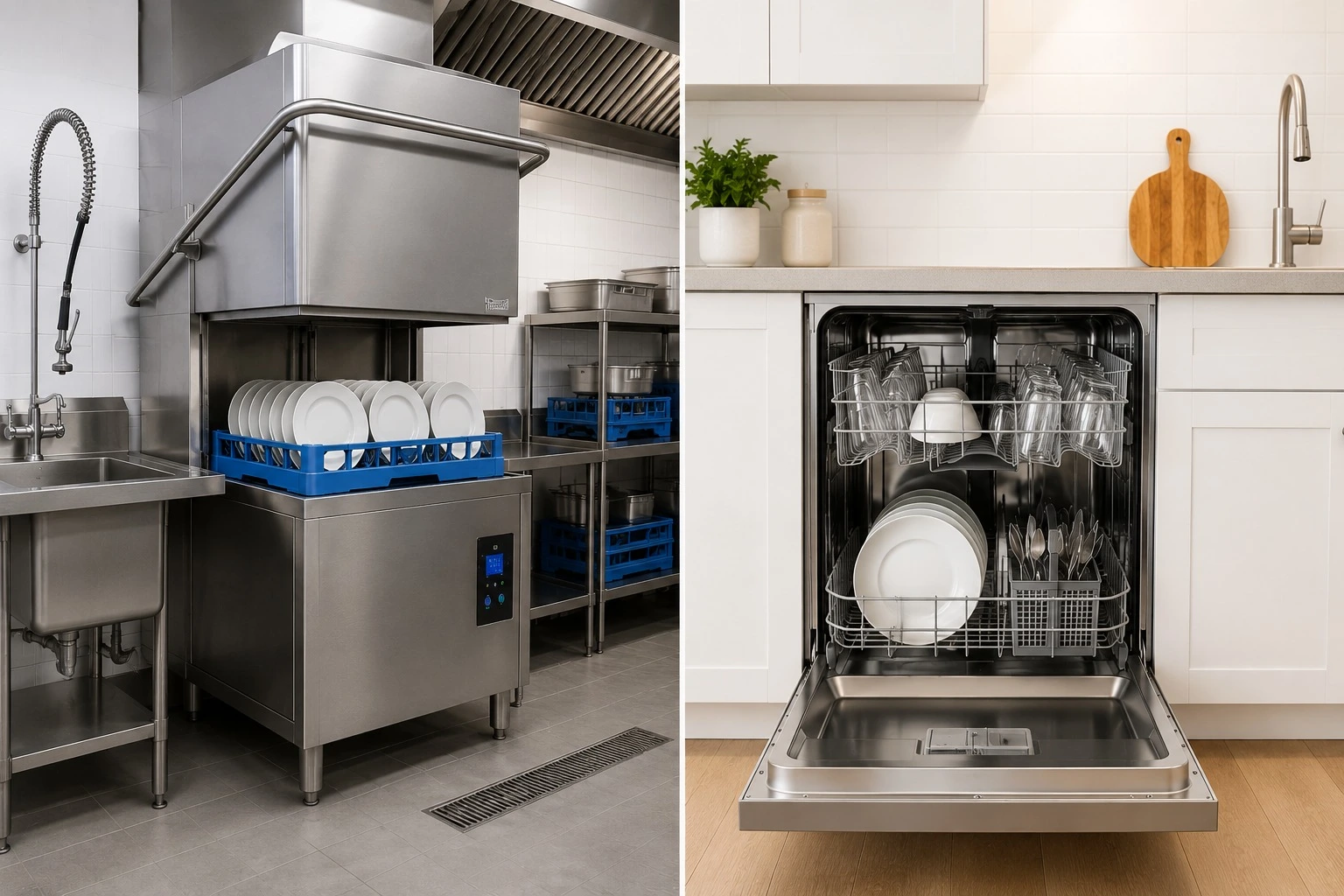
Commercial dishwashers are built almost entirely from food-grade stainless steel — interior chamber, exterior panels, racks, and wash arms — chosen specifically because stainless steel withstands constant high-temperature water exposure, resists corrosion, meets food safety surface requirements, and survives the mechanical wear of continuous commercial operation. Commercial-grade motors and pumps are rated for continuous duty cycles measured in years of near-constant operation, not months.
In the UAE specifically, this construction difference has an additional dimension: hard water. Much of the UAE's municipal water supply has significant mineral hardness, and commercial dishwashers — particularly premium brands like Winterhalter — typically feature sophisticated integrated water softening systems specifically engineered to manage this. Home dishwashers either lack this capability entirely or include only a basic, consumer-grade softening function inadequate for sustained commercial water volumes.
Water and Energy Consumption
A common misconception is that commercial dishwashers, given their power and throughput, must consume dramatically more water and energy than a home unit. In practice, the picture is more nuanced — and increasingly favours efficient commercial machines.
Modern commercial dishwashers from leading manufacturers are highly efficient, with some 2026 models using as little as 2 litres of water per cycle. Premium brands now incorporate heat recovery systems that capture rinse steam to pre-heat incoming cold water — a feature with particular relevance in the UAE, where it simultaneously reduces DEWA utility bills and reduces the heat and humidity load on a kitchen's air conditioning system.
The relevant comparison for a UAE operator isn't water per cycle — it's total water and energy cost per dish washed, at the volume the business actually needs. A commercial dishwasher processing 50 racks per hour with 2–3 litres per cycle is dramatically more water-efficient per item washed than running a home dishwasher continuously (and inadequately) to keep pace with the same volume, while also failing to meet sanitization standards in the process.
Resource Efficiency: Per-Item Comparison
| Metric | Home Dishwasher (Attempting Commercial Volume) | Commercial Dishwasher |
| Water per cycle | 10–15 litres | 2–4 litres (modern models) |
| Items per cycle | ~12 place settings | 16–24 items per rack |
| Cycles needed for 200 items/day | 16+ cycles (impossible in practice) | 8–10 racks |
| Practical daily capacity | Inadequate for commercial volume | Matched to business need |
| Heat recovery technology | Not available | Standard on premium UAE commercial brands |
| DEWA utility cost impact | High per-item cost; risk of non-completion | Optimised per-item cost |
Types of Commercial Dishwashers Available in the UAE
Once the case for commercial-grade equipment is clear, the next decision for UAE operators is which type of commercial dishwasher matches their specific volume and kitchen layout.
Undercounter dishwashers fit beneath a standard 900mm counter and are the standard choice for small cafés, coffee shops, and bars across Dubai — handling approximately 20–35 racks per hour, well-suited to operations serving fewer than 50 guests per hour.
Hood-type dishwashers are the gold standard for most mid-sized UAE commercial kitchens. The operator slides a rack in and pulls down the hood for a fast 60-second cycle, delivering 40–60 racks per hour — appropriate for restaurants serving 50–150 guests per hour.
Conveyor dishwashers are essential for hotels, hospitals, and large staff canteens processing upwards of 100 racks per hour, moving racks automatically through pre-wash, wash, and drying stages in continuous operation.
Glasswashers are a specialised undercounter category optimised specifically for glassware — common in UAE hotel bars, lounges, and beach clubs where spotless, streak-free glass presentation is a brand standard.
UAE Commercial Dishwasher Types: Quick Selection Guide
| Type | Racks/Hour | Best For | Typical UAE Kitchen |
| Undercounter | 20–35 | Fewer than 50 guests/hour | Small café, coffee shop, bar |
| Hood-type (pass-through) | 40–60 | 50–150 guests/hour | Mid-sized restaurant, hotel outlet |
| Conveyor | 100–300+ | High-volume, continuous | Hotel, hospital, large catering |
| Glasswasher | 20–40 racks | Glassware-focused service | Hotel bar, lounge, beach club |
Why a Home Dishwasher Is Illegal to Use in a UAE Commercial Kitchen
This is not simply a best-practice recommendation — it is a regulatory requirement across the UAE's food safety framework.
Dubai Municipality's Food Code and equivalent ADAFSA requirements in Abu Dhabi mandate HACCP-compliant equipment for any commercial food preparation business. Commercial dishwashers meeting a verified final rinse temperature — typically a minimum of 82°C — are a specific, checked compliance item during food safety inspections. Fines for food safety violations in Dubai range from AED 50,000 to AED 100,000, with the possibility of closure orders for serious or repeat violations.
A domestic dishwasher cannot demonstrate certified sanitization performance, cannot reliably reach or sustain the required rinse temperature under commercial load, and is explicitly outside the equipment specification that UAE food safety inspectors check for. Beyond the inspection risk, using a home appliance for commercial volume also voids any manufacturer warranty (virtually all home dishwasher warranties explicitly exclude commercial or business use) — leaving an operator with no recourse when the unit inevitably fails under a duty cycle it was never designed for.
For any UAE business preparing or serving food to the public — restaurants, cafés, hotels, cloud kitchens, catering companies, food trucks with a wash station — a certified commercial dishwasher is a baseline legal and operational requirement, not an optional upgrade.
Commercial Dishwasher Price Guide for the UAE
Understanding the true cost of commercial dishwashing equipment in the UAE helps operators budget correctly from the outset, rather than being tempted by the lower sticker price of a domestic unit.
Commercial Dishwasher Prices in the UAE — 2026
| Type | Capacity | Typical UAE Price (AED) | Best For |
| Entry-level undercounter | 20–25 racks/hour | 4,000 – 7,000 | Small café, coffee bar |
| Mid-range undercounter | 25–35 racks/hour | 6,500 – 12,000 | Café, restaurant, bar |
| Glasswasher (undercounter) | 20–40 racks/hour | 5,000 – 10,000 | Hotel bar, lounge |
| Entry hood-type | 40–50 racks/hour | 12,000 – 22,000 | Mid-sized restaurant |
| Premium hood-type (Hobart, Winterhalter) | 50–60 racks/hour | 20,000 – 40,000 | Busy restaurant, hotel outlet |
| Conveyor dishwasher (entry) | 100–150 racks/hour | 35,000 – 60,000 | Hotel, large catering |
| Conveyor dishwasher (industrial) | 150–300+ racks/hour | 55,000 – 120,000+ | Large hotel, hospital, central kitchen |
For comparison, a premium home dishwasher in the UAE typically costs AED 800–3,500 — a lower upfront price, but one that cannot legally or practically substitute for any of the categories above in a commercial food business.
Total Cost of Ownership: Commercial vs. Trying to Use a Home Unit
Some UAE entrepreneurs, particularly at the small café or cloud kitchen stage, are tempted to defer the commercial dishwasher purchase and run a home unit "just to get started." The total cost of this approach is almost always significantly higher than it appears.
True Cost Comparison: Home Dishwasher (Misused Commercially) vs. Commercial Unit — 12 Month Estimate
| Cost Factor | Home Dishwasher (Commercial Misuse) | Commercial Dishwasher |
| Upfront purchase | AED 1,500 – 3,500 | AED 4,000 – 12,000 |
| Expected functional lifespan under commercial load | 1–4 months | 7–15 years |
| Replacement units needed (12 months) | 3–6 units | 0 |
| Manufacturer warranty | Void (commercial use excluded) | Full coverage |
| DM compliance risk | High — fails inspection | Compliant |
| Inspection fine risk | AED 50,000 – 100,000 per violation | Not applicable (compliant) |
| Staff labour from breakdowns | Significant — manual washing fallback | Minimal |
| Hygiene/illness liability risk | Significant | Managed |
| Realistic 12-month total cost | AED 10,000–25,000+ (replacements, fines, disruption) | AED 4,000–12,000 (one-time) |
The arithmetic is unambiguous: even setting aside the legal non-compliance, attempting to run a UAE food business on a domestic dishwasher costs more — not less — within the first year, before factoring in reputational damage from an inspection failure or, worse, a foodborne illness incident traced back to inadequate sanitization.
When (If Ever) a Home-Style Dishwasher Makes Sense
To be fair to the question, there are a small number of UAE business contexts where a domestic-style dishwasher is genuinely appropriate — provided it is not used as a substitute for required commercial sanitization equipment.
Staff break rooms and back-office kitchenettes — for washing personal mugs and cutlery not used in food service to customers — can reasonably use a domestic dishwasher, as this is not a regulated food-contact sanitization context.
Very small-batch home-based food businesses operating under specific UAE home-business food permits (where applicable and licensed) may have different, lower-volume requirements — but should always confirm exact equipment requirements directly with Dubai Municipality or ADAFSA, as licensing and equipment requirements vary and are strictly enforced.
Office pantries and non-food-service environments with no public food service component fall outside commercial kitchen dishwashing regulations entirely.
For any business that prepares, serves, or sells food or beverages to customers in the UAE — which covers the overwhelming majority of F&B operations — a certified commercial dishwasher meeting the recognised temperature and sanitization standards is required, full stop.
At-a-Glance: Complete Comparison Table
Commercial vs. Home Dishwasher: The Definitive UAE Summary
| Category | Winner | Why |
| Sanitization certification | Commercial | Only commercial units meet NSF/ANSI 3 / DIN 10534 standards |
| Speed/throughput | Commercial | 60-second cycles vs. 60+ minute home cycles |
| Build durability | Commercial | Full stainless steel vs. mixed plastic/light steel |
| UAE regulatory compliance | Commercial | Legally required for any food service business |
| Upfront purchase price | Home | Lower sticker price, but irrelevant for commercial use |
| Water efficiency at scale | Commercial | Modern commercial units as efficient as 2L/cycle |
| Warranty protection (commercial use) | Commercial | Home warranties void under business use |
| Suitable for personal/staff use only | Home | Appropriate for non-food-service contexts only |
| Long-term cost of ownership | Commercial | Dramatically lower total cost despite higher upfront price |
Conclusion
The difference between a commercial and home dishwasher is not a matter of degree — it is a difference in fundamental purpose. A home dishwasher is built to make dishes look clean for a family of four, a handful of times a week. A commercial dishwasher is engineered, tested, and certified to make dishes genuinely safe for hundreds of customers a day, cycle after cycle, hour after hour.
For any UAE food and beverage business — from a small Dubai café to a five-star Abu Dhabi hotel kitchen — this distinction is not optional. It is a regulatory requirement, a genuine food safety necessity, and ultimately a sound financial decision once the total cost of ownership is properly understood. The higher upfront price of a commercial dishwasher reflects real engineering differences in temperature control, build quality, sanitization certification, and duty-cycle durability that a home appliance simply cannot replicate, regardless of its features or price point.
For UAE operators setting up a new kitchen in 2026, the correct question is never "can I get away with a home dishwasher to save money?" It is "which type and capacity of commercial dishwasher matches my service volume?" — and the answer to that question is what protects your customers, your compliance status, and your business.