
Quick Answer
There is no single "best" oven. The right choice depends on what you cook most.
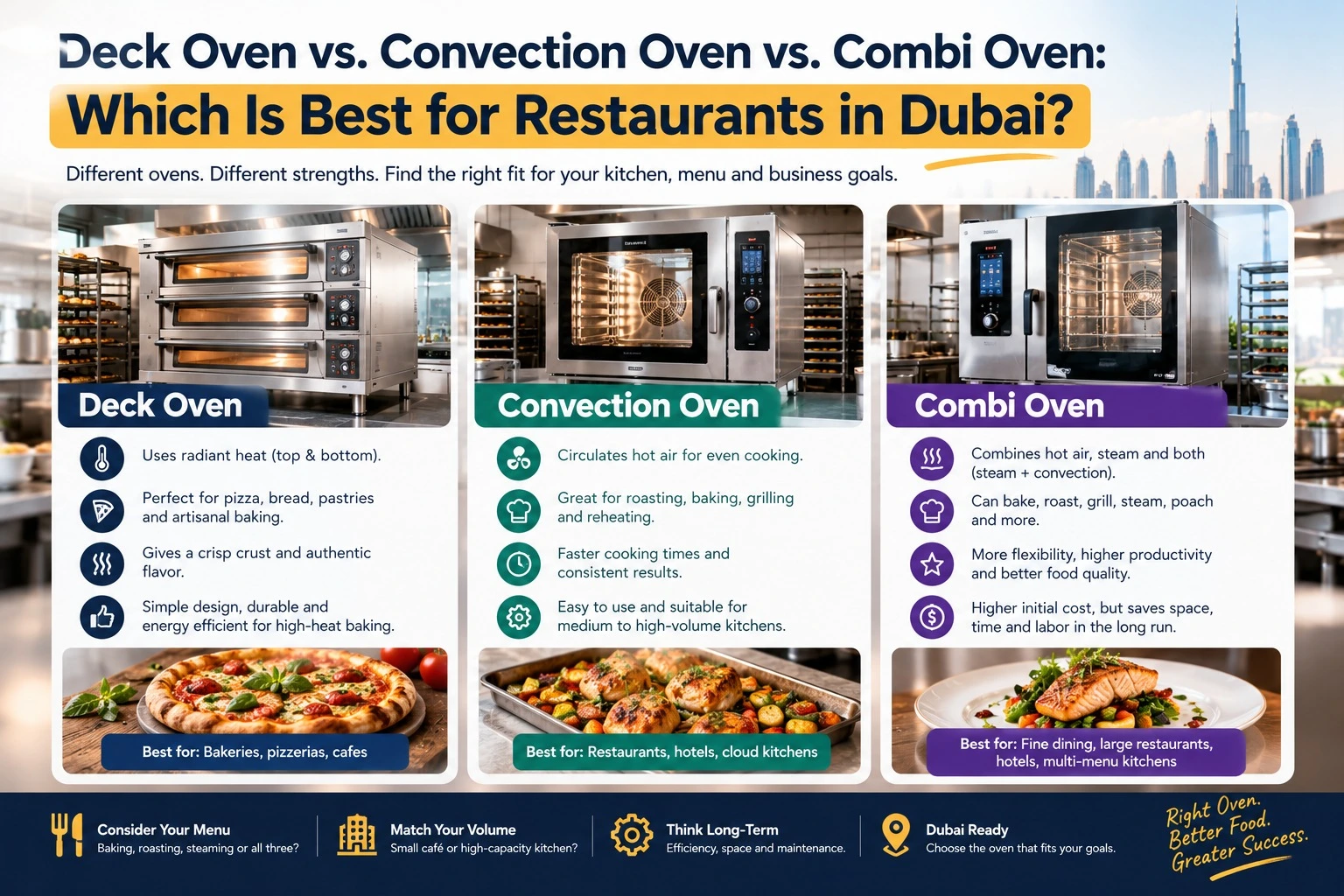
- Choose a deck oven if pizza, artisan bread, flatbreads, or manakish are core to your menu. Stone or steel decks give the crust, oven spring, and char that fan-driven ovens can't match.
- Choose a convection oven if you bake, roast, and reheat a wide range of dishes on a budget, such as cafés, bakeries focused on pastry, and small restaurants. It is the lowest-cost all-rounder.
- Choose a combi oven if you run a multi-menu or high-volume kitchen (hotels, catering, cloud kitchens, fine dining) and need roasting, steaming, baking, and regenerating from one machine, with programmable, repeatable results.
Typical Dubai price ranges: deck ovens AED 6,000–65,000 (single to triple deck), convection ovens AED 4,000–40,000, and combi ovens AED 18,000–170,000+ depending on capacity and brand. Combi ovens also need water, drainage, water treatment, and usually three-phase power, so budget for installation as well as the unit.
Key Facts at a Glance
- A deck oven cooks with radiant heat from heated stone or steel decks. Best for pizza and bread.
- A convection oven uses fans to circulate hot air. Best for even baking, roasting, and reheating at the lowest cost.
- A combi oven combines convection heat with steam in one unit. Best for versatility and consistency.
- Combi ovens are the most expensive to buy and the most demanding to install and maintain.
- Deck ovens have the largest footprint and slowest preheat, but the best result for crust-focused foods.
- Convection ovens are the cheapest and simplest to run.
- Many Dubai restaurants use a combination, such as a deck oven for pizza plus a combi oven for everything else.
Table of Contents
- Introduction
- What Is a Deck Oven?
- What Is a Convection Oven?
- What Is a Combi Oven?
- Deck vs. Convection vs. Combi: Side-by-Side Comparison
- Which Oven Is Best for Your Restaurant Type in Dubai?
- Decision Rules: If You Cook X, Choose Y
- Dubai-Specific Factors That Affect Your Choice
- Oven Price Ranges in the UAE
- Costs Beyond the Purchase Price
- Popular Oven Brands in the UAE
- Gas vs. Electric
- Compliance and Food Safety Considerations
- Warranty and Local Service
- Budget vs. Long-Term Value
- Pre-Purchase Checklist
- Final Thoughts
- Frequently Asked Questions
Few equipment decisions confuse new restaurant owners in Dubai as much as choosing an oven. Deck, convection, and combi ovens can all bake and roast, but they do it differently, cost very different amounts, and place very different demands on your kitchen's power, water, ventilation, and staff skills. This guide explains the practical differences and gives clear rules for choosing, using Dubai market pricing and local operating conditions.
What Is a Deck Oven?
A deck oven is an oven with one or more flat, heated stone or steel baking decks that cook food mainly through radiant and conductive heat from the base and top.
Food sits directly on the deck (or on trays placed on it), which gives strong bottom heat, a crisp crust, and excellent heat retention. Deck ovens are available in single-, double-, and triple-deck configurations, in gas or electric versions, and some bread models add steam injection.
Best for: pizza, artisan and sourdough bread, flatbreads, and manakish-style bakes.
Pros:
- Superior crust, oven spring, and char for pizza and bread
- Stable, retained heat that recovers well between bakes
- Long service life and mechanically simple construction
- Capacity scales by adding decks
Cons:
- Large footprint and heavy installation
- Slower preheat than a convection or combi oven
- Limited versatility beyond bread, pizza, and similar items
- Less automated than a combi oven, so results depend more on operator skill
What Is a Convection Oven?
A convection oven uses fans to circulate hot air around food, producing faster, more even cooking than a conventional oven.
Food is usually cooked on trays in racks. Convection ovens suit baking, roasting, grilling, and reheating, and they are the simplest, cheapest way to get consistent results from a wide menu.
Best for: pastries, cookies, cakes, roasted vegetables and proteins, reheating, and general kitchen baking.
Pros:
- Lowest purchase price of the three
- Even heat and good tray-to-tray consistency
- Compact options for tight kitchens
- Simple controls and low maintenance
Cons:
- Not ideal for pizza or crusty bread (no stone-deck bottom heat)
- Standard models have no steam, so they dry out some foods
- Fewer automation and programming features than a combi
What Is a Combi Oven?
A combi oven (combination oven or combi-steamer) combines convection heating with steam, letting you cook with dry heat, steam, or a mix of both in a single unit.
Combi ovens can roast, bake, steam, poach, grill, and regenerate food. They typically include programmable recipes, core-temperature probes, and automatic cleaning cycles, which makes results repeatable across staff and shifts.
Best for: hotels, catering, cloud kitchens, fine dining, and any kitchen that cooks many different dishes from one machine.
Pros:
- Maximum versatility, replacing several appliances
- Programmable, repeatable results and probe cooking
- Steam control helps retain moisture in roasts and delicate dishes
- Strong fit for batch cooking and holding
Cons:
- Highest purchase price
- Needs water supply, drainage, and water treatment
- Larger units typically need three-phase power
- Staff need training, and regular descaling and servicing are essential
Deck vs. Convection vs. Combi: Side-by-Side Comparison
| Feature | Deck Oven | Convection Oven | Combi Oven |
| Heat method | Radiant/conductive from stone or steel deck | Fan-circulated hot air | Hot air plus steam, in any mix |
| Best for | Pizza, artisan bread, flatbreads | Pastry, roasting, reheating, general baking | Multi-menu cooking, steaming, roasting, regenerating |
| Crust quality (bread/pizza) | Excellent | Fair | Good with steam, but not a stone-deck crust |
| Versatility | Low | Medium | Very high |
| Purchase price | Medium to high | Low to medium | High to very high |
| Installation needs | Heavy, large footprint, ventilation | Simple (power or gas) | Water, drain, water treatment, often three-phase power |
| Skill required | Medium (bread/pizza technique) | Low | Medium to high (programming, maintenance) |
| Preheat speed | Slow | Fast | Fast |
| Consistency across staff | Medium | Good | Excellent (programmable) |
| Maintenance burden | Low | Low | High (descaling, water treatment, servicing) |
| Typical Dubai user | Pizzerias, bakeries, Arabic bakeries | Cafés, small restaurants, pastry kitchens | Hotels, catering, cloud kitchens, fine dining |
Which Oven Is Best for Your Restaurant Type in Dubai?
| Restaurant Type | Best Oven | Why |
| Pizzeria | Deck oven | Crust quality and heat retention |
| Arabic bakery / manakish / flatbread | Deck oven (or specialist flatbread oven) | Strong bottom heat and high temperature |
| Artisan bakery (bread-focused) | Deck oven with steam | Crust and oven spring |
| Café / pastry shop | Convection oven | Low cost, even baking, simple operation |
| Small casual restaurant | Convection oven | Versatile and budget-friendly |
| Hotel kitchen / banqueting | Combi oven | Volume, versatility, repeatability |
| Catering company / central kitchen | Combi oven | Batch cooking, regeneration, consistent output |
| Cloud kitchen with a varied menu | Combi (or convection if budget-limited) | Many dishes from one compact appliance |
| Fine dining | Combi oven | Precision, low-temperature cooking, steam control |
| Steakhouse / grill concept | Combi or convection as a finishing oven | Roasting and holding alongside the grill line |
Decision Rules: If You Cook X, Choose Y
- If pizza or artisan bread is more than about a third of your sales, choose a deck oven. No fan oven replicates the crust.
- If you need one oven to do many different jobs and have staff who can be trained, choose a combi oven.
- If you mostly bake pastries, roast, and reheat, and your budget is limited, choose a convection oven.
- If you have both a crust-driven product and a varied menu, buy two ovens: a deck for the crust product and a combi or convection for everything else.
- If your water supply, drainage, or power cannot support a combi oven, choose a convection oven instead of forcing an unsuitable installation.
- If you have no technician access or service plan, avoid a combi oven until you do. Downtime is costly.
Dubai-Specific Factors That Affect Your Choice
Water quality and scale (combi ovens). Combi ovens generate steam and are sensitive to limescale and chlorine. Water quality varies by building and emirate, so water filtration or softening is standard practice and may be required to keep the warranty valid. Ask the supplier exactly what treatment they specify for your location.
Power supply. The UAE supply is 220–240V, 50Hz single-phase and typically 380–415V three-phase. Smaller countertop ovens often run on single-phase, while larger convection and combi ovens commonly require three-phase. Confirm your available supply and landlord approval before ordering.
Kitchen heat and ventilation. Ovens add significant heat to an already hot kitchen. Plan for adequate extraction and make-up air, and check the manufacturer's clearance requirements. Gas ovens also need flue and gas-safety approvals through the proper channels.
Space. Dubai kitchens, especially in malls and cloud kitchen units, are often compact. A countertop convection or small combi may fit where a deck oven will not.
Service availability. Choose brands with local distributors, trained technicians, and stocked spare parts, since oven downtime stops production.
Oven Price Ranges in the UAE
Prices vary widely by brand, capacity, and power source. As a general guide for the UAE market (supplier guides and retailer listings, 2026):
| Oven Type | Tier | Approximate Price (AED) |
| Deck oven | Single deck | 6,000–12,000 |
| Deck oven | Double deck | 15,000–30,000 |
| Deck oven | Triple deck | 35,000–65,000 |
| Convection oven | Entry | 4,000–8,000 |
| Convection oven | Mid-range | 9,000–18,000 |
| Convection oven | Premium | 20,000–40,000 |
| Combi oven | Entry (compact, about 6 trays) | 18,000–40,000 |
| Combi oven | Mid-range (about 10 trays) | 40,000–75,000 |
| Combi oven | Premium / large floor models | 80,000–170,000+ |
Examples seen in current UAE listings: a 4-tray electric convection oven from Unox at roughly AED 11,000; electric and gas 6-tray combi models from Unox at roughly AED 28,000–40,000; and a Rational iCombi Pro 6-1/1 electric at roughly AED 36,000, with 10-tray models roughly AED 51,000–64,000 and large 20-tray units exceeding AED 150,000. Some very compact or entry combi units are listed lower, so compare capacity, features, and warranty rather than price alone. Treat these figures as a budgeting guide, and request a current quote.
Costs Beyond the Purchase Price
- Installation: electrical work, gas connection, water and drain for combi ovens, and ventilation changes
- Water treatment: filters or softeners and cartridge replacements (combi)
- Cleaning and descaling: chemicals or tablets and routine servicing
- Trays and accessories: trays, racks, stands, and probes
- Training: especially for combi programming
- Service contracts: preventive maintenance reduces breakdowns
- VAT: 5% on top of quoted prices
Popular Oven Brands in the UAE
You will commonly encounter Rational, Unox, Lainox, Convotherm, and Eloma in combi and convection categories, and Italian and European makers such as Moretti Forni, Zanolli, and Cuppone for deck and pizza ovens, along with value-oriented convection brands such as Turbofan and MEC. Rather than choosing by brand name alone, compare:
- Local distributor, trained technicians, and parts availability
- Capacity and tray size (GN 1/1 versus 600x400 bakery trays)
- Boiler versus boilerless steam generation in combi models
- Warranty length and what it requires (such as water treatment)
- Energy consumption and whether you need gas or electric
Gas vs. Electric
- Gas ovens can offer faster heat-up and lower running costs in some settings, but need approved gas connections, flues, and ventilation.
- Electric ovens offer precise control and easier installation in many buildings, but may need three-phase power and sufficient electrical capacity.
Check which fuel your premises can support before choosing a model, as this can narrow your options.
Compliance and Food Safety Considerations
- Include your oven in the kitchen equipment list submitted for permit and layout approval, and avoid ordering before approval where possible.
- Combi ovens with core-temperature probes and cooking logs can help demonstrate that food reaches required cooking temperatures (the Dubai Food Code cooking and reheating requirement commonly cited is 75°C core temperature), but confirm current requirements with Dubai Municipality.
- Gas installations and ventilation fall under Civil Defence and building requirements, so use certified installers and keep documentation.
- Keep manufacturer certification, warranty documents, and maintenance records on file.
Warranty and Local Service
Choose a supplier that offers:
- A clear manufacturer warranty (commonly one to two years), with its conditions stated in writing
- Local, trained technicians and a stated response time
- Spare parts held in the UAE
- Installation, commissioning, and staff training, particularly for combi ovens
- A maintenance plan, since preventive servicing is cheaper than emergency repairs
Budget vs. Long-Term Value
- A deck oven costs more per unit of capacity, but if crust quality drives your sales, it pays back through product quality.
- A convection oven has the lowest entry cost and is hard to beat for general-purpose baking on a budget.
- A combi oven costs the most, but for a varied, high-volume kitchen it can replace several appliances and improve consistency, provided it is installed, treated with proper water, and maintained correctly.
The most expensive mistake is buying the wrong type: a combi oven used only as a basic oven, or a convection oven used for pizza and disappointing customers.
Pre-Purchase Checklist
Confirm you can answer "yes" to each:
- Have I listed my top five best-selling dishes and matched them to an oven type?
- Is my power supply (single-phase or three-phase) confirmed?
- If a combi, do I have a water supply, drain, and a water treatment plan?
- Is there ventilation and clearance for the oven's heat output?
- Is the oven included in my submitted equipment list?
- Does the supplier have local technicians and parts?
- Is the warranty clear, and do I understand its conditions?
- Do I have trained staff, or training included?
- Have I budgeted for installation, accessories, and VAT?
Final Thoughts
For Dubai restaurants, the choice comes down to your menu. A deck oven is the right tool when crust defines your product, a convection oven is the practical, low-cost all-rounder, and a combi oven is the premium choice for varied, high-volume, consistency-driven kitchens, provided you can support its water, power, and maintenance needs. Many successful kitchens combine two types rather than forcing one oven to do everything.
Start from your best-selling dishes, confirm your power, water, and ventilation, and choose a supplier with local service. That approach protects both your food quality and your budget.