
Quick Answer
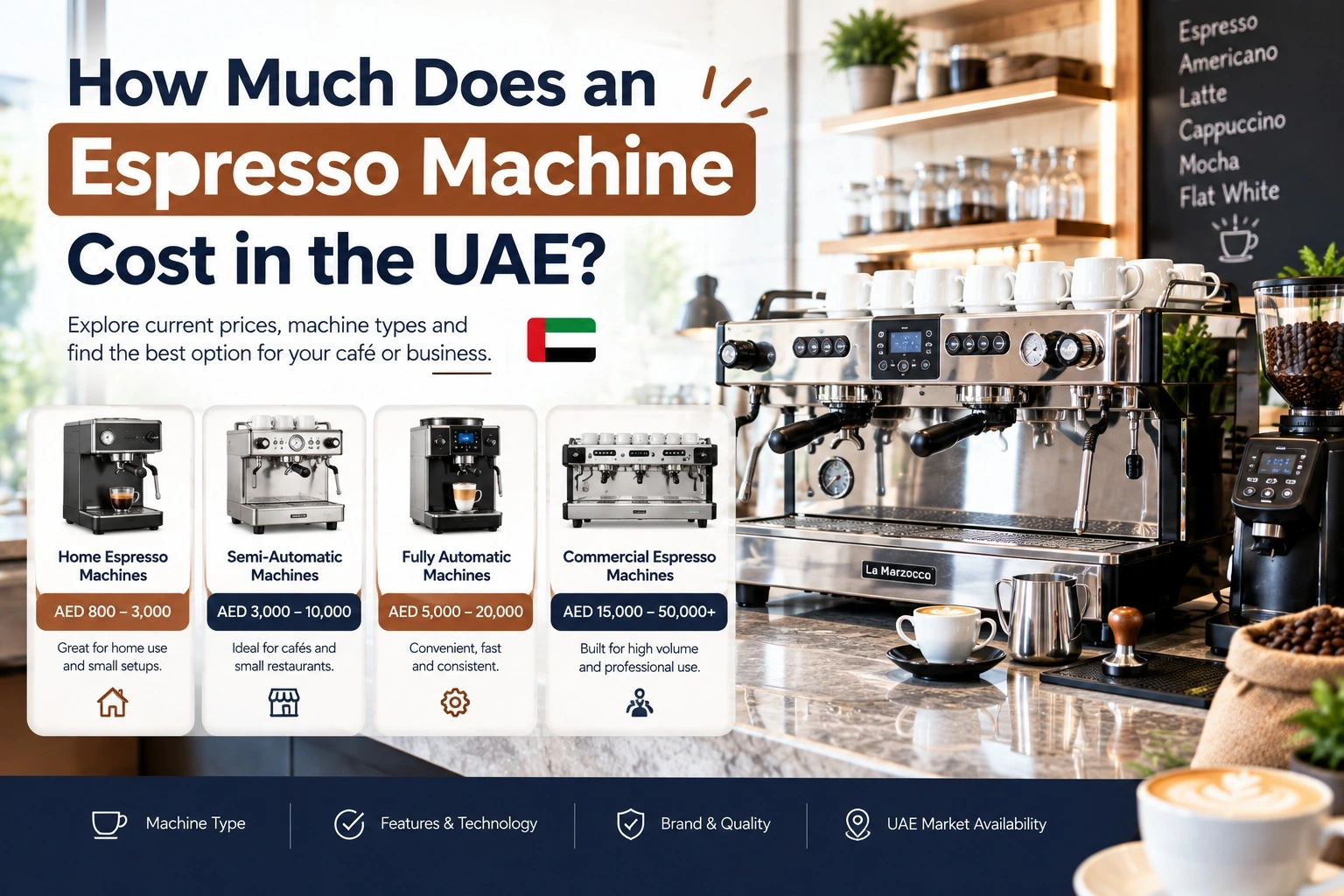
Espresso machine prices in the UAE range from roughly AED 230 for a basic capsule machine to over AED 130,000 for a premium multi-group commercial unit. As a general benchmark: basic home capsule or pod machines cost AED 230–800, home semi-automatic and bean-to-cup machines cost AED 1,500–5,000, prosumer/high-end home machines (like a Rancilio Silvia Pro X or entry La Marzocco) cost AED 6,800–35,000, entry-level commercial café machines cost AED 12,000–20,000, mid-range commercial workhorses cost AED 20,000–45,000, and premium specialty commercial machines (La Marzocco, Slayer) cost AED 45,000–130,000+ depending on group-head count and features.
Table of Contents
- Introduction
- Espresso Machine Segments: Which One Do You Need?
- Home Espresso Machine Costs
- Prosumer Espresso Machine Costs
- Commercial Espresso Machine Costs
- What Actually Drives the Price Difference?
- Espresso Machine Price Comparison Table
- Costs Beyond the Machine Itself
- New vs. Used Espresso Machines
- Leasing and Financing Options for Cafés
- Popular Espresso Machine Brands in the UAE
- Warranty and Local Service Support
- Budget vs. Long-Term Value
- Final Thoughts
- Frequently Asked Questions
Whether you're setting up a home coffee corner in Dubai or equipping a new café anywhere in the UAE, "how much does an espresso machine cost" doesn't have a single answer — the market spans from AED 230 capsule machines to six-figure commercial units used by specialty coffee shops. This guide breaks down real UAE pricing across every segment, explains what actually drives the cost difference, and covers what to budget for beyond the machine itself.
Espresso Machine Segments: Which One Do You Need?
Before comparing prices, it helps to identify which segment you actually need, since home and commercial machines are built for fundamentally different use cases.
- Home machines are designed for occasional, low-volume use — a handful of cups per day — and prioritize convenience and compact size.
- Prosumer machines bridge the gap, offering commercial-grade components (dual boilers, PID temperature control) in a smaller footprint for serious home baristas or very small cafés.
- Commercial machines are built for continuous, high-volume daily use in cafés, restaurants, and hotels, with multiple group heads, larger boilers, and components rated for all-day operation.
Buying a home machine for commercial use (or vice versa) is one of the most common and costly mistakes — home machines generally can't sustain café-level volume, while commercial machines are often unnecessarily large and expensive for home use.
Home Espresso Machine Costs
- Capsule/pod machines (Nespresso, Dolce Gusto): roughly AED 230–800. The most affordable entry point, though limited to proprietary coffee pods rather than fresh-ground espresso.
- Semi-automatic home machines (basic DeLonghi models): roughly AED 1,500–2,000. Entry-level traditional espresso with manual milk frothing.
- Bean-to-cup automatic machines (DeLonghi, mid-range): roughly AED 1,700–3,500. Built-in grinder and automated milk frothing for convenience.
- Premium home machines with integrated grinder (Breville Barista Touch/Express, DeLonghi La Specialista): roughly AED 2,400–5,000.
Prosumer Espresso Machine Costs
- Entry prosumer machines (Rancilio Silvia Pro X): roughly AED 6,800. Dual boiler and PID control at a relatively accessible price point for serious home use.
- High-end prosumer/crossover machines (La Marzocco Linea Mini, GS3): roughly AED 18,000–35,000. True commercial-grade components in a compact single-group format, popular with dedicated home baristas and very small specialty cafés.
Commercial Espresso Machine Costs
- Entry-level commercial machines: roughly AED 12,000–20,000. Suitable for low-volume cafés or as a secondary machine.
- Mid-range commercial workhorses: roughly AED 20,000–45,000. The most common choice for established cafés and restaurants with moderate daily volume.
- Premium specialty commercial machines (La Marzocco Linea Classic, GB5, KB90): roughly AED 45,000–95,000 depending on group-head count (1, 2, or 3 groups).
- Flagship/competition-grade machines (La Marzocco Strada X/S, Slayer): roughly AED 47,500–120,000+, used by specialty coffee shops prioritizing precision pressure profiling.
- Large multi-group or under-counter commercial systems: can exceed AED 130,000 for high-volume, multi-outlet or hotel installations.
What Actually Drives the Price Difference?
Several specific features explain why espresso machine prices vary so dramatically within the same general category:
- Boiler configuration: Single-boiler machines are cheaper but can't brew and steam milk simultaneously; dual-boiler machines (standard on most prosumer and commercial units) allow both at once, directly affecting speed during busy service.
- Group-head count: Commercial machines are priced per group head — a 1-group machine suits a small café, while 2- and 3-group machines support higher-volume, multi-barista operations and cost proportionally more.
- PID temperature control: Precise digital temperature regulation improves extraction consistency and is a feature that significantly separates entry-level from premium machines.
- Automation level: Fully automatic bean-to-cup machines cost less upfront in the home segment but limit barista control; manual and semi-automatic machines cost more but allow greater precision, which matters more as volume and quality expectations increase.
- Build materials and brand: Machines from established Italian manufacturers (La Marzocco, Rancilio, Nuova Simonelli) command a premium tied to component quality, consistency, and long-term reliability under continuous use.
Espresso Machine Price Comparison Table
| Segment | Typical Use Case | Price Range (AED) |
| Capsule/pod machine | Home, occasional use | 230–800 |
| Home semi-automatic | Home, daily personal use | 1,500–2,000 |
| Home bean-to-cup automatic | Home, convenience-focused | 1,700–3,500 |
| Premium home machine | Home, serious enthusiast | 2,400–5,000 |
| Entry prosumer | Home/micro-café crossover | 6,800 |
| High-end prosumer | Home barista/small café | 18,000–35,000 |
| Entry commercial | Small café, low volume | 12,000–20,000 |
| Mid-range commercial | Established café/restaurant | 20,000–45,000 |
| Premium commercial | Specialty café, higher volume | 45,000–95,000 |
| Flagship commercial | Competition-grade specialty café | 47,500–120,000+ |
Costs Beyond the Machine Itself
The espresso machine is rarely the only cost — budgeting accurately means accounting for the full setup.
- Grinder: A quality commercial or prosumer grinder is essential and can cost anywhere from AED 1,500 to AED 15,000+ depending on grade — pairing a premium machine with a weak grinder undermines the investment significantly.
- Water filtration system: Important in the UAE given local water hardness, protecting the machine's boiler and extending its lifespan.
- Regular descaling and maintenance: An ongoing cost that increases with machine complexity and usage volume.
- Barista training: Particularly relevant for cafés investing in manual or semi-automatic commercial machines, where technique directly affects output quality.
- Installation and plumbing: Commercial machines often require direct water line and drainage connections, adding to initial setup cost.
New vs. Used Espresso Machines
Used commercial espresso machines are widely available in the UAE and can meaningfully reduce upfront cost for new cafés.
- New machines carry full manufacturer warranty and the latest technology, at full retail pricing.
- Used commercial machines (commonly found through UAE classifieds and secondhand equipment dealers) often sell for a fraction of retail — light-use commercial units can be found well below AED 15,000 — though typically with limited or no warranty and unknown maintenance history.
If buying used, request maintenance records and have the machine inspected by a qualified technician before purchase, since boiler and group-head repairs can be costly if deferred maintenance has been an issue.
Leasing and Financing Options for Cafés
Not every café operator buys outright. Common alternatives in the UAE market include:
- Equipment leasing, converting a large upfront machine cost into fixed monthly payments
- Supplier financing or installment plans, offered by some commercial coffee equipment distributors
- Coffee supplier partnerships, where some roasters provide machines on loan or subsidized terms in exchange for a coffee bean supply agreement — worth exploring for new cafés before committing to a full outright purchase
Popular Espresso Machine Brands in the UAE
For home and prosumer machines, UAE buyers commonly choose DeLonghi, Breville (Sage), and Rancilio. For commercial machines, La Marzocco dominates the premium specialty segment, alongside Nuova Simonelli, Victoria Arduino, Rancilio, Franke, and Slayer at the flagship end. Rather than choosing on brand reputation alone, compare:
- Local distributor presence and warranty support, since imported machines without a UAE service network can mean long waits for repairs
- Group-head count matched to your actual daily volume, not your aspirational volume
- Total cost including grinder, water filtration, and installation, not just the machine's sticker price
- Genuine new unit vs. secondhand pricing, since some listings mix both without clearly distinguishing condition
Warranty and Local Service Support
Given how central an espresso machine is to café operations, after-sales support should weigh heavily in the purchase decision.
Choose a supplier or distributor that offers:
- A clear manufacturer warranty period, commonly 1–2 years on commercial units
- Local, responsive technician support, since machine downtime directly affects revenue for any café or restaurant
- Spare parts availability without long import wait times
- Installation support for commercial units requiring plumbing and electrical work
Budget vs. Long-Term Value
The cheapest machine that meets your volume needs isn't always the best long-term choice once reliability and consistency are factored in.
Higher-quality espresso machines generally offer:
- More consistent extraction and temperature stability, directly affecting coffee quality and customer satisfaction
- Greater durability under continuous daily commercial use
- Lower long-term repair frequency
- Better resale value if upgrading later
For a café where coffee is a core revenue driver, investing toward the upper end of your realistic budget in machine quality and grinder pairing tends to pay off through both consistency and reduced downtime.
Final Thoughts
Espresso machine costs in the UAE span an enormous range — from a AED 230 capsule machine for occasional home use to a AED 130,000+ flagship commercial unit for a high-volume specialty café. The right choice depends entirely on your actual use case: home convenience, serious home brewing, or commercial-grade daily volume. Beyond the machine's sticker price, budgeting for a quality grinder, water filtration, maintenance, and local warranty support will determine whether your investment performs reliably over time.
Whether you're setting up a home coffee corner in Abu Dhabi or equipping a new café in Dubai, matching the machine segment to your real volume and budget — rather than buying based on brand prestige alone — is what actually determines whether the investment pays off.