
Quick Answer
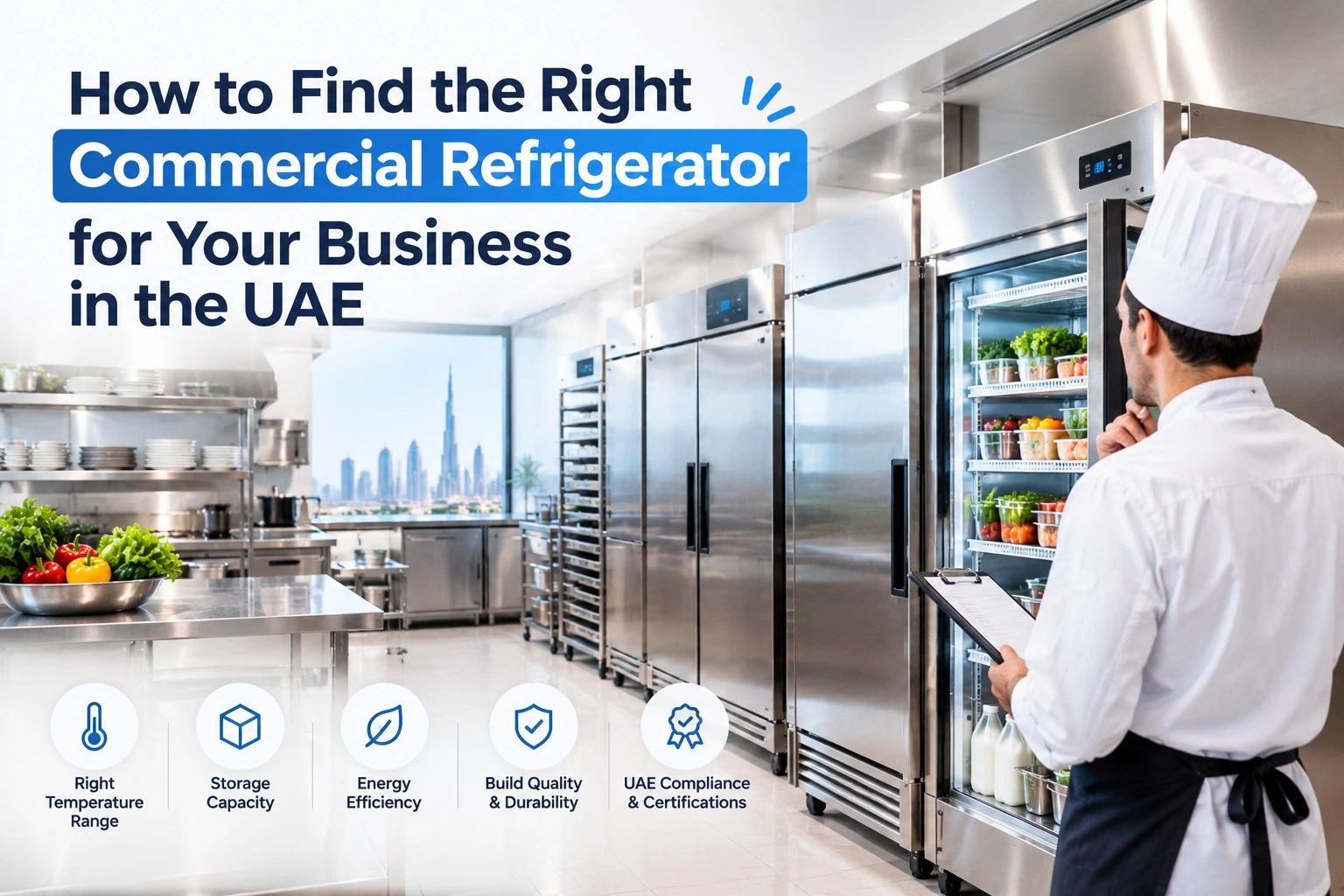
The right commercial refrigerator depends on your business type: reach-in refrigerators (AED 3,000–15,000) suit most restaurants and cafés for daily kitchen storage, undercounter and prep units (AED 2,000–12,000) work best where counter space is tight, walk-in coolers (AED 15,000–80,000+) suit high-volume kitchens and supermarkets, display/merchandiser chillers (AED 4,000–22,000) suit retail and bakery fronts, and blast chillers (AED 9,000–50,000+) suit kitchens needing rapid cooling for food safety compliance. Beyond size, prioritize inverter compressors, R290/R600a refrigerant, and NSF-certified food-grade construction — these affect running cost and compliance more than brand name alone.
Table of Contents
- Introduction
- Why Choosing the Right Commercial Refrigerator Matters
- Understand Your Business Requirements
- Types of Commercial Refrigerators
- Matching Refrigerator Type to Your Business
- Commercial Refrigerator Comparison Table
- Capacity Sizing: How Much Cold Storage Do You Actually Need?
- Refrigerant and Energy Efficiency
- Build Quality and Material Standards
- The UAE Heat Factor: Why Ambient Temperature Matters
- Noise, Placement, and Kitchen Workflow
- Compliance and Food Safety in the UAE
- Commercial Refrigerator Price Ranges in the UAE
- Popular Brands in the UAE
- New vs. Used Commercial Refrigerators
- Warranty and After-Sales Support
- Budget vs. Long-Term Value
- Final Thoughts
- Frequently Asked Questions
Refrigeration is the single most critical piece of equipment in any UAE food business — more than any range, fryer, or oven, a refrigerator failure puts your entire food safety compliance and stock at immediate risk. Yet with reach-in units, undercounter prep tables, walk-in coolers, display chillers, and blast chillers all marketed under the broad label "commercial refrigerator," choosing the right one for your specific business isn't always straightforward.
This guide breaks down every major commercial refrigerator type available in the UAE, how to match them to your business, and the UAE-specific factors — from ambient heat load to Dubai Municipality compliance — that should shape your decision.
Why Choosing the Right Commercial Refrigerator Matters
The right refrigeration setup directly affects food safety, operating cost, and daily kitchen efficiency.
Well-chosen commercial refrigerator delivers:
- Consistent, compliant food storage temperatures that protect both guests and your license
- Lower electricity costs through appropriate sizing and efficient compressor technology
- Reduced food spoilage and waste
- Faster, more organized kitchen workflow during service
- Fewer breakdowns and emergency repair costs
Because refrigeration runs continuously, 24 hours a day, it's also typically the largest single contributor to a commercial kitchen's electricity bill — making the right choice a long-term financial decision, not just an operational one.
Understand Your Business Requirements
Before comparing units, define exactly what you need refrigeration to do.
Ask yourself:
- What volume of fresh and frozen stock do you need to hold at any given time?
- Is storage needs steady throughout the day, or do you need rapid-access units during peak service?
- Do you need customer-facing display refrigeration, or purely back-of-house storage?
- Does your menu require rapid cooling of cooked food for food safety compliance (blast chilling)?
- How much physical space can you dedicate to refrigeration versus other kitchen functions?
A small café may need only a couple of reach-in units and an undercounter prep fridge, while a hotel kitchen or supermarket typically needs a combination of walk-in coolers, reach-ins, display units, and dedicated blast chilling capacity.
Types of Commercial Refrigerators
Reach-In Refrigerators
Reach-in refrigerators are upright, single- or multi-door units that function as the workhorse of most commercial kitchens, offering quick access to frequently used ingredients.
Best suited for general kitchen storage in restaurants, cafés, and catering operations of nearly any size.
Undercounter and Prep Refrigerators
Undercounter refrigerators fit beneath prep counters, often combined with a food-prep table or built-in ingredient rail (commonly called a "chef base" or "sandwich prep unit").
Ideal for kitchens with limited floor space, or for stations needing cold ingredients within immediate arm's reach during active prep and service.
Walk-In Coolers
Walk-in coolers are room-sized refrigerated spaces built into or added onto a kitchen, offering the largest practical storage capacity of any commercial refrigeration type.
Essential for high-volume restaurants, hotel kitchens, catering operations, and supermarkets managing large daily stock turnover.
Display and Merchandiser Refrigerators
Display refrigerators use glass fronts or open-air designs to showcase chilled products directly to customers — common in bakeries, delis, juice bars, and grab-and-go retail concepts.
These prioritize visual merchandising alongside cooling performance, often at some efficiency trade-off compared to solid-door units.
Blast Chillers
Blast chillers rapidly reduce the temperature of freshly cooked food, moving it through the food safety "danger zone" far faster than standard refrigeration — a requirement increasingly enforced for catering, central production kitchens, and HACCP-compliant operations.
Essential for any kitchen preparing food in advance for later service, including catering companies and hotel banqueting operations.
Back-Bar and Bottle Coolers
Compact refrigeration units designed for beverage storage behind a bar or counter, prioritizing quick access and presentation over large-volume storage.
Standard for cafés, bars, and any front-of-house beverage station.
Matching Refrigerator Type to Your Business
- Small cafés and kiosks: One or two reach-in units plus an undercounter prep fridge covers most daily needs.
- Casual dining and grill concepts: Reach-ins for general storage, a chef base/prep unit at the cooking line, and a back-bar cooler for beverages.
- Bakeries and delis: Display refrigeration is essential alongside standard reach-in and undercounter storage.
- Catering companies and central kitchens: Walk-in coolers for volume storage plus a dedicated blast chiller for food safety compliance on pre-prepared dishes.
- Hotels and large-volume restaurants: A full combination — walk-in cooler and freezer, multiple reach-ins across stations, prep units, and blast chilling capacity for banqueting.
- Supermarkets and grocery retail: Multideck display units and island freezers alongside walk-in storage.
Commercial Refrigerator Comparison Table
| Type | Best For | Typical Price (AED) | Space Needed |
| Reach-in refrigerator | General kitchen storage | 3,000–15,000 | Moderate |
| Undercounter/prep unit | Tight spaces, active prep stations | 2,000–12,000 | Compact |
| Walk-in cooler | High-volume storage | 15,000–80,000+ | Large |
| Display/merchandiser | Customer-facing retail, bakeries | 4,000–22,000 | Moderate to large |
| Blast chiller | Rapid cooling, food safety compliance | 9,000–50,000+ | Moderate |
| Back-bar/bottle cooler | Beverage service | 1,500–8,000 | Compact |
Capacity Sizing: How Much Cold Storage Do You Actually Need?
Undersizing refrigeration is one of the most common and disruptive mistakes in UAE commercial kitchens, since it directly limits how much stock you can hold between deliveries.
As a general guide:
- Size refrigeration around your busiest delivery cycle, not your average daily usage, so stock doesn't overflow between restock days
- Account for growth — a unit sized exactly for today's volume leaves no room as the business grows
- Separate raw and ready-to-eat storage wherever possible, which may mean more total units rather than one larger one, supporting both food safety and organization
Refrigerant and Energy Efficiency
Since refrigeration runs continuously, energy efficiency has an outsized effect on long-term operating cost.
Look for:
- Inverter compressor technology, which adjusts cooling output rather than cycling fully on and off, reducing energy consumption significantly over standard compressors
- R290 or R600a refrigerant, more energy-efficient and environmentally friendly options now standard across most modern commercial units sold in the UAE
- Manufacturer-stated energy consumption figures, compared across shortlisted models rather than assumed from price point alone
Build Quality and Material Standards
Commercial refrigerators face constant opening, heavy stock loads, and daily cleaning, so build quality directly affects lifespan.
Look for:
- Food-grade stainless steel construction, ideally Grade 304 for general use and Grade 316 in coastal or high-humidity locations
- Tight, well-sealed door gaskets that maintain consistent internal temperature
- Sturdy, easy-glide shelving rated for commercial loads
- Stable, corrosion-resistant hinges and door hardware rated for frequent daily use
The UAE Heat Factor: Why Ambient Temperature Matters
Commercial refrigerators in the UAE work harder than the same models in cooler climates, since compressors must overcome significantly higher ambient kitchen and outdoor temperatures to maintain internal cooling targets.
This has two practical implications for buyers:
- Choose units rated for high-ambient-temperature operation (sometimes listed as tropicalized or T-climate rated) rather than standard European climate ratings, since standard-rated units can struggle to maintain temperature or suffer shortened compressor life in UAE conditions
- Ensure adequate ventilation clearance around refrigeration units, particularly in smaller kitchens where heat from cooking equipment compounds the ambient heat load on nearby refrigerators
Noise, Placement, and Kitchen Workflow
Compressor noise and placement matter more in open-plan or front-of-house-adjacent kitchens than in fully enclosed back-of-house spaces.
- Display refrigerators placed near dining areas benefit from quieter compressor operation
- Back-of-house walk-ins and reach-ins have more placement flexibility, provided ventilation clearance is maintained
- Position refrigeration close to relevant prep and cooking stations to minimize staff movement and reduce the time food spends outside temperature-controlled storage
Compliance and Food Safety in the UAE
Commercial refrigeration in UAE food businesses should align with municipal and food safety requirements before service begins:
- Equipment should be suitable for inspection under Dubai Municipality (or the relevant emirate's municipality/food authority) food business regulations, including temperature logging and monitoring capability.
- Refrigeration used for raw meat, poultry, or seafood should be separable from ready-to-eat storage to support HACCP-aligned cross-contamination control.
- Blast chilling equipment may be required for kitchens preparing food significantly in advance of service, as part of food safety danger-zone compliance.
- Keep manufacturer certification (CE, or relevant safety marks) and temperature-monitoring records on file, as inspectors commonly request them during routine visits.
Commercial Refrigerator Price Ranges in the UAE
Pricing varies by brand, capacity, and build quality, but as a general guide for the UAE market:
- Back-bar/bottle coolers: roughly AED 1,500–8,000
- Undercounter and prep units: roughly AED 2,000–12,000, with branded units (True, Precision) often AED 10,000–28,000
- Reach-in refrigerators: roughly AED 3,000–15,000
- Display/merchandiser refrigerators: roughly AED 4,000–22,000
- Blast chillers: roughly AED 9,000–50,000+ depending on capacity
- Walk-in coolers: roughly AED 15,000–80,000+ depending on size and insulation specification
Prices shift with brand, capacity, and import costs, so treat these as a starting point for budgeting rather than fixed quotes — always request a current quote from your supplier.
Popular Brands in the UAE
When comparing options, you'll commonly come across brands such as True, Precision, Gemm, Cold Line, Gastrodomus, Scandomestic, and Irinox (for blast chillers), supplied through established UAE commercial kitchen equipment suppliers. Rather than choosing on brand name alone, compare:
- High-ambient-temperature rating suitability for UAE conditions
- Net vs. gross capacity, since gross figures are often higher than usable storage space
- Local spare parts and service network, since imported brands without UAE distributor support can mean longer repair downtime
- Energy consumption figures and refrigerant type
New vs. Used Commercial Refrigerators
Used commercial refrigeration is widely available in the UAE and can meaningfully reduce upfront costs, particularly for compact units.
- New units offer full manufacturer warranty and the latest energy efficiency and refrigerant standards, at full retail pricing.
- Used units, commonly found through UAE classifieds and secondhand equipment dealers, can sell for a fraction of retail, though compressor condition and remaining lifespan are harder to verify.
Given that refrigeration failure directly risks stock loss and compliance issues, many operators treat this as the equipment category where new purchase is worth prioritizing, even while buying used elsewhere in the kitchen.
Warranty and After-Sales Support
Given how critical refrigeration is to daily operations, after-sales support should weigh heavily in your purchase decision.
Choose a supplier that offers:
- A clear manufacturer warranty, commonly 1–2 years on the unit and longer on the compressor
- Responsive local technical support, since refrigeration downtime directly risks stock loss
- Local spare parts availability without long import wait times
- Installation support, particularly for walk-in coolers requiring on-site assembly
Budget vs. Long-Term Value
The cheapest refrigeration option rarely represents the best value once energy cost, reliability, and food safety risk are factored in.
Higher-quality commercial refrigerators generally offer:
- Better temperature stability, directly reducing spoilage risk
- Lower energy consumption over the unit's operating life
- Fewer breakdowns, reducing the risk of costly stock loss
- Longer service life before replacement is needed
Given that refrigeration operates continuously and directly protects your stock and compliance standing, it's one of the kitchen equipment categories where investing toward quality tends to pay for itself fastest.
Final Thoughts
Finding the right commercial refrigerator for your UAE business comes down to matching the unit type — reach-in, undercounter, walk-in, display, or blast chiller — to your actual storage needs, then factoring in UAE-specific considerations like high-ambient-temperature ratings and Dubai Municipality compliance. Getting refrigeration right protects both your food safety standing and your long-term operating costs, since it's the one piece of kitchen equipment that runs around the clock.
Whether you're equipping a small café, a full-service restaurant, or a hotel kitchen anywhere in the UAE, choosing refrigeration sized and specified for your real volume — backed by a supplier offering genuine local warranty support — will keep your kitchen compliant, your food safe, and your running costs under control.