
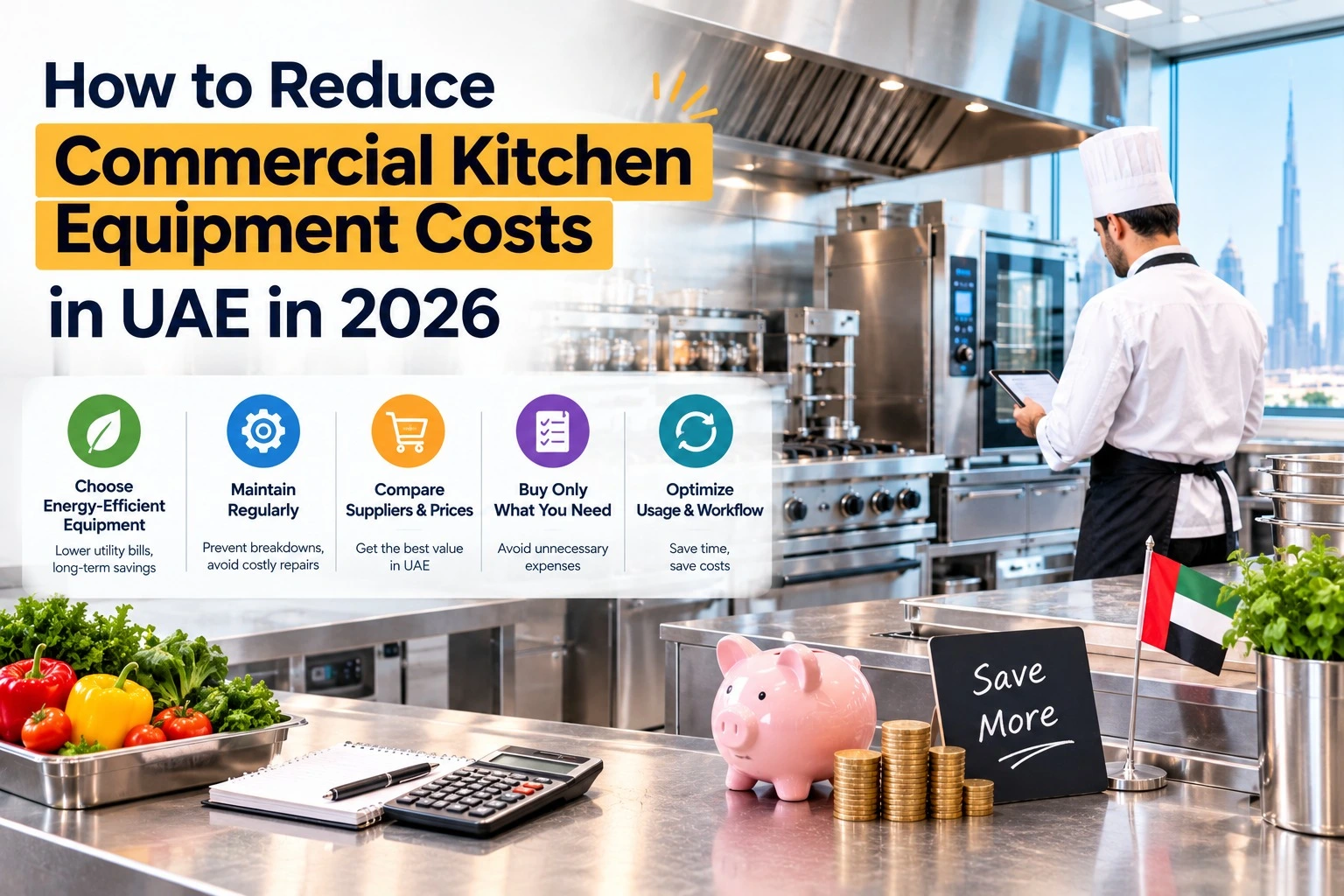
Quick answer: The biggest commercial kitchen equipment cost reductions in the UAE in 2026 don't come from the purchase price — they come from cutting the operating costs that run for years after: energy consumption (often the single largest controllable cost, driven by ambient-rated compressors and inverter technology), preventive maintenance (which can cut breakdown and replacement costs by more than it costs to run), and right-sizing equipment to actual kitchen volume instead of over-specifying "to be safe." Operators who combine correct UAE climate-class specification, a maintenance contract, and smarter procurement timing typically cut total 5-year equipment cost by 20–35% compared to those optimizing for purchase price alone.
Table of Contents
- The Short Answer: Where the Real Savings Are
- Why Equipment Costs Behave Differently in the UAE
- The 7 Biggest Levers for Reducing Equipment Costs
- Lever 1: Get the Ambient Temperature Rating Right From the Start
- Lever 2: Cut Energy Consumption, Not Just Purchase Price
- Lever 3: Preventive Maintenance vs. Reactive Repair
- Lever 4: Right-Size Equipment to Actual Volume
- Lever 5: Smarter Procurement — Timing, Bundling, and Quotes
- Lever 6: Refurbished and Strategic Used Purchasing
- Lever 7: Extend Equipment Lifespan Through Operating Discipline
- What Actually Drives Total Equipment Cost in a UAE Kitchen?
- Cost Reduction Potential by Category
- A Practical 2026 Cost Reduction Action Plan
- What NOT to Cut Costs On
- Common Cost-Cutting Mistakes That Backfire
- Conclusion: Where to Focus First
- Frequently Asked Questions (FAQ)
The Short Answer: Where the Real Savings Are
Where UAE Operators Actually Save Money — Ranked by Impact
| Cost Reduction Lever | Typical 5-Year Savings Impact | Effort to Implement |
| Correct ambient/climate-class specification | High — avoids 20–35% excess energy use and early failure | Low — a specification decision at purchase time |
| Preventive maintenance contract | High — reduces breakdown frequency and extends equipment life | Low-to-moderate — ongoing but predictable cost |
| Inverter/energy-efficient equipment | High on continuously-run units (refrigeration, ice) | Low — a purchase-time decision |
| Right-sizing to actual volume | Moderate-to-high — avoids oversized capital and energy cost | Moderate — requires a proper capacity audit |
| Smarter procurement (quotes, timing, bundling) | Moderate — one-time purchase price reduction | Low — mainly process discipline |
| Refurbished/strategic used purchasing | Moderate — 25–50% savings on eligible categories | Moderate — requires inspection and category judgment |
| Staff training on correct equipment use | Moderate — reduces misuse-driven breakdowns and energy waste | Low — ongoing training investment |
Why Equipment Costs Behave Differently in the UAE
UAE commercial kitchen equipment cost structure is genuinely different from cooler, cheaper-electricity markets, which is why cost-reduction strategies that work elsewhere don't always translate directly here. Three UAE-specific factors change the math: ambient temperatures regularly exceeding 40°C mean compressors and cooling systems work harder and consume more energy than identical equipment running in a temperate market; DEWA commercial electricity tariffs mean that energy consumption differences between equipment specifications translate into larger absolute AED costs than in markets with cheaper power; and UAE heat accelerates component wear on anything with a compressor or motor, meaning maintenance and replacement cycles run faster here than equipment manufacturer defaults (often set for temperate markets) would suggest.
This means the single biggest UAE-specific cost reduction opportunity isn't negotiating a better purchase price — it's eliminating the hidden operating cost penalty that comes from equipment specified for the wrong climate.
The 7 Biggest Levers for Reducing Equipment Costs
The sections below cover each lever in detail. Together, they represent the full range of places UAE operators can realistically reduce commercial kitchen equipment cost — from the specification decision at purchase through to how the equipment is operated and maintained for years afterward.
Lever 1: Get the Ambient Temperature Rating Right From the Start
What it is: Specifying refrigeration, freezing, and other compressor-driven equipment with a climate class rated for actual UAE ambient conditions, not a standard or sub-tropical rating built for cooler markets.
Why it saves money: A unit rated only to ST class (38°C) or lower, installed in a UAE kitchen reaching 40°C+, runs its compressor continuously under thermal stress — consuming 20–35% more electricity than rated and failing at roughly two to three times the rate of a correctly specified T-class unit. This single specification decision, made once at purchase time, is the largest lever available for reducing both energy cost and premature replacement cost.
Climate Class Quick Reference
| Climate Class | Ambient Range | UAE Suitability |
| ST (Sub-Tropical) | Up to 38°C | ⚠️ Marginal, indoor air-conditioned only |
| T (Tropical) | Up to 43°C | ✅ Minimum for most UAE kitchens |
| T+ (High Ambient) | Up to 50°C | ✅ Required for outdoor/un-air-conditioned locations |
How to action it: Request the climate class in writing for every compressor-driven purchase, and treat T-class as the non-negotiable floor for any indoor UAE kitchen installation.
Lever 2: Cut Energy Consumption, Not Just Purchase Price
What it is: Choosing inverter-compressor and other energy-efficient equipment variants, which modulate output to match demand rather than cycling fully on and off.
Why it saves money: At UAE DEWA commercial rates, inverter technology typically reduces energy consumption by 20–35% on continuously-run equipment — refrigeration, freezers, ice machines, and display units — with the efficiency premium usually paying for itself within 18–36 months, then generating pure savings for the remaining equipment life.
Energy Efficiency Savings by Equipment Type (UAE)
| Equipment | Typical Energy Saving with Inverter Tech | Approx. Payback Period |
| Commercial refrigeration/freezers | 20–35% | 18–36 months |
| Ice machines | 15–25% | 18–30 months |
| Walk-in cold rooms | 20–30% | 24–40 months |
| Multi-deck display units | 20–35% | 20–36 months |
How to action it: For any equipment that runs more than 12 hours a day, specifically ask suppliers whether an inverter-equipped version is available, even if it costs more upfront — run a simple payback calculation before dismissing it on price alone.
Lever 3: Preventive Maintenance vs. Reactive Repair
What it is: A scheduled maintenance program (cleaning condenser coils, checking seals, calibrating thermostats, inspecting electrical connections) versus waiting for equipment to fail and repairing reactively.
Why it saves money: UAE operators with annual maintenance contracts (AMCs) consistently report lower failure rates and longer compressor lifespans than those servicing equipment only when problems appear. Reactive repair also carries hidden costs preventive maintenance avoids entirely: emergency callout premiums, lost stock from a failure that happens overnight or over a weekend, and the accelerated wear that comes from running a degrading unit (worn seals, dirty condensers) for months before a breakdown forces attention.
Preventive vs. Reactive Maintenance Cost Comparison (Illustrative, per Refrigeration Unit)
| Approach | Annual Cost (AED) | 5-Year Failure Risk | Hidden Costs |
| Preventive (AMC) | 800 – 2,000 | Low | Predictable, budgetable |
| Reactive only | 0 (until failure) | High | Emergency callout premiums, stock loss, accelerated wear |
How to action it: Budget AMC cost into equipment planning from day one, not as an optional add-on — it's consistently cheaper than the reactive-repair alternative over any multi-year horizon.
Read more: For a detailed breakdown of kitchen equipment costs and budgeting tips, read this blog on budgeting for kitchen equipment in the UAE.
Lever 4: Right-Size Equipment to Actual Volume
What it is: Specifying equipment capacity based on a real calculation of covers, turnover, and product volume, rather than defaulting to the largest unit that fits the available space "to be safe."
Why it saves money: Oversized capacity means paying more upfront, consuming more energy to run a larger compressor or cooking surface than needed, and tying up capital that could fund other parts of the business. This is a common first-time-operator mistake — over-speccing out of uncertainty rather than from an actual demand calculation.
How to action it: Calculate actual daily volume per product category (using covers, turnover, and realistic peak-season buffer) before specifying capacity, rather than working backward from available floor space or a supplier's largest in-stock model.
Lever 5: Smarter Procurement — Timing, Bundling, and Quotes
What it is: Using UAE market timing, multi-item bundling, and competitive quoting to reduce purchase price without compromising specification.
Why it saves money: UAE suppliers consistently offer better per-unit pricing on bundled multi-item orders than single-item purchases, and requesting a minimum of two to three competing quotes — while telling suppliers you're doing so — reliably produces sharper pricing. Post-summer (September–October) and trade show periods also tend to offer softer pricing as suppliers clear stock or chase show-driven volume.
How to action it: Write a full specification sheet first (so price comparisons are apples-to-apples), request at least three quotes for anything above AED 5,000, and bundle related purchases into a single supplier relationship where possible.
Lever 6: Refurbished and Strategic Used Purchasing
What it is: Buying refurbished equipment — inspected, serviced, and sold with some warranty by a reputable UAE refurbisher — for categories where this represents genuine value, rather than defaulting to new across the board.
Why it saves money: Refurbished equipment typically costs 25–50% less than new while still carrying some warranty and service history, making it the strongest real value tier for many UAE operators on a constrained budget. Raw used equipment (bought unseen, no warranty) can save even more but carries meaningfully higher risk, particularly for refrigeration where UAE-heat compressor wear is hard to assess externally.
How to action it: Reserve new-only purchasing for revenue-critical, customer-facing, or compliance-sensitive equipment (primary refrigeration, blast chillers). Consider refurbished secondary or backup equipment, and treat raw used equipment as acceptable only for genuinely non-critical, backup, or supplementary use.
Lever 7: Extend Equipment Lifespan Through Operating Discipline
What it is: Operating practices that extend the working life of equipment already purchased — proper ventilation clearance, correct door seal maintenance, avoiding equipment misuse, and basic staff training on correct operation.
Why it saves money: Equipment lifespan in the UAE is significantly affected by how it's operated day to day, not just how it was specified at purchase. Restricted ventilation clearance, worn door seals left unreplaced, and basic operational misuse (overloading, incorrect defrost cycles, equipment positioned next to heat sources) all accelerate wear regardless of original equipment quality.
Low-Cost Operating Practices That Extend Equipment Life
| Practice | Why It Matters |
| Maintain 150mm+ ventilation clearance around compressor units | Restricted airflow is a leading cause of premature compressor failure |
| Replace worn door seals and gaskets promptly | Worn seals force compressors to run continuously, wasting energy and accelerating wear |
| Position equipment away from heat sources (ovens, fryers, direct sun) | Adjacent heat significantly increases compressor workload |
| Train staff on correct loading and operation | Reduces misuse-driven breakdowns and early failures |
| Clean condenser coils monthly | Dust and grease buildup in UAE environments reduces heat rejection efficiency |
What Actually Drives Total Equipment Cost in a UAE Kitchen?
5-Year Total Cost of Ownership Breakdown — Typical UAE Commercial Refrigeration Unit
| Cost Element | % of 5-Year Total Cost (Typical) |
| Purchase price | 25–35% |
| Energy consumption | 30–40% |
| Maintenance | 10–15% |
| Failure/replacement risk | 10–25% (highly dependent on specification quality) |
Purchase price is consistently a smaller share of total 5-year cost than most first-time buyers assume — energy consumption alone is usually the largest single line item, which is precisely why specification and energy efficiency decisions matter more for cost reduction than purchase price negotiation alone.
Cost Reduction Potential by Category
Realistic Cost Reduction Potential by Equipment Category
| Category | Primary Cost Reduction Lever | Realistic 5-Year Savings |
| Refrigeration & freezing | Correct T-class rating + inverter technology | 25–40% vs. underspecified equivalent |
| Cooking equipment | Right-sizing + preventive maintenance | 10–20% |
| Warewashing | Energy-efficient models + water-saving features | 10–25% |
| Ice machines | Inverter technology + correct sizing | 15–30% |
| Ventilation/extraction | Correct initial specification (avoids costly retrofit) | Primarily avoids one-time overspend, not recurring |
A Practical 2026 Cost Reduction Action Plan
- Audit existing equipment — identify any units running without confirmed T-class ambient rating; these are the highest-priority targets for review or replacement.
- Put a preventive maintenance contract in place for all compressor-driven equipment if one doesn't already exist.
- Run a right-sizing check against actual current volume data, not opening-day assumptions — many operators discover they're running oversized capacity once real demand data exists.
- Request competing quotes on any planned 2026 equipment purchases, with a full written specification sheet, before approaching a single supplier.
- Evaluate refurbished options for any planned secondary or backup equipment purchases.
- Review ventilation clearance and door seal condition across existing equipment — both are low-cost fixes with meaningful energy and lifespan impact.
- Train staff on correct equipment loading, defrost cycles, and basic daily care as part of standard onboarding.
What NOT to Cut Costs On
Cost reduction in UAE commercial kitchens has real limits, and cutting in the wrong places creates larger costs later.
Don't cut costs on:
- Ambient temperature rating — this is never the place to save money; the energy and failure cost consequences consistently exceed the upfront saving
- Blast chilling capability where HACCP requires it — this is a compliance requirement, not a discretionary cost
- Food-grade material compliance — DM inspection failures cost more than compliant materials
- Preventive maintenance on revenue-critical equipment — reactive-only maintenance is consistently more expensive over any multi-year horizon
- Local UAE service and parts support — an unsupported "deal" becomes expensive the first time something breaks
Common Cost-Cutting Mistakes That Backfire
| Mistake | Why It Backfires |
| Buying the cheapest available compressor-driven equipment | Non-tropicalized units cost more in energy and early replacement than the upfront saving |
| Skipping maintenance contracts to save monthly cost | Reactive repair and stock-loss costs typically exceed AMC cost over a multi-year period |
| Oversizing equipment "to be safe" without a capacity calculation | Wastes both capital and ongoing energy cost on unused capacity |
| Buying used refrigeration without inspection | UAE-heat compressor wear is invisible without proper assessment; failure risk often exceeds the savings |
| Delaying equipment replacement past its efficient working life | Aging units consume disproportionately more energy and fail more often as they approach end-of-life |
Conclusion: Where to Focus First
The biggest commercial kitchen equipment cost reductions available to UAE operators in 2026 aren't found in harder price negotiation — they're found in specification discipline and operating practices that reduce the far larger energy and failure costs that accumulate over an equipment's working life. Getting the ambient temperature rating right, committing to preventive maintenance, and right-sizing capacity to actual demand together represent the highest-impact, lowest-effort cost reduction opportunity most UAE operators haven't fully captured. Procurement tactics — competitive quoting, bundling, smart timing, refurbished purchasing — then compound those savings further on top.
The practical starting point for any UAE operator reviewing 2026 equipment costs: audit existing compressor-driven equipment for confirmed T-class rating first, since that single check typically reveals the largest, most addressable cost leak in the entire kitchen.