
Quick Answer
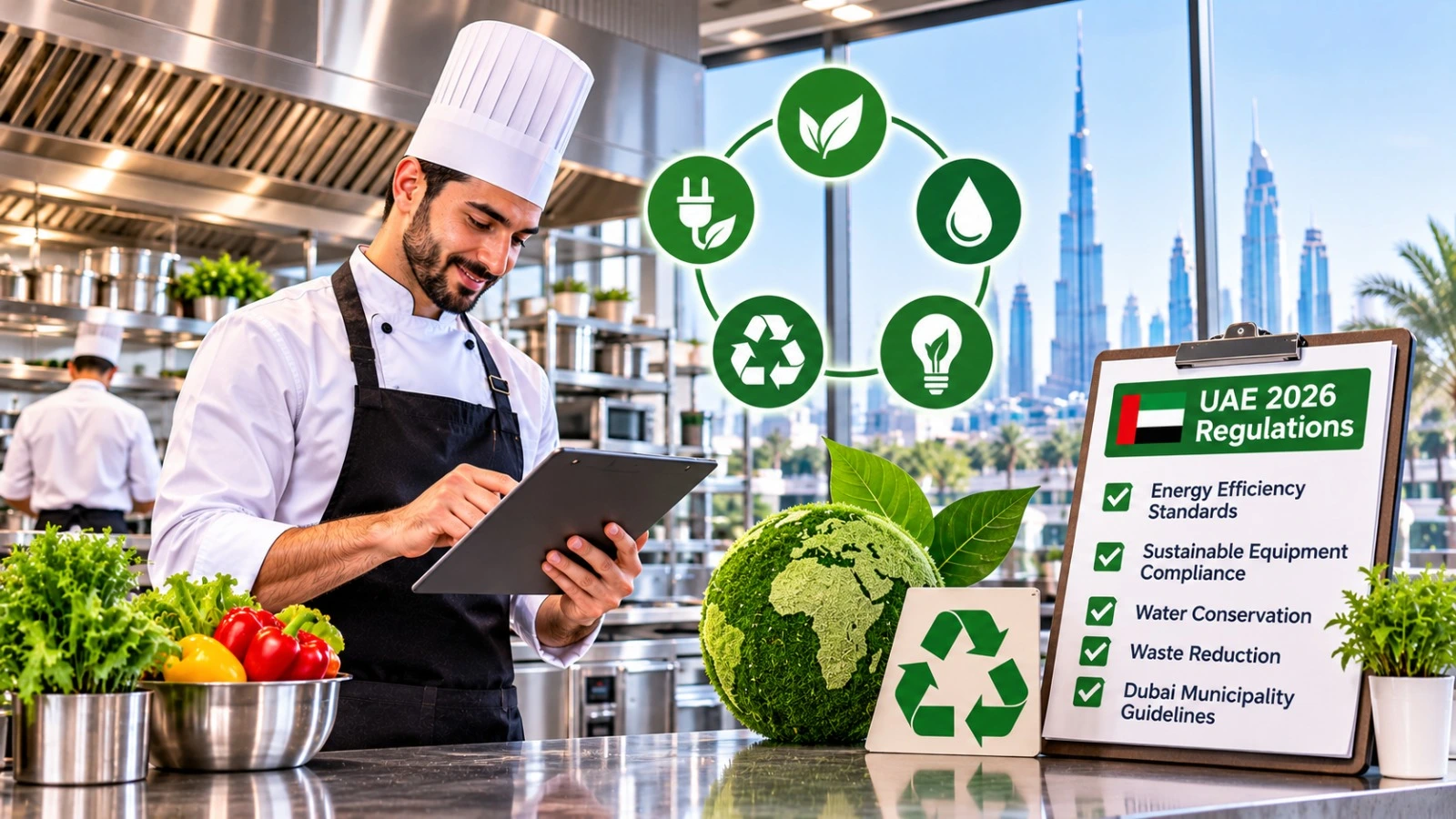
There is no single UAE law that defines or certifies "sustainable commercial kitchen equipment." Sustainability is regulated indirectly, through five overlapping regimes that affect what you buy and how you operate in 2026:
- Single-use plastics rules (Dubai's final phase took effect on 1 January 2026), which affect packaging, tableware, and how much dishwashing capacity you need.
- Grease and used cooking oil rules (Dubai Municipality requires grease interceptors and licensed collection of fats, oils, and grease), which affect kitchen drainage, fryers, and waste contracts.
- The federal climate law (Federal Decree-Law No. 11 of 2024, in force since 30 May 2025), which creates emissions measurement and reporting obligations and makes energy, gas, and refrigerant data more important.
- The HFC phase-down under the Kigali Amendment (UAE ratified in April 2024), which pushes new refrigeration toward low-GWP refrigerants.
- Product conformity and energy labeling (ECAS/MoIAT), where the UAE star label for refrigerators covers household appliances, not commercial units.
What to do as a buyer: choose low-GWP refrigeration, efficient and metered equipment, water-efficient dishwashing sized for reusables, properly sized grease management, and suppliers who provide conformity documents, spare parts, and local service. Keep energy, gas, water, refrigerant, oil, and waste records, because they support both compliance and cost control.
Note: This guide summarizes regulations as reported by government coverage, law-firm and compliance publications, and industry sources, and some details differ between sources. Where claims could not be confirmed, they are flagged. Confirm requirements for your premises with Dubai Municipality (or your emirate's authority), the Ministry of Climate Change and Environment (MOCCAE), and the Ministry of Industry and Advanced Technology (MoIAT) before making decisions.
Key Facts at a Glance
- Dubai's single-use plastics ban was phased in from 2024 to 1 January 2026, when plastic cups and lids, cutlery, food containers, and plates were added.
- Dubai Municipality requires grease traps (interceptors) for food establishments, with cleaning by licensed providers, and used cooking oil must not go down the drain.
- Federal Decree-Law No. 11 of 2024 on climate change effects entered into force on 30 May 2025, with a one-year transition period reported to end on 30 May 2026 unless extended.
- Refrigerant choice is the clearest equipment-level sustainability issue: R290, R600a, and CO₂ are low-GWP options, while R404A has a GWP of about 3,922.
- The UAE energy efficiency label (1–5 stars) for refrigerating appliances covers household products up to 1,500 litres, and the updated regulation excludes commercial equipment.
- Sustainable equipment usually means lower energy, water, and refrigerant impact over its life, plus durability and repairability.
Table of Contents
- Introduction
- What "Sustainable Commercial Kitchen Equipment" Actually Means
- The 2026 Regulatory Landscape at a Glance
- Regime 1: Single-Use Plastics
- Regime 2: Grease, Used Cooking Oil, and Waste Contractors
- Regime 3: The Federal Climate Law and Emissions Reporting
- Regime 4: Refrigerants and the HFC Phase-Down
- Regime 5: Product Conformity and Energy Labels
- Claims to Verify Before You Rely on Them
- Equipment Category Guide: What to Buy and What to Ask
- Sustainability and Compliance Data to Keep
- Sustainable Equipment and Your Budget
- Decision Rules: If You Are X, Do Y
- Questions to Ask Your Supplier
- Compliance Checklist
- What Might Change Next
- Final Thoughts
- Frequently Asked Questions
For UAE restaurants, hotels, cafés, and cloud kitchens, sustainability is no longer only a branding choice. Packaging rules, grease management requirements, climate reporting, and refrigerant commitments now shape equipment decisions and daily operations. This guide explains which rules affect commercial kitchen equipment in 2026, which are clear and which are uncertain, and how to buy and operate in a way that supports both compliance and lower running costs.
What "Sustainable Commercial Kitchen Equipment" Actually Means
In practice, sustainable equipment is equipment that reduces environmental impact and operating cost across its life, including:
- Lower energy use, for example inverter compressors, efficient ovens and fryers, LED lighting, and induction where suitable
- Low-GWP refrigerants such as R290, R600a, or R744 (CO₂)
- Water efficiency, such as low litres-per-rack dishwashers and efficient ice machines
- Reduced waste heat, which lowers cooling load in hot kitchens
- Durability and repairability, including stocked spare parts and local service
- Resource tracking, such as metering, temperature logging, and oil monitoring
- Second-life options, including quality refurbished equipment and proper end-of-life refrigerant recovery
Because there is no mandatory UAE "sustainable equipment" certification for commercial kitchens that I could find, buyers should rely on measurable specifications rather than marketing terms such as "eco" or "green."
The 2026 Regulatory Landscape at a Glance
| Regime | Authority | Key Date or Status | Equipment and Operations Impact |
| Single-use plastics | Dubai Municipality (and federal measures, see below) | Final Dubai phase effective 1 January 2026 | Packaging, tableware, delivery stations, dishwashing capacity |
| Grease interceptors and used cooking oil | Dubai Municipality | Ongoing requirement | Drainage design, fryers and filtration, waste contracts |
| Federal climate law | MOCCAE | Decree-Law 11 of 2024, in force 30 May 2025 | Emissions data, energy and gas metering, refrigerant leakage records |
| HFC phase-down | MOCCAE (Kigali) | UAE ratified April 2024; freeze 2028 | Refrigerant choice for new equipment and servicing |
| Product conformity and labels | MoIAT / ECAS | In force | Documentation for electrical equipment; household-only star label |
Regime 1: Single-Use Plastics
What happened: Dubai phased out single-use plastics in stages. Single-use plastic bags were banned from 1 January 2024 and all single-use bags from 1 June 2024. From 1 January 2025, polystyrene (Styrofoam) cups and food containers, plastic stirrers, straws, and table covers were banned. The final phase took effect on 1 January 2026, adding single-use plastic cups and lids, cutlery, food containers, and plates.
A note on federal rules: several compliance publications describe a federal single-use plastics measure taking effect on 1 January 2026, but the details and legal basis are described differently across sources. Confirm the current position for your emirate with the relevant authority.
Why it matters for equipment:
- Reusable tableware and cutlery increase dishwashing load, so check your dishwasher's real throughput. See our guide on undercounter versus hood-type dishwashers.
- Delivery and takeaway stations need space and storage for compliant packaging.
- Beverage equipment and dispensers may need to support reusable or compliant cups and lids.
- Cloud kitchens are covered because they rely heavily on disposable packaging.
Regime 2: Grease, Used Cooking Oil, and Waste Contractors
What the rules say (as reported):
- Dubai Municipality requires food establishments to install approved grease traps or interceptors that separate fats, oils, and grease before wastewater reaches the sewer.
- Cleaning and waste removal should be done by licensed providers. One compliance guide reports that these providers must be registered on Dubai Municipality's FoodWatch platform and use approved, GPS-tracked vehicles.
- Used cooking oil must not be poured down the drain. It should be stored in sealed containers and collected by a licensed used cooking oil contractor, often with documentation of collection.
Why it matters for equipment:
- Fryers: choose models with filtration and accurate temperature control to extend oil life and reduce oil waste. See our guide on choosing a commercial fryer.
- Drainage and layout: grease trap sizing and location should be planned during design and approval, not after equipment is installed.
- Hoods and exhaust: grease filters and collectors are part of the ventilation system and need regular cleaning.
- Waste contracts: set up licensed collection for used oil and food waste before opening.
Regime 3: The Federal Climate Law and Emissions Reporting
What the law is: Federal Decree-Law No. 11 of 2024 on the Reduction of Climate Change Effects was issued on 28 August 2024 and entered into force on 30 May 2025. Law-firm and compliance summaries describe it as requiring entities with greenhouse gas emissions sources, including free zones, to measure, report, and keep records of emissions in the formats and timelines set by MOCCAE, with a one-year transition period reported to end on 30 May 2026 unless extended.
What is uncertain: how the reporting requirements apply in practice to a small restaurant or café (for example, which sources and thresholds apply, and what formats are required) is determined by MOCCAE and related implementing rules. One vendor publication mentions penalties of up to AED 2 million, but I could not verify that figure from official text, so confirm penalties with the authority or a legal adviser.
Why it matters for equipment:
- Energy, gas, and refrigerant records become more valuable. Gas use contributes to direct emissions, and refrigerant leakage counts as well.
- Metering and monitoring (energy sub-metering, temperature and alarm logging) make data collection easier.
- Efficient, low-GWP equipment reduces both your emissions and your costs.
What to do: ask your landlord, accountant, or sustainability adviser whether your premises fall under reporting, and start capturing basic data (electricity, gas, refrigerant top-ups, oil and waste volumes) now.
Regime 4: Refrigerants and the HFC Phase-Down
The UAE ratified the Kigali Amendment in April 2024 and, as a Group 2 country, must freeze HFC consumption in 2028 and reduce it by 85% by 2047. For buyers, this means:
- Prefer R290, R600a, or R744 for new equipment where appropriate
- Be cautious about buying new equipment designed around R404A (GWP about 3,922)
- Ask who services the refrigerant locally, since hydrocarbon systems need trained technicians
- Keep leak and service logs
See our dedicated guide on commercial refrigeration energy efficiency standards and regulations for the detailed picture.
Regime 5: Product Conformity and Energy Labels
- Regulated electrical products generally need ECAS conformity to be traded in the UAE, and buying from an authorized local distributor usually shifts that burden to the supplier.
- The UAE's mandatory 1–5 star energy label for refrigerating appliances (UAE.S 5010-3:2023) covers household appliances up to 1,500 litres and excludes commercial or industrial units. Ask your supplier what documentation applies to a commercial model.
- Because there is no mandatory commercial energy label, compare stated energy consumption (kWh per 24 hours) and test conditions instead.
Claims to Verify Before You Rely on Them
Some compliance and supplier publications make strong statements about 2026 requirements that I could not confirm from official sources. Treat these as unverified until you have confirmed them with the authority:
- Claims that restaurants must submit annual waste audit reports or run composting programs as part of 2026 food safety rules
- Specific fine amounts for grease, oil, plastics, or climate reporting violations
- Claims that a federal single-use plastics ban applies in exactly the form and scope described by some publications
- Claims of fixed energy savings or payback periods for specific equipment types
Where a supplier or consultant cites a rule, ask for the regulation number or official source.
Equipment Category Guide: What to Buy and What to Ask
| Equipment | Sustainable Specification to Look For | Regulatory Link | Ask Your Supplier |
| Refrigeration | Low-GWP refrigerant, inverter compressor, EC fans, high-ambient rating | HFC phase-down, climate reporting | Refrigerant, GWP, kWh per 24 hours, climate class, local service |
| Ovens and cooking | Efficient models, programmable controls, suitable size, induction where it fits | Climate reporting, energy cost | Energy use data, power and cookware requirements |
| Fryers | Filtration, accurate thermostat, oil monitoring | Used cooking oil and grease rules | Filtration options, oil life data, recovery time |
| Dishwashers | Low litres per rack, heat recovery options, water treatment compatibility | Single-use plastics (reusables increase load), water use | Litres per rack, kW, cycle times, detergent dosing |
| Ice and beverage equipment | Efficient ice machines, low-GWP refrigerant, water filtration | HFC phase-down, water management | Water and energy per kg of ice, refrigerant type |
| Ventilation and extraction | Properly sized hoods, grease filters, demand-based controls where approved | Grease rules, approvals | Airflow, filter cleaning schedule, approval requirements |
| Grease management | Correctly sized, approved interceptor, accessible for cleaning | Dubai Municipality grease requirements | Sizing basis, approvals, licensed servicing |
| Packaging and delivery stations | Space for compliant packaging, reusable options | Single-use plastics rules | Storage and workflow design |
| Utilities and monitoring | Sub-metering, temperature logging, leak logs | Climate law, food safety | Data export options, subscription costs |
Sustainability and Compliance Data to Keep
Keeping simple, organized records supports compliance, audits, landlord and franchise requests, and cost control.
- Energy: electricity and gas bills, and sub-meter readings if available
- Refrigerants: equipment refrigerant type and charge, service and leak-check records
- Water: utility bills and dishwasher or ice machine consumption data
- Oil and grease: used cooking oil collection records, grease trap servicing records
- Waste: licensed contractor agreements and collection records
- Packaging: supplier declarations showing compliant packaging
- Equipment documents: ECAS or conformity documents, spec sheets, warranty and service records
- Food safety: temperature logs and calibration certificates
Sustainable Equipment and Your Budget
- Efficient and low-GWP equipment may cost more upfront but can reduce energy, water, and service costs over its life, so compare lifetime cost, not sticker price.
- Reusable tableware may require extra dishwashing capacity, so budget for a suitably sized machine and water treatment.
- Metering and monitoring add some cost but reduce the effort of collecting data.
- Refurbished equipment can lower upfront cost and extend equipment life, but verify refrigerant type, condition, and service support.
- For baseline pricing, see our guides on restaurant equipment costs, kitchen equipment budgeting, and commercial refrigerators in the UAE.
Decision Rules: If You Are X, Do Y
- If you are buying refrigeration, choose a low-GWP model with stated kWh per 24 hours and local service.
- If you plan to use reusable tableware, size your dishwasher for the added load.
- If you run fryers, choose filtration and set up a licensed used cooking oil contract before opening.
- If you are designing a new kitchen, plan grease interceptor sizing and location during layout approval.
- If you operate multiple outlets or serve corporate clients, ask whether climate reporting applies and start collecting data now.
- If a supplier makes sustainability claims, ask for datasheet figures and an official source.
- If you are buying used or refurbished equipment, verify refrigerant type, condition, and local parts support.
- If you cannot get kWh, litres-per-rack, or conformity information, choose another supplier.
Questions to Ask Your Supplier
- What refrigerant does this model use, and what is its GWP?
- What is the stated energy consumption (kWh per 24 hours or kW rating) under which test conditions?
- What are the water consumption figures (for example, litres per rack or per kg of ice)?
- Is this model ECAS-registered or conformity-certified for the UAE, and can you provide the reference?
- Who services this equipment locally, and are spare parts stocked in the UAE?
- Does it support temperature logging, energy monitoring, or data export, and are there subscription fees?
- What is the expected lifespan, warranty, and end-of-life refrigerant recovery process?
- Do you supply or recommend compliant packaging and licensed oil and waste collection partners?
Compliance Checklist
Confirm you can answer "yes" to each:
- Does new refrigeration use a low-GWP refrigerant, and do I know its kWh per 24 hours?
- Is my packaging and tableware compliant with the current single-use plastics rules?
- Do I have an approved grease interceptor and a licensed servicing and oil collection arrangement?
- Have I checked whether climate reporting obligations apply to my business?
- Am I capturing energy, gas, refrigerant, oil, and waste data?
- Is my dishwashing capacity enough for reusables?
- Does each regulated electrical item have ECAS or conformity documentation where applicable?
- Are all items on my submitted equipment list and approved layout?
- Do I have temperature logs, calibration certificates, and service records?
- Have I confirmed current requirements with the relevant authorities?
What Might Change Next
- Climate law implementing rules: reporting formats, thresholds, and enforcement for smaller businesses may become clearer.
- HFC implementation: quotas and permits may tighten ahead of the 2028 freeze.
- Packaging rules: further guidance on alternatives, exemptions, and enforcement may emerge.
- Energy standards for commercial refrigeration: none confirmed in the UAE, but this could change.
- Emirate differences: Dubai, Abu Dhabi, and other emirates may apply different details, and free zones may add their own requirements.
Because rules are still evolving, confirm current requirements before major purchases or contracts.
Final Thoughts
For UAE commercial kitchens in 2026, "sustainable equipment" is less about a label and more about a set of practical choices that align with real regulations: low-GWP refrigeration, efficient and metered equipment, water-efficient dishwashing sized for reusables, properly sized grease management, licensed oil and waste collection, and good records. Buy on measurable specifications, ask suppliers for official sources behind any claim, and keep the data that proves your compliance. Done well, the same choices that keep you compliant also reduce your energy, water, and waste costs.