
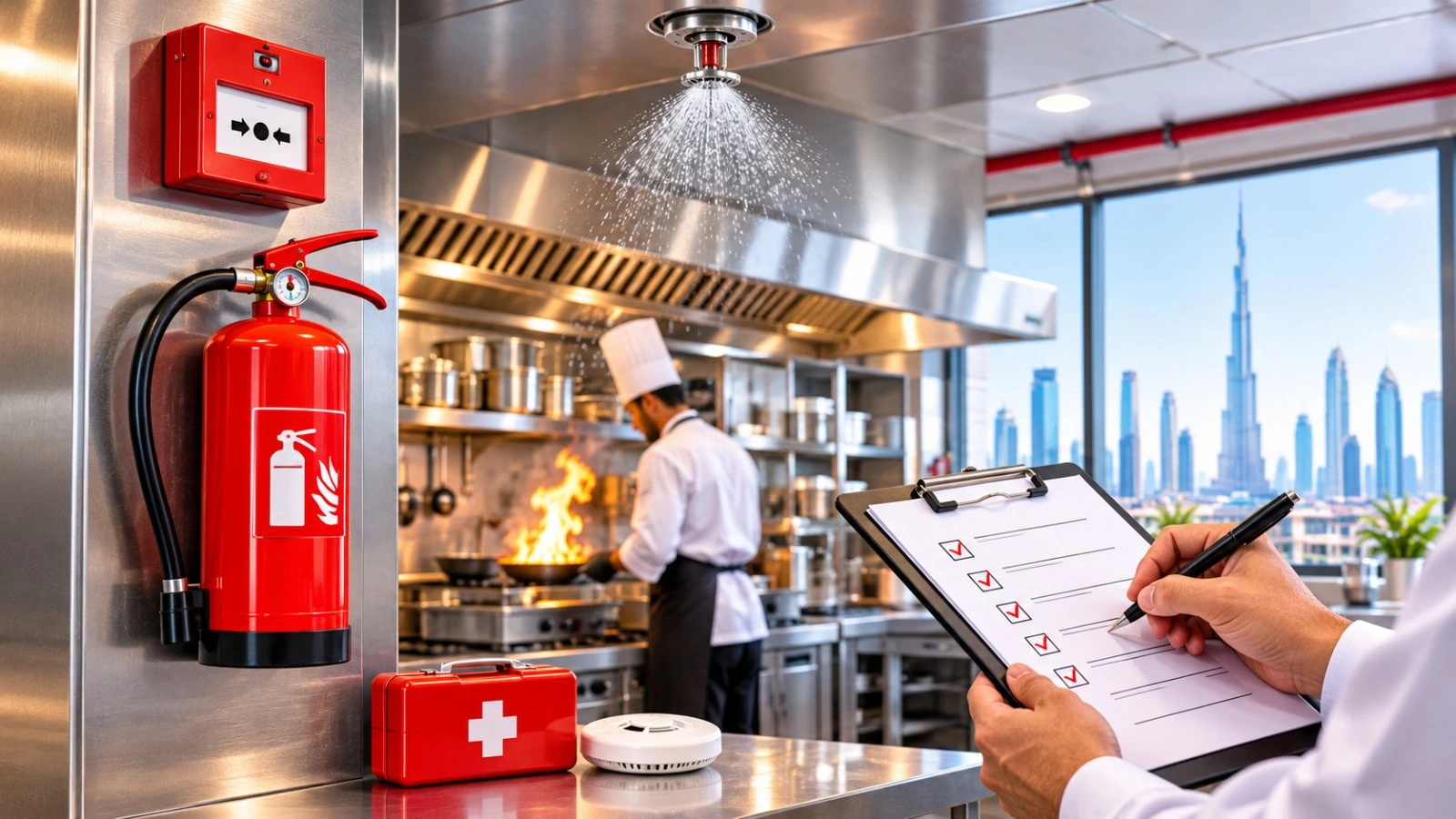
Quick answer: UAE restaurant kitchen fire safety is governed by the UAE Fire and Life Safety Code of Practice issued by the General Headquarters of Civil Defence (Ministry of Interior), enforced in practice by each emirate's Civil Defence authority. For a commercial kitchen, the essentials are: a compliant extraction hood and grease-filtered ductwork, an automatic wet-chemical fire suppression system over the cooking line (commonly specified to UL 300 or equivalent), correctly rated portable extinguishers, fire detection and alarm coverage, safe gas/LPG and electrical installations, clear exits with emergency lighting, and a written emergency plan with trained staff. Kitchen fire systems typically need Civil Defence-approved drawings, installation by an approved contractor, and inspection before opening and on renewal. Requirements vary by emirate, building, and cooking type, so confirm specifics with your local Civil Defence authority and your building's fire consultant before you design or buy.
This guide is general information, not legal or engineering advice. Fire codes are technical and change over time. Always confirm current requirements with Civil Defence and a licensed fire protection consultant.
Table of Contents
- The Short Answer: The 10 Fire Safety Essentials for a UAE Restaurant Kitchen
- Who Sets Fire Safety Standards for UAE Restaurants?
- Why Kitchen Fire Safety Matters More in the UAE
- What Are the Core Fire Safety Requirements for a Commercial Kitchen?
- Extraction Hoods, Ducts, and Grease Control
- Fire Suppression Systems Over the Cooking Line
- Portable Fire Extinguishers: What Kitchens Need
- Fire Detection, Alarms, and Sprinklers
- Gas and LPG Safety
- Electrical Safety in the Kitchen
- Solid Fuel, Tandoors, Charcoal Grills, and Shawarma Machines
- Exits, Emergency Lighting, and Evacuation
- Emergency Plans and Staff Training
- Cloud Kitchens, Mall Units, and Ventless Equipment
- The Approval and Inspection Process: What to Expect
- Inspection and Maintenance Schedule
- Fire Safety Cost Planning for UAE Operators
- What To Do If a Kitchen Fire Starts
- Common Fire Safety Mistakes in UAE Kitchens
- Fire Safety Compliance Checklist
- Conclusion: Treat Fire Safety as Part of the Design, Not an Add-On
- Frequently Asked Questions (FAQ)
The Short Answer: The 10 Fire Safety Essentials for a UAE Restaurant Kitchen
Kitchen Fire Safety Essentials at a Glance
| # | Essential | What It Does | Who Typically Signs It Off |
| 1 | Compliant extraction hood with grease filters | Captures grease-laden vapour at the source | Civil Defence / fire consultant / MEP designer |
| 2 | Fire-rated ductwork and clean-out access | Contains fire in the exhaust path and allows cleaning | Civil Defence / MEP |
| 3 | Automatic wet-chemical suppression system | Detects and extinguishes cooking-line fires, usually with fuel and power shut-off | Approved fire protection contractor |
| 4 | Correct portable extinguishers | First response for small fires | Civil Defence / approved supplier |
| 5 | Fire detection and alarm | Early warning for staff and building | Building fire consultant |
| 6 | Safe gas/LPG installation with shut-off | Prevents leaks and fuel-fed fires | Licensed gas contractor / Civil Defence |
| 7 | Safe electrical installation | Reduces ignition risk from overloaded or damaged circuits | Licensed electrical contractor |
| 8 | Clear exits, signage, and emergency lighting | Safe evacuation | Civil Defence / fire consultant |
| 9 | Written emergency plan and staff training | Ensures people know what to do | Management / Civil Defence |
| 10 | Scheduled inspection, cleaning, and maintenance records | Proves the system works and is maintained | Approved service provider |
Who Sets Fire Safety Standards for UAE Restaurants?
The foundation is the UAE Fire and Life Safety Code of Practice, published by the General Headquarters of Civil Defence, Ministry of Interior. The code's contents list includes a dedicated section on kitchens within its guidance on fire separation and protection of various rooms, alongside chapters on fire detection and alarm and fire protection systems. The code also references international standards, and its published material includes requirements such as providing portable extinguishers in line with its extinguisher tables and, as an additional annexure, a requirement that each facility prepare a specific emergency plan and inform occupants of their roles.
Enforcement and approvals are handled emirate by emirate:
Who Does What: UAE Fire Safety Authorities
| Authority | Role |
| General Headquarters of Civil Defence (Ministry of Interior) | Issues the national Fire and Life Safety Code of Practice |
| Emirate-level Civil Defence (for example Dubai Civil Defence and Abu Dhabi Civil Defence) | Reviews drawings, inspects installations, and issues approvals and certificates |
| Municipality / food safety authority (for example Dubai Municipality, ADAFSA) | Food safety licensing; fit-out approvals often run alongside fire approvals |
| Building owner / master developer | Often sets additional rules for tenant fit-outs, especially in malls and towers |
| Abu Dhabi EHS regulatory framework | Abu Dhabi has its own EHS fire prevention code of practice for employers and duty holders; where requirements conflict, the more stringent one applies |
International standards also shape kitchen fire design. Industry sources describe NFPA 96 (ventilation control and fire protection of commercial cooking operations) as the foundation for hood and duct practice in the region, with UL 300-style wet-chemical suppression commonly specified, and DW172 used by many consultants for hood airflow design. Whether and how these apply to your unit depends on your authority and building, so treat them as reference points your consultant will confirm, not as a substitute for local approval.
Why Kitchen Fire Safety Matters More in the UAE
Commercial kitchens are inherently high fire-risk spaces: hot oil, open flames, grease deposits, and continuous electrical load. UAE conditions raise the stakes:
- Dense, multi-storey buildings. Many restaurants sit in towers, malls, and mixed-use developments where a kitchen fire can threaten many occupants, so landlords and authorities scrutinise kitchens closely.
- High-heat environments. Ambient heat adds load to kitchen cooling and electrical systems, and heat-stressed equipment is more likely to fail.
- High-risk cuisines and equipment. Deep fryers, charcoal grills, tandoors, and shawarma machines are common in UAE restaurants and carry specific fire risks.
- Tight, fast fit-outs. Compact units and quick openings can tempt operators to treat extraction and suppression as late-stage items, which often causes delays and rework.
- Strict approval gates. You generally cannot open until fire approvals are in place, so a failed inspection directly delays revenue.
What Are the Core Fire Safety Requirements for a Commercial Kitchen?
Core Requirement Overview
| Area | What Is Generally Required or Expected | Notes |
| Extraction | Hood and duct system sized for the cooking equipment, with grease filtration | Design is usually by an MEP consultant using recognised standards |
| Ductwork | Fire-rated construction and cleaning access | Vendor guidance commonly cites a 2-hour rating; confirm with Civil Defence |
| Suppression | Automatic fixed system over cooking appliances, with fuel and power shut-off | Often UL 300 or LPCB-certified wet chemical; drawings approved by Civil Defence in Dubai and Abu Dhabi |
| Extinguishers | Portable extinguishers placed and rated per the code | Kitchens typically need extinguishers suited to cooking oils (commonly wet chemical, or "Class K"/F); confirm with Civil Defence |
| Detection and alarm | Detection suited to kitchens (often heat detection rather than smoke) | Building-level system design is by the fire consultant |
| Sprinklers | Required based on building classification and area | Depends on the building and occupancy |
| Gas / LPG | Compliant piping, regulators, shut-off valves, and storage | LPG cylinder siting and quantities are regulated |
| Electrical | Properly rated circuits, protection, and earthing | Use licensed contractors |
| Means of egress | Clear exits, signage, and emergency lighting | Applies to the whole unit, including kitchen |
| Emergency plan | A facility-specific emergency plan, with occupants informed of their roles | Published as a Civil Defence mandatory requirement for each facility |
Extraction Hoods, Ducts, and Grease Control
Grease is the main fuel in a kitchen fire. A hood and duct system captures vapour, filters grease, and carries exhaust out of the building, which is also why dirty ducts are a leading fire hazard.
Hood and Duct Fire Safety Points
| Topic | What to Know |
| Sizing | Exhaust rate depends on the equipment (fryers and solid-fuel appliances need higher rates). Consultants commonly use DW172 or code tables |
| Hood construction | Typically stainless steel, with proper overhang beyond the appliances |
| Grease filters | Baffle filters are standard; UV-C and water-mist systems are used for specific cooking types, including solid-fuel cooking |
| Ductwork | Fire-rated, with clean-out access at changes of direction; routes should be straight and as short as practical |
| Fans | Up blast centrifugal fans suitable for grease-laden exhaust, typically roof-mounted |
| Make-up air | Replacement air must be planned so the kitchen doesn't become over-negative, which can affect capture and flame behaviour |
| Cleaning | Hoods, filters, and ducts need scheduled cleaning by competent providers; frequency depends on cooking volume and fuel type |
Cleaning frequency: NFPA 96, commonly used as a reference, links inspection and duct cleaning frequency to cooking type and volume, with solid-fuel and high-volume cooking needing the most frequent attention. Many UAE operators clean filters weekly to monthly and have ducts professionally degreased on a regular schedule agreed with their provider and Civil Defence. Confirm the required interval for your kitchen rather than relying on a generic figure.
Fire Suppression Systems Over the Cooking Line
An automatic fire suppression system is the single most important active fire protection feature in a commercial kitchen. A typical system includes:
- Wet-chemical agent tanks designed for cooking oils and fats
- Nozzles positioned over fryers, grills, ranges, and in the hood plenum and duct
- Detection (often fusible links or heat detectors) that triggers discharge
- Manual pull station near an exit so staff can activate the system
- Shut-off interlocks that cut gas and electrical supply to cooking appliances when the system activates
Suppression System Planning Points
| Topic | What to Know |
| Approvals | Guidance for the region states Dubai and Abu Dhabi require Civil Defence-approved suppression drawings |
| Certification | Systems are commonly specified to UL 300 or LPCB-certified standards; check what your authority accepts |
| Design | Nozzle layout must match the actual appliance lineup; changing equipment later can invalidate coverage |
| Installation | Use an approved fire protection contractor |
| Service | Systems need periodic servicing by an approved provider; international practice commonly uses six-monthly inspection, but confirm your required interval |
| Access | Pull stations and control panels must be clearly visible and accessible |
| Equipment changes | If you add a fryer or move a grill, notify your supplier so the system can be re-designed and re-certified |
Portable Fire Extinguishers: What Kitchens Need
Portable extinguishers are the first response for small fires. Placement and ratings are set by the Fire and Life Safety Code's extinguisher requirements and your Civil Defence authority.
Kitchen Extinguisher Guidance
| Fire Type | Typical Extinguisher | Notes |
| Cooking oil and fat fires | Wet chemical (often called Class K or F) | Do not use water; it can spread burning oil |
| Ordinary combustibles (paper, wood, packaging) | Water or ABC dry powder, per code | Keep clear of the cooking line |
| Electrical equipment | CO2 or dry powder, per code | Cut power first where safe |
| Gas fires | Do not extinguish unless the supply is shut off | Shut off gas, evacuate, and call Civil Defence |
Placement tips: keep extinguishers visible, near exits and the cooking line but not so close that a fire blocks access, mounted at the right height, tagged and inspected, and serviced by an approved provider. Train staff to use them and to know when to leave instead.
Fire Detection, Alarms, and Sprinklers
Kitchens usually need detection suited to heat, steam, and cooking fumes. Smoke detectors in a kitchen tend to cause false alarms, so heat detectors are often used there. The Fire and Life Safety Code includes dedicated chapters on fire detection and alarm and on fire protection systems, and its published tables tie requirements such as sprinklers to building classification, area, and occupancy.
Practical points:
- Kitchen detection and alarm design is normally part of the building fire design by a fire consultant.
- Tenants in malls and towers usually connect to the building's fire alarm panel, with landlord and Civil Defence requirements for how.
- Sprinkler requirements depend on the building. Confirm with your landlord and fire consultant what the tenancy must provide.
- Test and log alarm checks as required.
Gas and LPG Safety
Gas-fired equipment is common in UAE restaurants, and gas leaks create explosion and fire hazards. The fire code material includes specific guidance on LPG, including storage, piping, shut-off arrangements, and cylinder installations.
Gas Safety Essentials
| Topic | Good Practice |
| Piping and fittings | Installed by a licensed contractor to the required standard, pressure-tested, and certified |
| Isolation | Clearly marked main shut-off valve that staff can reach quickly |
| Interlocks | Gas supply cuts automatically when the suppression system activates |
| Gas detection | Detectors where required, especially in enclosed spaces or basements |
| Cylinder storage | Follow the code on where LPG cylinders may be stored and in what quantities; never keep spare cylinders in the kitchen |
| Ventilation | Adequate ventilation in gas-fired areas |
| Inspection | Regular checks for leaks, damaged hoses, and worn regulators |
| Staff awareness | Everyone should know the smell of gas, the shut-off location, and the evacuation rule: no switches, no flames, leave and call for help |
Electrical Safety in the Kitchen
Electrical faults are a common ignition source, especially in hot, humid, grease-laden kitchens.
- Use licensed electricians and rated cables and fittings for kitchen conditions.
- Don't overload circuits or run equipment from extension leads or multi-plugs.
- Protect circuits with appropriate breakers and residual current devices.
- Keep water and electrical connections separated and use proper IP-rated enclosures where needed.
- Inspect cords, plugs, and sockets regularly and replace damaged items immediately.
- Make sure heavy equipment (combi ovens, dishwashers, blast chillers) has the circuit capacity it needs; confirm single- or three-phase requirements before purchase.
- Keep electrical panels clear and accessible.
Solid Fuel, Tandoors, Charcoal Grills, and Shawarma Machines
Several popular UAE cooking styles carry higher or different fire risks.
Higher-Risk Cooking Equipment
| Equipment | Main Fire Risk | Typical Considerations |
| Charcoal / solid-fuel grills | Sparks, embers, and heavy grease and soot loading in ducts | Specific exhaust design (for example water-mist or specialised filtration), more frequent cleaning, and careful ember and ash handling |
| Tandoors | Extreme radiant heat and fuel storage | Clearances, appropriate flue and exhaust design, and heat-resistant surroundings |
| Gas shawarma machines | Open flame, LPG supply, and grease dripping | Gas safety, grease collection, hood coverage, and suppression coverage |
| Deep fryers | Hot oil that can ignite | Suppression coverage, thermostat cut-outs, oil management, and no water near oil |
| Griddles and grills | Grease buildup | Regular cleaning and hood and filter maintenance |
Industry guidance on solid-fuel cooking in the Gulf highlights that these appliances need specialised exhaust and cleaning arrangements, so tell your designer and Civil Defence reviewer about them early.
Exits, Emergency Lighting, and Evacuation
- Keep exit routes clear at all times, including back-of-house corridors, delivery routes, and stair doors.
- Do not lock or obstruct fire exits during service.
- Install exit signs and emergency lighting as the code and your fire consultant require, and test them regularly.
- Make sure kitchen layouts allow staff to reach an exit without crossing the cooking line.
- Post evacuation plans where staff and guests can see them.
- Know your assembly point and make sure staff do too.
Emergency Plans and Staff Training
The Civil Defence emergency action plan guidance states that each facility must have a specific emergency plan prepared and that all occupants must be informed of their role in emergency management. For a restaurant, that means more than a laminated sheet.
A Practical Kitchen Emergency Plan Includes
| Element | What to Cover |
| Roles | Who calls Civil Defence, who shuts off gas and power, who leads evacuation, who accounts for staff and guests |
| Alarm and call procedure | How to raise the alarm and which number to call |
| Shut-off locations | Gas, electrical, and suppression pull-station locations |
| Evacuation routes | Primary and alternative routes and assembly point |
| Extinguisher use | Who is trained, and when not to fight a fire |
| Guest handling | How staff direct guests, including those with mobility needs |
| Drills | Regular drills and records |
| New staff | Fire safety induction for every new employee, before they work a shift |
Training topics: fire triangle basics, cooking oil fire response (never water), using the suppression pull station, using an extinguisher safely, gas leak response, evacuation, and good housekeeping to prevent fires. Keep training records; inspectors may ask for them.
Cloud Kitchens, Mall Units, and Ventless Equipment
Smaller formats face the same fire principles with extra constraints.
- Cloud kitchens: Shared facilities often have building-level extraction and suppression, but your tenancy may still need its own suppression coverage for your equipment. Confirm what the operator provides and what you must supply.
- Mall units: Landlords often impose strict fit-out rules, approved contractors, and design criteria on top of Civil Defence requirements. Get the landlord's design guidelines before you commit to equipment.
- Ventless equipment: Ventless fryers, ovens, and hoods can reduce ducting needs, but they are not exempt from fire safety. Acceptance depends on your authority, landlord, and menu, and suppression and detection requirements may still apply. Get written confirmation before buying.
- Compact kitchens: Tight spaces increase the importance of clearances, clean ducts, and clear exits.
The Approval and Inspection Process: What to Expect
Exact steps vary by emirate and building, but the process typically follows this shape:
Typical Approval Flow
| Stage | What Happens |
| 1. Design | Your MEP and fire consultants prepare hood, duct, suppression, detection, and egress drawings |
| 2. Landlord review | In malls and towers, the landlord reviews the design against building rules |
| 3. Civil Defence approval | Drawings are submitted for approval, with product certifications and equipment data (regional guidance notes UL, CE, LPCB-type certifications and airflow calculations are commonly requested) |
| 4. Installation | Approved contractors install hood, ducts, suppression, detection, and related systems |
| 5. Inspection and testing | Civil Defence inspects and tests the installed systems |
| 6. Certificates and licensing | Certificates are issued, supporting your trade licence and food safety approvals |
| 7. Ongoing compliance | Regular servicing, inspection, and renewals |
Planning tip: Start fire approvals early. Extraction and suppression are among the most common causes of delayed openings, because drawings, approvals, and installations take time and each stage can raise comments to fix.
Inspection and Maintenance Schedule
Fire Safety Maintenance Schedule (Indicative)
| Frequency | Task | Done By |
| Daily | Check cooking area is clean; wipe grease from hoods and surfaces; confirm exits are clear; ensure extinguishers are in place; switch off equipment at close | Kitchen staff |
| Weekly | Clean grease filters (more often for heavy frying or grilling); check pull station access; check gas hoses and connections visually | Kitchen staff |
| Monthly | Inspect extinguishers (tag, pressure, access); test emergency lighting where possible; check electrical cords and plugs | Supervisor / maintenance |
| Quarterly | Review duct and fan condition; run a staff fire drill | Maintenance / management |
| Six-monthly (commonly) | Suppression system inspection and service | Approved fire protection contractor |
| Annually | Extinguisher servicing; fire alarm testing; gas system inspection; professional hood and duct cleaning (more often for high-volume or solid-fuel cooking); review of the emergency plan | Approved contractors / management |
Intervals above are indicative and vary by system, authority, and kitchen type. Confirm the schedule with your service providers and Civil Defence.
Fire Safety Cost Planning for UAE Operators
Fire safety spending is a major part of kitchen fit-out cost, and it varies widely with kitchen size, cooking type, building requirements, and whether extraction infrastructure already exists.
Indicative Cost Considerations (Modelled Planning Ranges, Not Quotes)
| Item | Planning Notes |
| Hood, ducting, and fan | Often one of the largest kitchen fit-out lines; cost rises sharply with duct length, fire wrapping, and rooftop work |
| Suppression system | Priced by number of appliances and nozzle layout; get quotes from approved contractors |
| Fire wrap and duct enclosures | Added cost where ducts pass through building shafts |
| Detection and alarm connection | Depends on the building's system and landlord requirements |
| Extinguishers and signage | Relatively low cost but required |
| Training and drills | Low direct cost; high value |
| Servicing contracts | Recurring annual cost; get itemised quotes |
Ask for itemised quotes and compare at least two or three. Do not cut corners on certified systems or approved contractors; the cost of a failed inspection or a fire is far higher.
What To Do If a Kitchen Fire Starts
These are general safety principles; your own emergency plan and training take priority.
- Raise the alarm and alert everyone in the kitchen.
- Activate the suppression system if the fire is on the cooking line (use the manual pull station).
- Shut off gas and power to equipment if it's safe to do so.
- Call Civil Defence (the UAE emergency number for fire is 997) and give clear location details.
- Do not use water on cooking oil or electrical fires.
- Only fight a small fire if you are trained, the exit is behind you, and the fire is not spreading. Otherwise, leave.
- Evacuate guests and staff by the nearest safe exit and go to the assembly point.
- Do not re-enter until Civil Defence says it is safe.
Common Fire Safety Mistakes in UAE Kitchens
| Mistake | Why It's Dangerous | How to Avoid It |
| Leaving extraction and suppression until the end of fit-out | Delays opening and forces rework | Involve fire and MEP consultants at design stage |
| Changing equipment without updating suppression coverage | New appliances may be unprotected | Re-design and re-certify after any change |
| Skipping duct and hood cleaning | Grease buildup is a primary fire fuel | Schedule cleaning by competent providers and keep records |
| Using water on a grease fire | Spreads burning oil | Train staff on correct response and keep proper extinguishers |
| Blocked or locked exits | Prevents safe evacuation | Keep exits clear at all times, including during deliveries |
| Overloaded electrical circuits | Ignition risk | Use rated circuits and licensed electricians |
| Unsafe LPG storage | Explosion and fire risk | Follow code on cylinder siting and quantity |
| No staff training or drills | Panic and delay in an emergency | Train at induction and run regular drills |
| Assuming ventless equipment means no fire requirements | May still need suppression and approvals | Get written confirmation from authorities and landlord |
| Using unapproved contractors or uncertified products | Failed inspections and invalid systems | Use approved contractors and certified products |
Fire Safety Compliance Checklist
- [ ] Confirm fire requirements with your emirate's Civil Defence, your landlord, and a fire consultant before design
- [ ] Have hood, duct, suppression, and egress drawings prepared and approved
- [ ] Use approved contractors and certified products
- [ ] Confirm suppression coverage matches every appliance on the cooking line
- [ ] Install fuel and power shut-off interlocks linked to the suppression system
- [ ] Place correct extinguishers (wet chemical for cooking oils) and signage
- [ ] Confirm detection and alarm connection with the building system
- [ ] Have gas and LPG installations certified and cylinders stored as the code requires
- [ ] Keep exits, signage, and emergency lighting clear and working
- [ ] Prepare a written emergency plan and train all staff
- [ ] Set up a cleaning and servicing schedule for hoods, ducts, suppression, and extinguishers
- [ ] Keep logs, certificates, and training records ready for inspectors
- [ ] Re-check suppression and approvals whenever you change equipment
Conclusion: Treat Fire Safety as Part of the Design, Not an Add-On
Fire safety in a UAE restaurant kitchen is built on a small set of non-negotiables: a properly designed extraction system, a certified automatic suppression system, the right extinguishers, safe gas and electrical installations, clear exits, and people who know what to do. The UAE Fire and Life Safety Code of Practice and your emirate's Civil Defence authority set the framework, and international standards such as NFPA 96 and UL 300-type certification commonly shape the technical detail.
The operators who open smoothly are the ones who involve fire and MEP consultants at the design stage, confirm landlord and Civil Defence requirements before buying equipment, use approved contractors, and keep systems cleaned, serviced, and documented after opening. Fire safety rarely feels urgent until the day it is, so build it into your layout, your budget, your equipment choices, and your daily routine from the start.