
Quick Answer
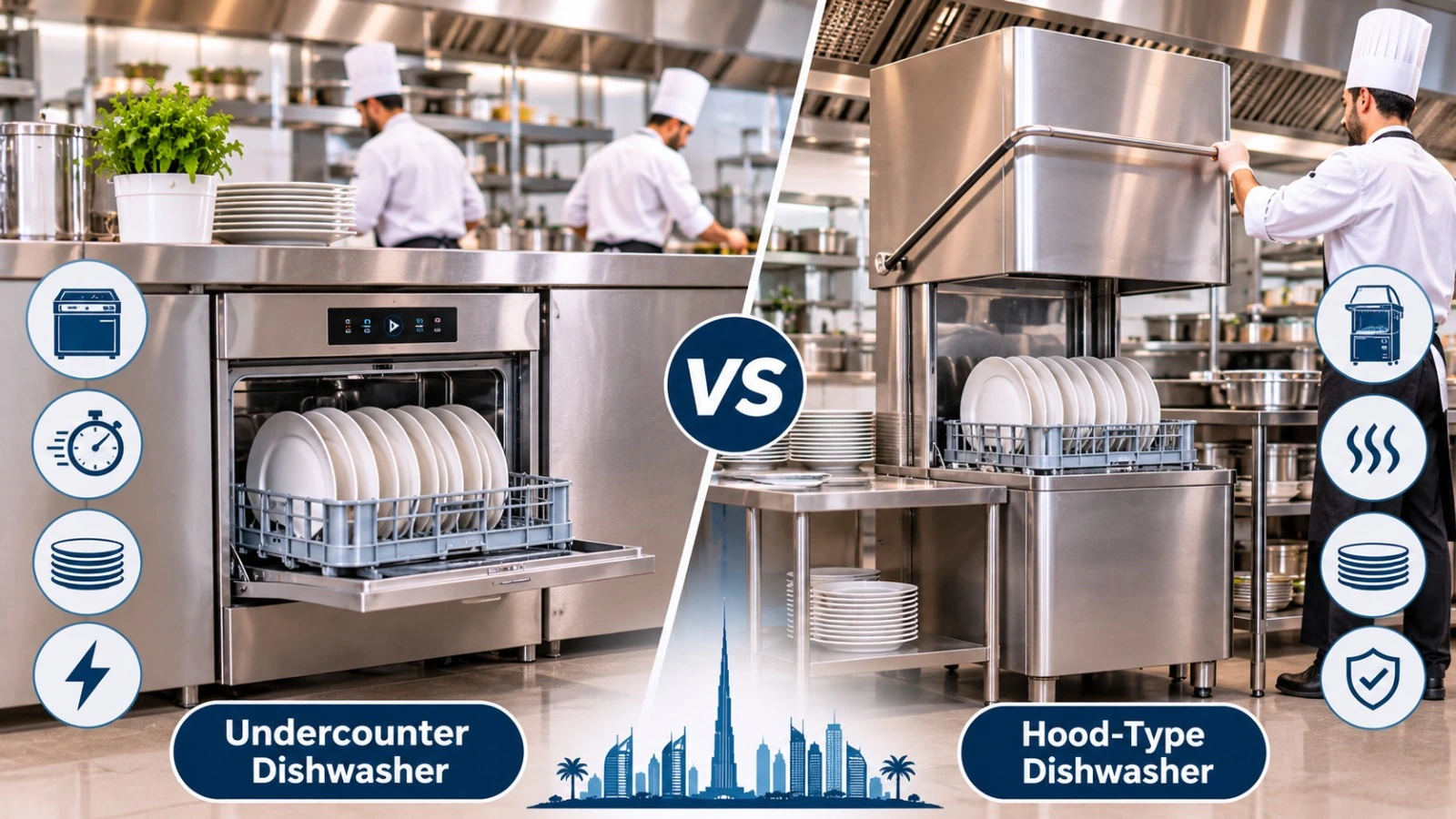
Neither is "best" for everyone. Choose by peak-hour volume, item size, and space.
- Choose an undercounter dishwasher for cafés, kiosks, cloud kitchens, bars, and small restaurants with peak demand of roughly 20–40 racks per hour and limited floor space. It fits under a counter and handles plates, cups, and glasses.
- Choose a hood-type (pass-through) dishwasher for restaurants, hotel outlets, and catering kitchens with peak demand of roughly 40–80 racks per hour, or any kitchen that washes large items such as GN pans, trays, and pots.
- Choose a rack conveyor only for large hotels, banqueting, and central kitchens needing 100+ racks per hour.
Typical UAE prices (supplier listings, mostly inc. VAT): undercounter about AED 3,500–15,000, hood-type about AED 6,000–28,000, and conveyor about AED 32,000–83,000+. Most commercial dishwashers in the UAE need three-phase power, water treatment for scale, and a booster heater for hot-rinse sanitizing, so plan installation costs as well as the machine.
Key Facts at a Glance
- A "rack" is the unit of dishwasher capacity. Most commercial racks are 500 × 500 mm.
- Manufacturers' "up to" rack-per-hour figures assume the shortest cycle. Real throughput is lower with heavily soiled items or longer cycles.
- Undercounter machines load from the front and are limited by door height.
- Hood-type machines have a lift-up hood and a pass-through design, so dirty racks go in one side and clean racks come out the other.
- Hot-rinse (thermal) sanitizing typically means a final rinse around 82°C, with wash water around 60°C. Chemical-sanitizing models are an alternative.
- Hard or scaling water shortens machine life and spots glassware. Water treatment is standard practice in the UAE.
- A glass washer is a specialized undercounter machine, useful for bars and coffee shops.
Table of Contents
- Introduction
- What Is an Undercounter Dishwasher?
- What Is a Hood-Type Dishwasher?
- Undercounter vs. Hood-Type: Side-by-Side Comparison
- What About Conveyor Dishwashers?
- How to Size a Dishwasher: A Simple Method
- Which Dishwasher Is Best for Your Business Type?
- Decision Rules: If You Wash X, Choose Y
- UAE-Specific Factors
- Installation Requirements
- Running Costs Beyond the Purchase Price
- Compliance and Food Safety Considerations
- Dishwasher Price Ranges in the UAE
- Popular Brands in the UAE
- New vs. Refurbished
- Warranty and Local Service
- Common Mistakes to Avoid
- Pre-Purchase Checklist
- Final Thoughts
- Frequently Asked Questions
Dishwashing is one of the most overlooked bottlenecks in a UAE commercial kitchen. A Commercial dishwasher that is too small causes clean-plate shortages during the rush, longer table turnover, and staff hand-washing, while one that is too big wastes space and money. The choice most buyers face is between an undercounter and a hood-type machine. This guide explains the difference, how to size the machine, and what to plan for in UAE conditions.
What Is an Undercounter Dishwasher?
An undercounter dishwasher is a compact commercial dishwasher with a front-opening door, designed to fit beneath a standard counter.
Staff load a rack, close the door, and run a short cycle. Typical models run cycles of roughly one to three minutes and are commonly rated at up to about 20–60 racks per hour, depending on the cycle chosen.
Best for: cafés, coffee shops, bars, cloud kitchens, kiosks, and small restaurants.
Pros:
- Small footprint, fits where a larger machine can't
- Lower purchase price
- Simple operation and quick installation
- Good for plates, cups, glasses, and cutlery
- Some models are available in single-phase or convertible versions
Cons:
- Limited height clearance, so large pans and trays may not fit
- Lower throughput, so it can bottleneck at peak times
- Front loading requires staff to bend and handle racks one at a time
- Less suited to continuous, high-volume washing
What Is a Hood-Type Dishwasher?
A hood-type dishwasher is a floor-standing machine with a lift-up hood. Staff slide a rack in from one side, lower the hood to start the cycle, and slide the clean rack out the other side.
It is built for faster, continuous workflow and taller items. Typical models are rated at roughly 40–80 racks per hour, and cycle times are commonly around 75 to 150 seconds on common models.
Best for: restaurants, hotel outlets, catering kitchens, canteens, and any kitchen washing large pots, pans, and GN trays.
Pros:
- Higher throughput than undercounter machines
- Taller loading space for large items
- Ergonomic pass-through workflow with dish tables
- Better for continuous service and busy periods
- More robust for heavy-duty daily use
Cons:
- Larger footprint, which needs dish tables and rack storage
- Higher purchase and installation cost
- Typically requires three-phase power and more careful ventilation planning
- Needs layout planning for dirty-in and clean-out sides
Undercounter vs. Hood-Type: Side-by-Side Comparison
| Feature | Undercounter | Hood-Type (Pass-Through) |
| Typical capacity | about 20–40 racks/hr realistic (up to about 60 rated) | about 40–80 racks/hr (some rated higher) |
| Best for | Cafés, bars, small restaurants, cloud kitchens | Restaurants, hotels, catering, large pans |
| Footprint | Small, fits under a counter | Larger, needs dish tables and rack space |
| Item height clearance | Limited | Taller, handles larger items |
| Workflow | Load and unload from the front | Pass-through, dirty side to clean side |
| Typical cycle times | about 60–180 seconds | about 75–150 seconds |
| Power | Often three-phase; some single-phase or convertible | Typically three-phase |
| Typical UAE price | about AED 3,500–15,000 | about AED 6,000–28,000 |
| Installation complexity | Lower | Higher |
| Staff handling | Bending, one rack at a time | Easier, faster rack flow |
| Ideal volume | Under about 500 items per shift (guideline) | 500+ items per shift (guideline) |
Capacity figures vary between suppliers and between "rated" and "real-world" numbers, so compare machines using the manufacturer's stated cycle times and your own volume estimate.
What About Conveyor Dishwashers?
A rack conveyor dishwasher moves racks through the machine automatically on a conveyor, and typically handles about 100–300 or more racks per hour.
It is designed for large hotels, banqueting, hospitals, and central production kitchens. It needs a larger footprint, higher power (often tens of kilowatts), and a trained dishroom team. For most restaurants and cafés, a conveyor is more than needed. If you're regularly above about 80–100 racks per hour, ask suppliers about a conveyor or a pair of hood-type machines.
How to Size a Dishwasher: A Simple Method
Many buyers choose by price or brand, but the better method is to estimate peak-hour racks.
- Estimate peak-hour covers (guests served in your busiest hour).
- Estimate washable pieces per cover (plates, bowls, glasses, cups, and so on).
- Divide total pieces by pieces per rack. A standard 500 × 500 mm rack typically holds around 18–20 dinner plates or roughly 25–49 glasses, depending on the rack type, so check your rack configuration.
- Add pots, pans, and trays that need machine washing.
- Add 20–30% headroom for delays and growth.
Illustrative example only: 120 covers in the busiest hour × 5 pieces per cover = 600 pieces. At about 18 pieces per rack, that's roughly 33 racks per hour. With headroom, you would look for a machine that realistically delivers 40+ racks per hour, which points toward a hood-type machine rather than a small undercounter.
Remember that "up to X racks per hour" figures assume the shortest cycle, so choose a machine whose realistic throughput meets your peak, not its headline number.
Which Dishwasher Is Best for Your Business Type?
| Business Type | Recommended Machine | Why |
| Coffee shop / kiosk | Undercounter or glass washer | Low volume, tight space |
| Cloud kitchen | Undercounter or compact hood-type | Containers and trays may favor hood-type |
| Bar | Glass washer (undercounter) | Fast glass turnaround |
| Casual restaurant (40–80 seats) | Hood-type (or undercounter if volume is low) | Peak-hour capacity and larger items |
| Full-service restaurant | Hood-type or small conveyor | Handles peak service |
| Hotel outlet / banquet | Hood-type or conveyor | High volume and large pans |
| Catering / central kitchen | Hood-type or conveyor | Large trays, pots, and volume |
Many kitchens use both: an undercounter or glass washer at the bar and a hood-type in the main dish area.
Decision Rules: If You Wash X, Choose Y
- If your peak is under about 30–40 racks per hour and space is tight, choose an undercounter machine.
- If your peak is above about 40 racks per hour, choose a hood-type machine.
- If you wash GN pans, sheet pans, or large pots by machine, choose a hood-type machine (or check the undercounter's clearance carefully).
- If you run a bar or coffee shop with lots of glassware, add a dedicated glass washer.
- If you can't provide three-phase power, choose a model confirmed for your electrical supply before comparing prices.
- If you have no water treatment, budget for it before buying the machine.
- If you can't get local service for a brand, choose a different brand.
UAE-Specific Factors
- Scale and water quality: water quality varies by building and emirate, and scale damages heating elements and spots glasses. Water softening or treatment is standard practice and may be a warranty condition.
- Three-phase power: many commercial dishwashers use 380–415V three-phase supply. Some undercounter models are single-phase or convertible, so confirm before ordering.
- Heat and steam: hot-rinse machines release steam into already hot kitchens. Plan ventilation, and consider models with heat or steam management features.
- Compact outlets: malls and cloud kitchen units often have limited space, which favors undercounter machines and compact layouts.
- Multilingual teams: choose machines with simple, pictogram-based controls and provide training for all staff.
- Local service: choose brands with UAE distributors, trained technicians, and stocked spare parts, because a broken dishwasher disrupts the whole kitchen.
Installation Requirements
Before ordering, confirm the following with your supplier and fit-out contractor:
- Electrical supply: single-phase or three-phase, and the machine's kW rating (examples in UAE listings range from about 6–8 kW for smaller machines to about 12–13 kW for larger hood-types and tens of kW for conveyors)
- Water supply and pressure, and whether a water softener is needed
- Hot water or booster heater requirements for final rinse temperature
- Drainage location and capacity
- Dish tables, pre-rinse sink, and rack storage (especially for hood-type)
- Ventilation or condensation management for steam
- Chemical dosing: detergent and rinse aid dispensing, and safe chemical storage
- Door and doorway access to bring the machine in
Running Costs Beyond the Purchase Price
- Detergent and rinse aid
- Water softener salt or cartridges
- Water and energy consumption, so compare stated litres per rack and kW ratings
- Descaling and preventive maintenance
- Wear parts such as wash arms, curtains, and seals
- Service contract or call-out fees
- Installation and plumbing
- VAT: 5% where not already included in quoted prices
Compliance and Food Safety Considerations
- Include the dishwasher in your equipment list submitted for permit and layout approval, and avoid ordering before approval where possible.
- Inspectors commonly look for effective sanitizing. Thermal machines typically use a final rinse around 82°C, while chemical-sanitizing machines rely on validated chemical concentration. Confirm which method your municipality accepts for your type of premises.
- Keep a temperature verification routine (such as machine displays, thermo-labels, or probe checks) and records.
- Many kitchens are expected to keep manual wash facilities as a backup, so plan your sink layout accordingly.
- Keep manufacturer certification, conformity documents, and warranty papers on file.
- Confirm current requirements with Dubai Municipality or your emirate's authority, as details can change.
Dishwasher Price Ranges in the UAE
Prices vary by brand, capacity, and supplier. Most UAE listings are shown including 5% VAT, and some are refurbished or discounted. As a general guide (supplier listings, 2026):
| Type | Approximate Price (AED) |
| Undercounter, value and mid-range | about 3,500–8,000 |
| Undercounter, premium brands | about 10,000–15,000 |
| Hood-type, value and mid-range | about 6,000–13,500 |
| Hood-type, premium brands | about 15,000–28,000 |
| Rack conveyor | about 32,000–83,000+ |
| Glass washer (undercounter) | about 4,500–12,000 |
Examples seen in current UAE listings include an undercounter Mach at about AED 3,570, a Kromo Aqua 50 undercounter at about AED 6,650, a Hobart Eco undercounter at about AED 10,000, and a Winterhalter U50 undercounter at about AED 12,600–14,000. For hood-type, examples include a Sammic at about AED 5,985, a Comersa at about AED 9,450, Hobart Eco-H604 at about AED 15,750–16,580, and a Meiko UPster H500 at about AED 20,000. Conveyor examples include a Dihr at about AED 32,000, a Winterhalter at about AED 38,850, a Hobart with dryer at about AED 44,600–49,350, and a larger Hobart at about AED 82,950. Treat these as a budgeting guide and request a current quote that states whether VAT, delivery, installation, and water treatment are included.
Popular Brands in the UAE
Commonly encountered brands include Hobart, Winterhalter, and Meiko at the premium end, Electrolux, Comenda, Dihr, Classeq, and Sammic in the mid-to-upper range, and value brands such as Kromo, Comersa, Colged, and Mach, Empero. Rather than choosing by brand alone, compare:
- Local distributor, trained technicians, and spare parts availability
- Realistic racks per hour and cycle times
- Hot-rinse temperature and booster heater design
- Water and energy consumption per rack
- Height clearance and basket options
- Warranty conditions, including water treatment requirements
New vs. Refurbished
Refurbished and used dishwashers, particularly Hobart and Meiko units, are widely available in the UAE at lower prices. They can suit tight budgets, but inspect heating elements, pumps, and wash arms, and confirm any remaining warranty and spare parts availability. For high-volume kitchens or hotels, new equipment with a clear warranty and service plan is usually safer.
Warranty and Local Service
Choose a supplier that offers:
- A clear manufacturer warranty and stated service response time
- Locally stocked spare parts such as heating elements and wash arms
- Installation, commissioning, and staff training
- Chemical dosing and water treatment advice
- A preventive maintenance plan, since scale and neglect are the most common causes of failure
Common Mistakes to Avoid
- Choosing by price and ignoring peak-hour rack requirements
- Buying an undercounter machine for a kitchen that washes large pans
- Forgetting three-phase power, water treatment, or a booster heater
- Skipping water treatment, causing scale and warranty problems
- Not planning dish tables, rack storage, and workflow
- Ordering before layout approval
- Forgetting detergent, installation, and VAT in the budget
- Choosing brands without local service
Pre-Purchase Checklist
Confirm you can answer "yes" to each:
- Have I estimated my peak-hour racks and added headroom?
- Does the machine's realistic throughput meet my peak, not just its headline number?
- Will the machine fit my largest items (GN pans, trays, pots)?
- Is my power supply (single-phase or three-phase) confirmed?
- Do I have water supply, drainage, hot water or a booster heater, and water treatment planned?
- Have I planned dish tables, rack storage, and ventilation?
- Is the dishwasher on my submitted equipment list and approved layout?
- Does the supplier provide local service, spare parts, and a clear warranty?
- Have I budgeted for detergent, maintenance, installation, and VAT?
Final Thoughts
For UAE commercial kitchens, a best undercounter dishwasher is the right tool for cafés, bars, cloud kitchens, and small restaurants with limited space and moderate volume. A hood-type dishwasher is the better choice for busy restaurants, hotel outlets, and catering kitchens that need faster throughput and room for large items. Size by your realistic peak-hour racks, plan power, water treatment, and workflow before you buy, and choose a supplier who can service the machine locally.